Developing Youth Basketball Program Culture From Scratch: What This Coach in Vietnam Is Actually Building

Only 400 kids enrolled. Low retention. Coaches still running sessions like it's a military drill. And a young coach from abroad trying to figure out how to change all of it — without speaking the local language. When I first heard this conversation, I couldn't stop thinking about how many people working on developing youth basketball programs never have to face this level of complexity all at once. Most of us get to inherit something. This guy is starting from absolute zero, in a foreign country, with a cultural gap so wide it affects everything from how a coach touches a player's shoulder to whether a kid even wants to come back next week.
The Vietnam Situation Is More Common Than You Think
John describes this role in Vietnam — still waiting on final confirmation, by the way, which I found oddly relatable — where he'd be doing a dual job of implementing a one-club philosophy while also trying to actually develop the coaches on the ground. Four hundred youth athletes. Low retention. Kids going through three months of "class" — and they literally call it a class, like math or music — and maybe, maybe getting one small tournament at the end of it.
When I heard that framing, I immediately thought: of course the retention rate is low. Why would a kid stick around for three months of structured drill work with an authoritative coach who barely lets them play, then get five or ten minutes of scrimmage at the end of practice? That's not a basketball experience. That's a basketball lecture.
And the parental dynamic makes it even more stark. Parents pull up on motorbikes, drop the kid off, go run errands, come back. Basketball is just another extracurricular box to check. There's no emotional investment, no community built around the program, no reason to feel like this is their team or their club. I've seen this play out personally at the recreational level here — when kids don't feel ownership over what they're doing, they disappear. Quietly. And the program never knows exactly why.
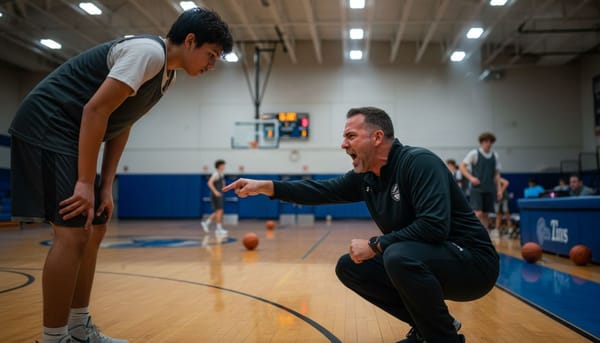
The coaching culture John describes is also worth pausing on. He's careful not to frame it as right or wrong — he explicitly says he's staying out of that judgment — but the picture is clear. Physical authority, traditional methods, very little room for player expression. That's a difficult environment to introduce anything player-centered into, especially when you're an outsider. And this is something I think about a lot: how do you shift a culture without making the people inside it feel attacked?
The Glossary Idea Is Smarter Than It Sounds
Here's the part that genuinely surprised me. When John talks about his plan to develop a shared glossary — a common language for coaches, players, and parents — I think most people's first instinct is to underestimate how important that is. A glossary sounds like an administrative task. Something you'd put together for a handbook nobody reads.
But that's not what he's describing. He's describing something closer to a cultural document. A set of words that travel across a language barrier and still communicate the same thing. And when Neil pushes him to think about whether this is only on-court terminology or something wider, John gives the right answer: it can't just be on-court. Not in a role where you're trying to impact 400 kids and a whole coaching staff.
This connects directly to something I read about a high school coach navigating the language barrier around constraints-led coaching — the realization that the words you use to describe your philosophy either create clarity or confusion, and that getting that language right is one of the most underrated parts of building a program. It's not glamorous work. But it's foundational.
What struck me most was John's honesty about the pressure he feels. He's young. He hasn't done anything at this scale before. He knows he has a limited window — he's not even sure how long he'll be there. And yet he's not trying to blow up the entire culture on day one. He's trying to build something that can outlast his own presence. That's a maturity a lot of coaches don't reach until much later.
Five Words Can Carry an Entire Philosophy
Then the other coach in the conversation drops something that stopped me cold. His club identity, built around a single phrase: play with fun and freedom. Five words. Every parent understood it immediately. No explanation needed, no methodology breakdown, no lengthy philosophy document. Just that.
I don't fully agree that five words is always enough — there's a real risk of it becoming a poster on the wall that nobody actually lives by — but I completely agree with the underlying point. Simple, specific language creates alignment. And when you're trying to manage coaches who may not share your background, parents who view basketball as just another scheduled activity, and kids who are one bad session away from quitting forever, alignment is everything.
The "play the game, not run plays" framing that comes up later in the conversation is another version of this. One sentence. Immediately understood. And it sets a clear direction for why modern player development has to move away from rigid systems and toward genuine basketball understanding. You're not teaching compliance. You're teaching decision-making. You're teaching the game itself.
What I appreciate about this conversation is that it's not abstract. These aren't theoretical coaching frameworks being debated in a comfortable academic setting. This is a real person, in Vietnam, with 400 kids and a ticking clock, trying to figure out what words to write in a document that might actually change how those coaches show up on Monday. That's as real as coaching gets.
And the values conversation that follows — where one of the coaches talks about developing the whole player beyond just on-court skills — reinforces why the glossary can't stop at basketball terminology. If you want kids smiling and cheering each other on regardless of the score, that's not a basketball skill. That's a value. And it has to be named, defined, and modeled — every single day — before it becomes real.
Three Months, Two Concepts: What This Conversation Made Me Rethink About Youth Development
When I heard the host describe this situation — a revolving door of kids, three-month terms, low retention, and the best players suddenly pulled away into a separate club — I immediately thought: that's not a development problem, that's a design problem. And the honest truth is, most people running youth programs don't even realize the design is what's working against them.
What struck me most was the simplicity of the answer. Three months, uncertain rosters, language gaps, beginner-level players — and the guest's response was essentially: don't panic, just focus on two things. Creating advantage and using advantage. That's it. I'll be honest, my first reaction was skepticism. Surely there's more? But the more I sat with it, the more it clicked. Because if you zoom out and think about what actually makes players enjoy the game and feel like they're improving, it almost always traces back to those moments where they created something and then capitalized on it. Everything else is noise, especially in a compressed timeline.
I've seen this play out personally watching youth practices that are stuffed with drills, plays, and instructions — and the kids look completely disengaged. Then you strip it back, run a simple small-sided game where the advantage is already built into the constraint, and suddenly they're alive. That's not a coincidence. When players can feel themselves winning the moment — beating a defender, finding the open man, finishing through contact — that's when confidence actually builds. Not from a coach telling them they did well. From the action itself.
This connects to something I think about a lot when it comes to why certain traditional youth basketball concepts actually slow development down rather than accelerating it. We fill limited time with systems that require repetition over months to even make sense, and then wonder why kids don't retain anything.
The Coach Education Problem Nobody Wants to Talk About
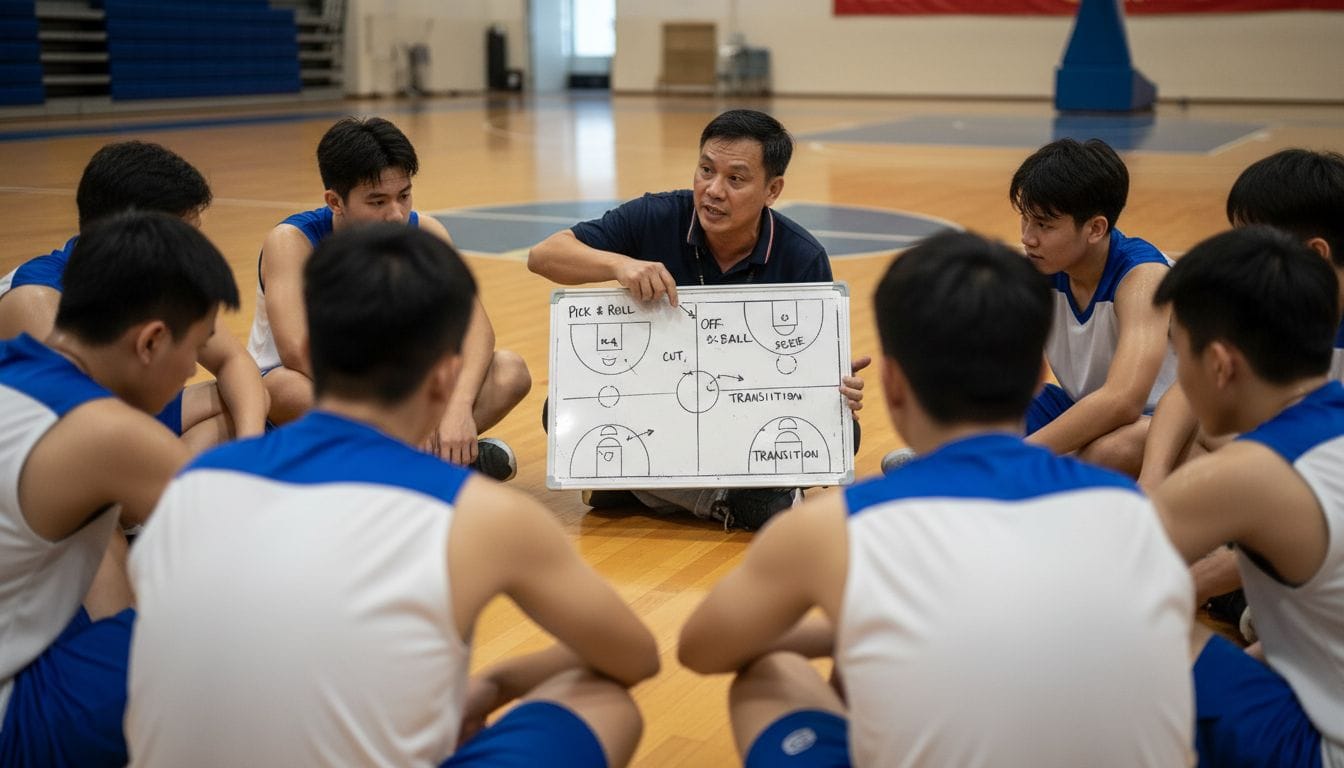
This part of the conversation hit differently for me. Because developing the players is one challenge — but developing the coaches who are barely getting paid, juggling university, don't speak much English, and can't always show up to group sessions? That's a whole other beast.
I don't fully agree with the idea that young university-age coaches are automatically at a disadvantage here. The guest actually flipped this really well. These coaches are literally immersed in a learning environment every single day. They understand theory. They're comfortable absorbing ideas through frameworks and models. That's actually a massive entry point for introducing ecological dynamics and constraints-led thinking — because you don't have to fight the "but this is how it's always been done" resistance that you get from older, more entrenched coaches.
The short video idea resonated with me too. Five minutes, one theme, voice over a drill or a clip, export it, send it. That's accessible. And the suggestion to pair the video with a one-page visual — something simple, clean, diagram-forward — makes the language barrier far less of a wall. You're not asking someone to read a coaching manual. You're showing them something and letting them feel it on the court afterward. That experiential overlap is exactly how understanding actually forms, regardless of what language you speak.
I've read about how coaches working through a constraints-led approach often describe a specific moment where everything suddenly makes sense — not from reading about it, but from experiencing it physically. That's the aha moment you're chasing with these young local coaches. You can't manufacture it through a Thursday lecture. But you can design the conditions for it to happen.
The Bubble Problem Is Bigger Than Anyone's Admitting
There was this offhand comment about kids scrimmaging against the same guys their whole lives and falling into a bubble — and I think that deserved way more attention than it got. Because it's not just a competitive exposure problem. It's a perceptual problem. When you only ever read the same defensive schemes, the same tendencies, the same spacing patterns from the same ten kids, your game adapts to that specific environment. And then you step outside of it and you're lost.
This is something I think about a lot in the context of how skills are actually formed. There's a real difference between a player who has learned to exploit advantages in a controlled, familiar setting versus one who can scan, read, and respond to genuinely unpredictable environments. The latter is what we should be building. And the only way to build it is to introduce variation — different opponents, different constraints, different scenarios — even within the limited three-month window.
What's interesting is that the research on this is pretty clear. Skills don't get acquired through repetition alone — they emerge through variable, representative practice environments. The bubble isn't just bad for competitive exposure. It's actively limiting skill emergence because the environment never changes enough to force genuine adaptation.
And this is where the challenge of developing youth basketball program participants in resource-constrained, high-turnover settings gets really real. You can't always get them into tournaments. You can't always bring in outside competition. But you can change the game. You can modify the rules. You can rotate partners. You can make the familiar unfamiliar. That costs nothing. And it might be the single most valuable thing a coach in this situation can do with the time they have.
Coaching at Scale: The Intention Behind Every Interaction
One of the most powerful moments in this conversation came near the end, and honestly, it's something I've been sitting with ever since. The idea of intention — having a clear reason behind every drill, every constraint, every interaction — sounds almost too simple. But when I heard this, I immediately thought about how many practices I've watched where the session just... happens. Coaches fill time. Players run for no reason. Nobody's asking why. And that's not coaching. That's babysitting with a whistle.
Neil made the point that intention matters at every scale — whether you're planning a whole season, a single practice, or even one brief moment with a player. Are these words I actually need to say? Do I need to intervene here, or should I let the constraint do the work? That self-awareness is something most coaches have to build. It doesn't just arrive. And it's one of those things I think is especially critical when you're developing the whole player rather than just drilling skills in isolation.
What struck me most was John's honesty about building the language barrier up in his head. I get that. I've done the same thing. You convince yourself that the theoretical gap is so wide that no one on the other side could possibly understand it. But Adam's suggestion was so practical it almost felt obvious in hindsight — start with what coaches are already doing. Take the drills they know, the sessions they've already planned, and reshape them. Don't arrive with a lecture. Arrive with curiosity. That shift alone changes everything about how the conversation lands. If you're curious about how this approach plays out in a real environment, the ecological learning approach in basketball coaching goes deep on exactly why starting from familiar ground is so effective.
Neil's version of the same idea — showing up to a live practice, standing side by side, and just observing together — is something I don't think enough coaches do. Not evaluating. Not critiquing. Just watching and talking. That's a completely different energy than being assessed, and it opens coaches up in ways that formal feedback sessions rarely do. The language barrier around constraints-led approaches often dissolves the moment a coach sees it working in front of them rather than hearing about it in a room.
Scaling Coach Development: From One to Fifty
John's closing question is the one I'm still thinking about. How do you develop one coach versus ten coaches versus fifty? Does the approach change? It has to, right? Because the personal, side-by-side dynamic that Neil described — that one-to-one interaction watching a live practice — it doesn't scale easily. You can't clone that experience across a network of coaches spread across an entire country, let alone one navigating Vietnam's youth basketball scene with a language barrier on top of everything else.
I don't fully agree with the idea that you can just replicate the intimate coaching conversation at scale and get the same result. Something changes when you're addressing fifty people. The psychological safety shrinks. The vulnerability disappears. Coaches perform rather than explore. So the question isn't just how to scale the content — it's how to scale the conditions that make genuine development possible in the first place. That question connects directly to what coaches from four countries identified as truly transformational environments — and spoiler, it's never about the size of the group. It's always about the culture inside it.
Adam's point about the permission piece — documenting contact consent, creating a short video demonstrating it, getting it translated — that's not just a legal or procedural detail. That's culture-building in the most practical sense. It tells every coach, every player, every parent: we do things intentionally here. We ask before we act. That kind of clarity sets the tone for everything that follows.
Final Thoughts
This conversation reminded me that developing a youth basketball program — really developing it, not just running it — is a long, layered, human process. John's situation is genuinely fascinating because he's not just coaching players. He's trying to build a coaching culture from scratch in an unfamiliar context, with language barriers, cultural nuances, and theoretical frameworks that most coaches in that room have never encountered. And yet the principles these three kept coming back to — intention, permission, observation, meeting coaches where they are — those are universal. They work in Vietnam and they work in your local rec gym on a Tuesday night. What I'm taking from this episode is simpler than any framework: show up curious, not certain. Start with what's already there. And always, always know why you're doing what you're doing.