The Best Youth Basketball Coaching Tips I've Heard in a Long Time — A Deep Dive Into This Podcast
Only about 5% of youth athletes who play organized sports at age six are still playing by the time they're eighteen. Five percent. When I heard that statistic for the first time, it stopped me cold. And honestly, it's the reason I think conversations about youth basketball coaching tips matter so much more than most people give them credit for. I recently came across a podcast episode featuring two coaches — Tyler and Mark — going deep on what youth basketball development should actually look like, and I had so many reactions listening through it that I knew I had to write them down. This wasn't surface-level stuff. These two went after some ideas I've held for years, confirmed a few things I already believed, and said a few things I'm still chewing on.
The First Thing That Hit Me: Energy Is a Teaching Tool, Not a Side Effect
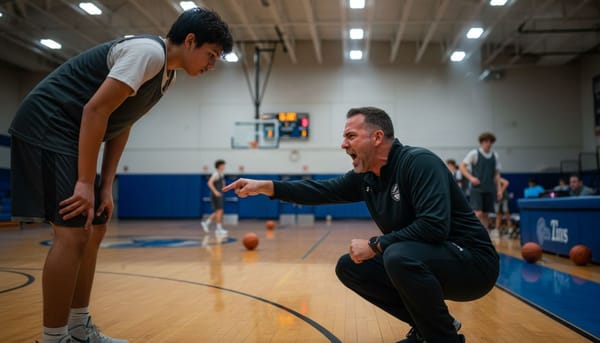
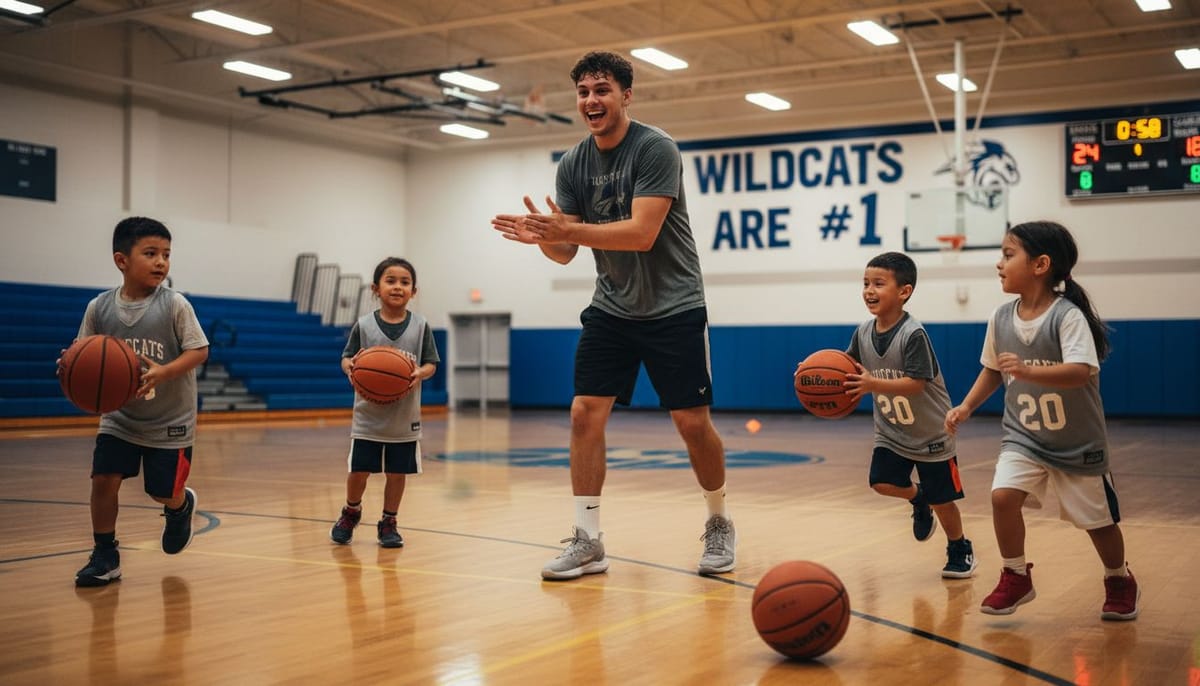
Tyler opens by saying something that sounds almost too simple. If you're going to coach youth basketball, you have to be high energy. Fun. Playful. His exact phrase was "college professor energy does not work for youth basketball" — and I laughed out loud because I've sat in gyms and watched coaches stand there with clipboards talking to eight-year-olds like they're delivering a TED Talk to adults.
But here's where it gets interesting. Tyler's not just saying "be enthusiastic." He's saying that directing energy is actually the first real skill you're teaching. Young players have boundless energy. The question is whether it's being channeled toward the game or scattered everywhere else. When I heard this, I immediately thought about how many youth practices I've seen where the coach is fighting the kids' energy instead of using it. That's exhausting for everyone. And nothing gets learned.
The second pillar he puts under this is communication. Teaching players how to talk on the court. Call out screens. Talk on defense. Encourage each other. He makes the point that most coaches skip this entirely and go straight to dribbling and pivoting and defensive stance — the stuff they think of as "fundamentals." And I think he's right that this is a mistake. If players don't know how to communicate and don't know how to direct their energy, the physical skills you're trying to teach just disappear into the noise. You spend the whole practice repeating yourself and wondering why nothing sticks.
This is something I think about a lot — the idea that the environment of a practice might matter more than the content of it at the youth level. There's a lot of research pointing in this direction, and if you want to go deeper on it, the work on the ecological learning approach in basketball coaching is genuinely eye-opening. The environment shapes behavior. Build the right one and the skills start to follow naturally.
Teaching How to Play vs. Teaching a Play — This Distinction Is Everything
This is where Tyler said something that I think is one of the most honest and underrated observations in youth coaching. He said coaches too often teach a play rather than how to play. And the reason they do it isn't laziness or bad intent — it's that a play works faster. The spacing looks better. You might actually score. Everyone's happy. Parents are happy. The kids feel good. The coach feels like something got accomplished.
But none of it transfers.
I've seen this play out personally. A team runs a beautiful set play all season, looks organized, wins some games — and then the next year the coach is gone, the play is gone, and the players are just as lost as they were before. Because they never actually learned to read the game. They learned to follow a script. And the moment the script gets taken away, there's nothing underneath it.
Tyler's alternative is to teach principles instead. Three specific ones for youth basketball: speed, spacing, and matching up on defense. I want to sit with each of these for a second because I think the way he frames them is genuinely useful.
Speed isn't just about being athletic. It's about decision speed. Transition speed. Sprinting to rebound. Making fast choices with the ball. This is learnable. It's a habit. And it's the kind of thing that transfers up through every level of the game.
Spacing is harder to teach but maybe more important. Tyler calls it "the oxygen that lets us breathe." I love that framing. Space isn't just a tactical concept — it's the precondition for almost everything else working. Bad spacing kills offense regardless of how skilled your players are individually. I think about why pass and cut is harming youth basketball and the deeper issue there is often that players don't have a real feel for space yet — so even good-looking actions fall apart.
Matching up on defense — and specifically Tyler's argument against zone defense at the youth level — is something I don't fully agree with, at least not universally, but I understand the point he's making. Zone defense lets players hide. It removes individual accountability. His concept of "dual awareness" — knowing your responsibility to your player and your responsibility to the ball — is a genuinely important idea. If a player never develops that, they're going to struggle at every level above youth ball. That part I'm completely on board with.
Player Development Is Not What Most Coaches Think It Is
Tyler's third pillar is Player Development — and both he and Mark make a point here that I think is the most practically useful thing in the entire conversation. Player development isn't just skill work. It's marrying skills with reads.
Not just how to shoot. When to shoot. That's shot selection. Not just how to pass. When to pass. That's a visual read off a visual cue. Not just how to help on defense. When to help. That's defensive IQ. The physical skill without the decision-making attached to it is basically useless in a live game. You can look great in isolation drills and fall completely apart when there's a defender in front of you and three seconds on the shot clock.
What struck me most was how clearly this connects to the critique of traditional drill-based training. Mark pushes back on the word "fundamentals" in a way I found interesting. His argument is that calling certain skills fundamentals makes coaches think in terms of technique — rigid, block-practice, do-it-exactly-this-way thinking. And that blocks them from seeing skill development as something more organic and contextual. It's a subtle distinction but I think it's a real one. Skills aren't acquired in a vacuum — they emerge through the right conditions, and that science is pretty hard to argue with once you actually dig into it.
The practical implication? Small-sided games. Read-based training. Put players in situations where they have to make decisions, not just execute movements. This is the direction both coaches are pointing toward, and it lines up with what a lot of the most innovative coaches around the world are doing right now — including coaches at the high school level who've gone deep on constraints-led approaches and found the results to be genuinely transformational.
Mark also adds something that I think is the emotional core of everything else being discussed: fall in love with the game. Before skill, before principles, before any of it — if a young player doesn't love being on that court, none of the development matters. They'll quit. And we're back to that five percent statistic.
Coaching to Teach vs. Coaching to Win — Why I Think Most Youth Coaches Have It Backwards
When I heard this part of the conversation, I immediately thought about every youth coach I've ever watched frantically drawing up baseline out-of-bounds plays for ten-year-olds. There's this obsession with manufacturing baskets, engineering wins through set plays and scripted actions — and honestly, I get it. Winning feels like proof that you're doing your job. But is it?
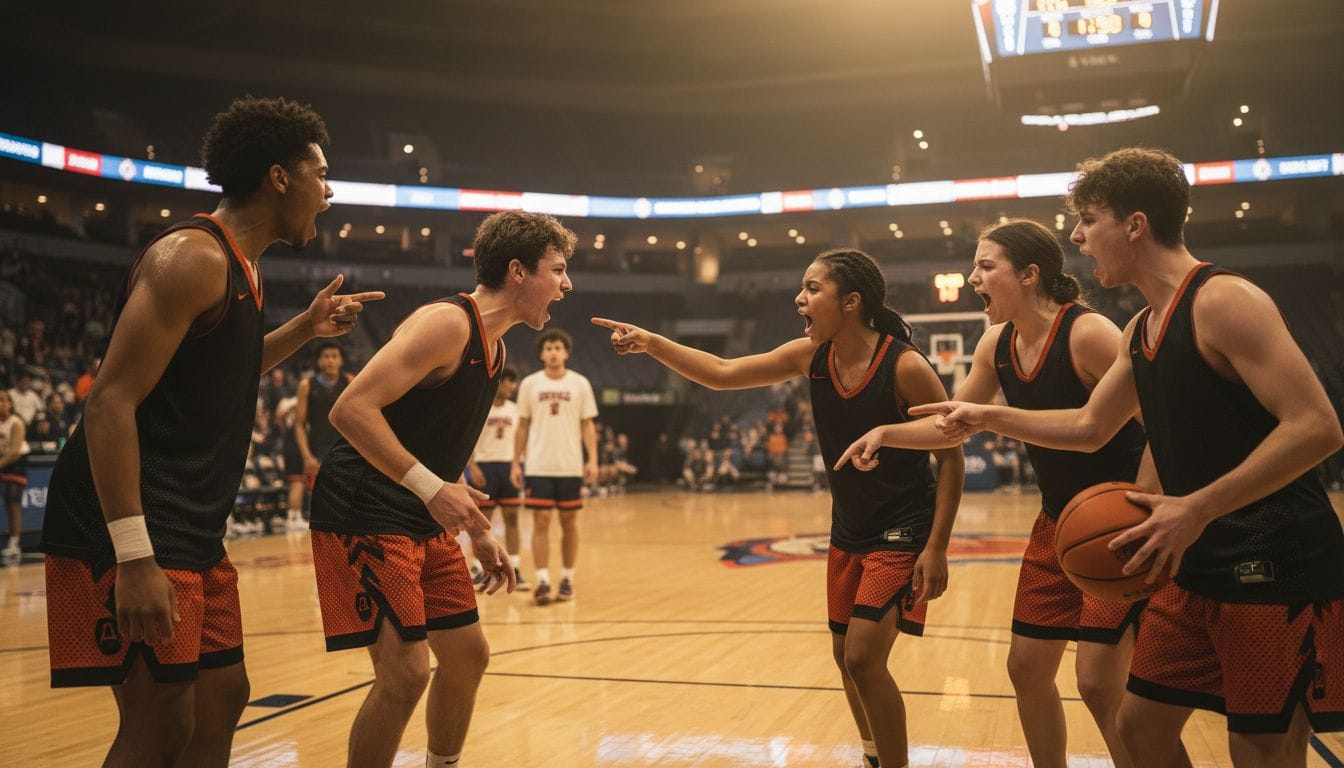
The argument made here is something I think about a lot: if you teach your players to play aggressively and you genuinely coach to teach the game, you're probably going to win anyway. Aggression creates space. Space creates opportunity. And somewhere in there, real development actually happens. It's almost counterintuitive — stop trying so hard to win, and you win more. I've seen this play out personally watching coaches who strip everything back to fundamentals and principles, and their teams just move differently than everyone else on the floor.
What struck me most was the driving analogy. A 15-year-old daughter learning to drive, stopping at a stop sign without understanding why she's stopping. Sound familiar? That's basically youth basketball in a nutshell. Kids doing things because a coach told them to, with zero understanding of the purpose behind the action. The moment she understood that the stop sign exists so she doesn't get killed by crossing traffic — she didn't need to be reminded anymore. The behavior changed because the understanding changed.
That's the whole game right there. And it connects deeply to what athlete-centered coaching really demands — you're not just issuing commands, you're building thinkers. Kids who understand the why behind every decision they make on the court.
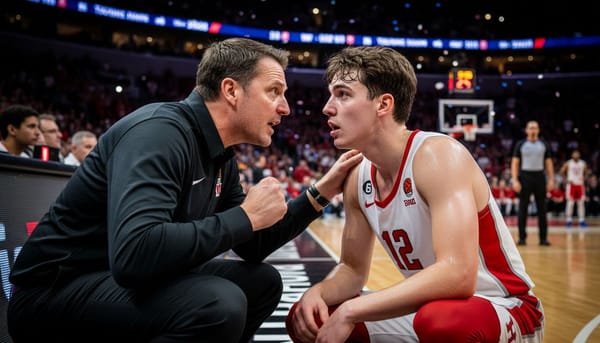
The timeout story sealed it for me. Up two with nine and a half seconds left, and instead of barking "don't foul!" — the instinctive, reactive thing every coach would do — the question asked was "should we foul right now?" Half the team said yes. Half said no. That detail matters more than people realize. It means half those kids were about to make a catastrophic decision in a championship game. And you only discovered that by asking. By creating a conversation instead of issuing a command. I don't fully agree that this is easy under pressure — it takes serious discipline to slow down in those moments — but the payoff is obvious. They won. And more importantly, those kids left that timeout actually understanding why they weren't fouling.
Elephant, Airplane, Skyscraper — And Why External Cues Are Everything at the Youth Level
Okay, I'll admit — when I first heard "elephant, airplane, skyscraper" as defensive stances, I laughed a little. But then I thought about it for ten seconds and realized it's genuinely brilliant.
Think about what you're fighting against with young kids. They're not analytical. They're not processing technical feedback in real time. If you're mid-game shouting "contest the shot, hands up, don't reach, stay disciplined" — that's just noise to a ten-year-old. But skyscraper? They know exactly what that means. Hands up. Tall. No reaching. All in one word. One image. One external cue that bypasses the cognitive overload entirely.
This is something the research on skill acquisition has been pointing at for years. Skills don't get drilled in through repetition of internal cues — they emerge when the environment, the constraints, and the feedback actually match how the brain naturally processes movement and information. Internal cues — "bend your knees more, extend your elbow, follow through" — require conscious processing. External cues tap into something more automatic. More intuitive. They let the body figure it out instead of the brain trying to micromanage every movement.
I've seen coaches go deep on this idea, and it genuinely changes the way you think about communication on the court. The language you use with a fifth grader should look completely different from what you use with a high school player. And even at the high school level, the best coaches are still leaning on metaphor and analogy more than most people realize. There's actually a really honest breakdown of how one coach navigated this language barrier with his high school players — and the lightbulb moments that came from it.
The other piece I want to highlight here is the constraint-shaping idea. Add a constraint at the youth level and it just works. They're not sophisticated enough to game the system or find the loophole. The constraint shapes the environment, and the skill emerges naturally from exploration. And here's the part I find most underrated: wait longer before giving feedback. Way longer than feels comfortable. Especially when kids are encountering something for the first time, they need discovery time. They need to fail, adjust, try again, figure something out on their own. The moment you rush in with a correction, you rob them of that. It's a hard instinct to fight — coaches want to fix things — but the best youth basketball coaching tips I keep coming back to always circle around this same idea: trust the process, shape the environment, and let the game teach.
The Game of the Week: 101 K-State and Why I Love It
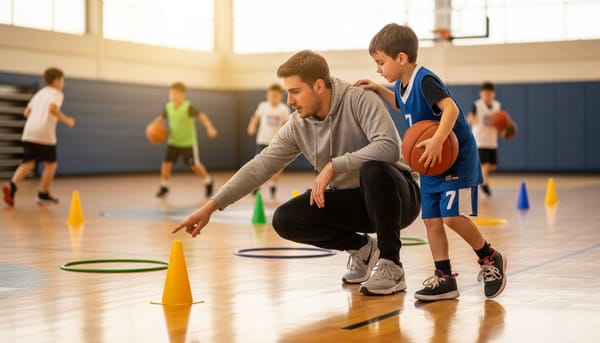
When I heard this, I immediately thought — this is exactly the kind of drill disguised as a game that actually changes how players think at the rim. The 101 K-State game is simple on the surface: one defender starts with the ball near the nail, passes to the offensive player, then sprints to touch the sideline before recovering. The moment that pass is made, it's live. What I find brilliant about this is that the timing of the defender's recovery determines everything. Early defender? The offensive player has to deal with a body in front. Late defender? Body on the side. Really late? Total open floor. And each of those scenarios demands a completely different finishing solution — one foot, two feet, pro hop, Euro step, pivot counter. The game isn't telling you what finish to use. The environment is.
This is something I think about a lot — how often we over-script finishing drills by deciding in advance what move a player should make. We set up the cone, we show them the footwork, we run it in isolation. But the game never tells you what's coming. That's why I think struggling with finishing under pressure is such a common problem — players have drilled moves in a vacuum and never learned to read the situation first. This game forces that read every single rep.
What struck me most was the layering concept. You can take any fundamental — between the legs dribble, stride stop, pivot, push pass — and just wrap it into the start or end of a live rep. Want stride stops? Have both players stride stop as they set up before the ball is live. Want passing touches? Trigger it through the coach before the attack. You're not abandoning the fundamental. You're giving it context. And honestly, that's something I've seen play out personally — players who've done thousands of isolated reps of a move but freeze up the moment a defender is anywhere near them. The problem was never the skill. It was that they'd never practiced it inside the chaos of a real decision.
Messy Is the Point — And That's What I Think Coaches Forget Most
The phrase "messy wins" hit me harder than almost anything else in this conversation. There's a version of coaching — one I've seen a lot — where the goal of practice is to make everything look clean. Smooth reps. Correct footwork. No hesitation. And I get it. It feels productive. But what they said here reframes that completely. Messy doesn't mean the players are failing. Messy means they're exploring. They're experimenting. They're actually trying to figure something out rather than just executing a memorized pattern.
I don't fully agree that block practice is useless — I think there's a place for it, especially early in skill development — but I completely agree that the transfer problem is real. If you only ever practice a between-the-legs dribble in a clean, no-defender environment, you've taught a movement, not a skill. When you layer it into live 1v1 and say "you have to go between the legs before you score," now the player has to figure out when and why to use it. It gets messy. Defenders adjust. Players counter. That's the learning. That's what we actually want. The idea that skills emerge rather than get acquired in a straight line — that's exactly what I see happening in games like this.
And the master coach point — that's the one I keep coming back to. A master coach isn't the one with the cleanest practice. It's the one who can look at a messy, chaotic live rep and know that something real is being built underneath it. They've shaped the environment deliberately. The messiness isn't accidental. It's designed. That takes a fundamentally different coaching philosophy — one where adopting a constraints-led approach stops feeling like a risk and starts feeling like the most honest way to develop real players.
My Final Takeaway
This conversation gave me a lot to sit with. The youth basketball coaching tips shared throughout weren't just theoretical — they were practical, honest, and grounded in what actually happens when you put young players in real situations. The finishing reads, the layering of fundamentals into games, the willingness to let practice look messy — none of that is complicated, but all of it requires a coach to let go of the need for control. And I think that's the real challenge. Not the drills. Not the systems. The mindset. Because once you accept that learning rarely looks clean in the moment, you stop interrupting it. You stop correcting every rep. You start watching instead — and what you'll see, if you give it time, is players who can actually solve problems on their own. That's the whole point. That's what development looks like when it's real. If any of this resonates with you, I'd genuinely encourage you to explore what it means to develop the whole player — because the best youth coaches I've ever seen aren't just teaching basketball. They're teaching people how to think.