Skills Aren't Acquired — They Emerge: What Skill Acquisition Research Really Means for Basketball Coaches
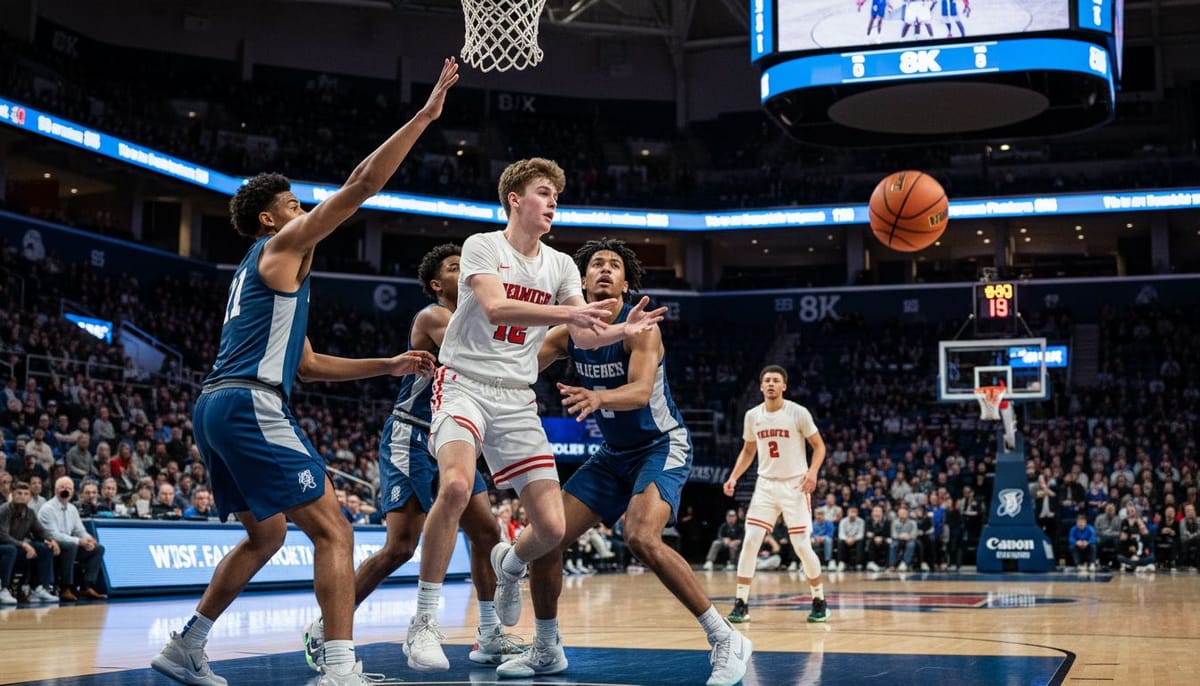
A point guard is wedged near the basket. Three defenders are practically wrapping themselves around him. No clear path. No obvious outlet. And then — without looking — he threads a no-look pass underneath a defender's arm and finds his teammate on the perimeter. Nobody drew that up. Nobody drilled that specific scenario a hundred times in practice. It just happened. And when I heard this described in the podcast, I immediately thought: that's the conversation basketball coaching has been desperately needing to have.
Because here's the thing. Most coaches — myself included at various points — would watch that play and say "great instincts" and move on. We'd never stop to ask why that pass emerged in that moment, or what that tells us about how we should actually be designing practice. That's exactly the gap this episode digs into, and honestly, it's one of the more thought-provoking conversations I've come across in the basketball space in a long time.
Why Basketball Has Been Weirdly Immune to Evidence-Based Thinking
One of the first things that struck me in this conversation was the observation that basketball coaching has largely been immune to the kind of evidence-based evolution we've seen in other fields. Think about medicine. The host makes this comparison directly — if a doctor was treating you today using methods from even ten or fifteen years ago, you'd be concerned. You'd want to know why they weren't using the best available information. We expect that in healthcare. We demand it, actually.
But in basketball? We just kind of... accept that coaches coach the way they coach because that's how their coach coached them. And their coach before that. And so on.
The term used here is path dependency, and it's a concept that genuinely stopped me in my tracks. It means that even when better, more research-backed ideas exist and are readily accessible, practitioners keep defaulting to traditional approaches — not because they're lazy or malicious, but because the sociocultural pull of "this is how it's always been done" is extraordinarily powerful. Former playing experience, observational learning from previous coaches, social media framing the game through X's and O's, traditional coach education — all of it funnels coaches back toward the same familiar methods.
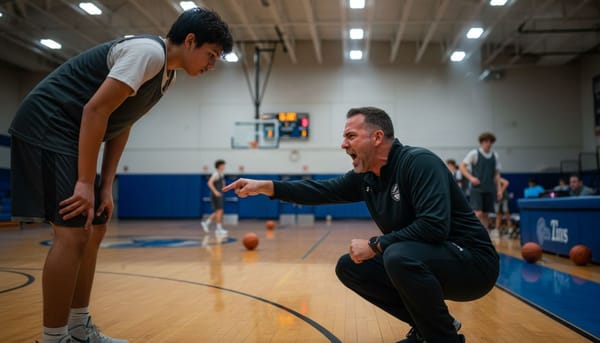
I've seen this play out personally. I've been in gym settings where a coach is running the same drill they ran as a player twenty years ago, and nobody in the building has ever asked whether it actually works. It's just inherited wisdom. And the players — the ones who deserve the best possible development environment — are the ones absorbing the cost of that complacency.
This connects directly to something I think about a lot: the idea that modern basketball demands a fundamentally different development approach than the one most coaches inherited. Path dependency is exactly what stands in the way of that shift happening.
What "Skill Acquisition" Actually Means — Because It's Probably Not What You Think
Here's where the episode gets genuinely fascinating, and also a little bit mind-bending if you're hearing this for the first time.
The phrase "skill acquisition" sounds straightforward, right? Players acquire skills. They drill them. They store them. They pull them out in games. That's the dominant mental model most coaches operate from, whether they realize it or not. You do the footwork drill enough times, it becomes muscle memory, and then in a game situation your body just knows what to do.
Except — and this is the key insight from researchers like Keith Davids — that's not actually how skill works.
The argument being made here, rooted in empirical research rather than opinion, is that skill is not something you possess. It's not a technique you store somewhere in your body and retrieve on command. Instead, skill is an emergent property. It emerges from the interaction between a player and their environment in a specific moment. That pass Jamie made — surrounded by three defenders near the basket — didn't come out of a stored movement pattern he'd rehearsed a thousand times in isolation. It emerged because of the specific constraints and affordances of that exact situation.
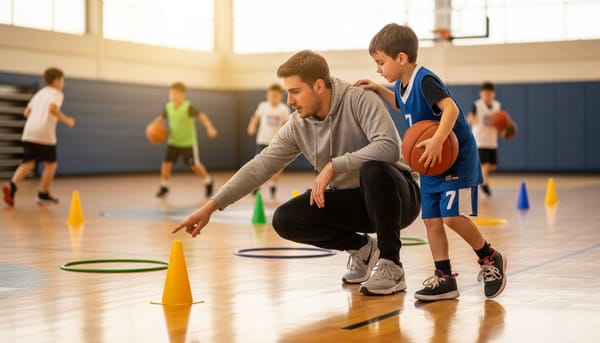
When I heard this, I immediately thought about how much practice time across all levels of basketball is spent doing the exact opposite of what this research suggests. Stationary ball-handling. Cone drills with no defender. Shooting form repetitions in the air. All of it operating under the assumption that if you engrave the movement pattern deeply enough, it'll show up in the game. But if skill is emergent — if it's fundamentally relational and contextual — then those isolated reps aren't building what we think they're building.
This is actually something an NCAA head coach has spoken about directly when arguing against cone drills — the idea that decontextualized repetition creates a false sense of development that doesn't transfer when a real defender enters the picture. The skill acquisition research being discussed here gives that argument a rigorous theoretical foundation.
And honestly? I don't think most coaches are even aware this conversation is happening in the research world. That's the gap the podcast is explicitly trying to close — taking genuinely complex academic ideas about ecological dynamics, affordances, and emergent skill and translating them into something a youth coach or a college assistant can actually use on Monday morning.
The Implications Are Bigger Than Any One Drill
Let me be clear about something: this isn't just a debate about which drills are better. If skill is truly emergent — if it arises from the environment rather than being downloaded into a player through repetition — then it challenges virtually every default assumption in conventional basketball coaching.
It challenges how we think about technical instruction. It challenges how we design practice. It challenges the entire logic of running the same set play until players have it memorized. And it raises a genuinely uncomfortable question: if we've been wrong about how skill develops, how much time have we wasted — and more importantly, how much player potential has been left on the table?
What struck me most was the framing around who ultimately pays the price for coaching inertia. It's the players. They're the ones going through practices built on outdated assumptions about how the brain and body actually learn. And the podcast makes this point without being preachy about it — it's just honest. Players deserve better practices because we now have the evidence to build them.
This also connects to something deeper about how players actually develop quick decision-making — which is less about drilling pre-set responses and more about creating environments rich enough in perceptual information that players can read and react to what's actually in front of them. The skill acquisition lens reframes decision-making not as a cognitive library you build up, but as something that emerges from exposure to game-like complexity.
The research framework being introduced here — rooted in ecological dynamics and the work of people like Keith Davids and Darte Araújo — isn't fringe thinking. It's rigorous, peer-reviewed, and increasingly being applied in elite sport environments. Basketball is just catching up later than some other sports. The question now is how quickly coaches are willing to move past path dependency and engage seriously with what the evidence actually says.
I'm not going to pretend I have everything figured out on this. But I'm convinced the conversation is worth having — loudly, and in as many gyms as possible.
The Brain Is Not a Computer — And Basketball Proves It
When I heard the host introduce the term ecological dynamics, I immediately thought — okay, here we go, academic jargon incoming. But then something shifted. The more he unpacked it, the more I realized this framework had been sitting right in front of me my whole life as a player and a coach. I just didn't have the language for it.
The big contrast being drawn here is between two theories of how humans learn movement. The older one — information processing theory — treats the brain like a computer. Stimulus goes in, brain processes it, action comes out. Clean. Linear. Mechanical. And honestly? That framing made sense to me for a long time. It's how a lot of coaches still teach. You see the defender, you decide, you react. Simple, right?
Except basketball is never that simple.
The problem with the computer model is it assumes movement is managed top-down — the brain calls the shots, the body executes the program. But what ecological dynamics suggests is that movement is actually self-organizing. Your body doesn't wait for instructions. It responds to the environment and figures itself out. That idea genuinely stopped me in my tracks. Because when I think back to my best moments playing — a contested finish I somehow pulled off, a pass I threw before I even consciously saw the window — I wasn't computing anything. Something else was happening.
This connects directly to making quicker decisions in basketball, which so many coaches approach as a cognitive problem to solve. Teach players to read the defense, memorize the reads, process faster. But what if the real answer isn't faster processing — it's better perception? That's a completely different thing.
The affordance concept sealed it for me. Picture Steph Curry, Nikola Jokić, and Giannis all holding the ball at the top of the key with seven seconds left. Same situation. Completely different responses. Steph sees space as a shooting window. Jokić sees it as a deception opportunity. Giannis sees a runway to the rim. None of them are wrong. They're each perceiving different affordances — different opportunities for action — based on who they are as individuals. Their body type, their skill set, their instincts. It's deeply personal. And no coach can fully program that for them.
I don't fully agree with every implication of this, because there's a version of this thinking that could slide into "just let players do whatever feels natural" — which I think ignores how structure and constraint actually create the conditions for better self-organization. But the core idea? That players are constantly perceiving and acting in a continuous loop that you can't really separate? That feels true to me in a bone-deep way.
Constraints Aren't Restrictions — They're the Whole Point
This is something I think about a lot. Coaches have been using constraints forever. We just never called them that. Three-on-two drills. No-dribble conditions. Half-court only. We were creating task constraints without knowing it. What this framework does is give you a way to intentionally design those constraints instead of just stumbling onto them.
The constraints-led approach breaks things into three categories — task constraints, individual constraints, and environmental constraints. Task constraints cover things like the shot clock, boundary lines, referee rules, teammate and opponent positioning, defensive coverages. Individual constraints are about the player themselves — their height, their dominant hand, their particular athleticism, their experience. Environmental constraints are the physical space, the court, the conditions.
What struck me most was how this reframes the coach's job entirely. Instead of being the person who gives answers, you become the person who designs the question. You shape the environment in a way that nudges players toward solving problems on their own. That's a fundamentally different role. And honestly, a more interesting one.
I've seen this play out personally when working with younger players. The moment you slap a constraint on a drill — say, you can only score from inside the paint, or you lose possession if you don't move within three seconds — something clicks. Players stop looking at you for the answer. They start figuring it out. Which is exactly what you want happening in a game, when you're sitting on the bench and can't do anything about it.
This also reframes the whole debate around whether teams should run set plays. If movement is self-organizing and perception-action coupling is continuous, then over-scripting your offense might actually be working against the very process that makes players effective. You're interrupting the loop instead of letting it run.
And it's worth connecting this to individual development too. If every player perceives affordances differently based on their own constraints, then treating skill development as a one-size-fits-all curriculum is genuinely counterproductive. A drill that unlocks something for a long, slow-twitch big man might do nothing for a quick, undersized guard — and that's not a failure of effort or attention. It's just ecological reality. This is exactly why training with a defender present matters so much — because the affordances only emerge when there's actually something to respond to. Cones don't pass. Cones don't cut off angles. A real defender does.
The more I sit with this framework, the more it makes me question how much of traditional basketball coaching has been — unintentionally — robbing players of the very thing they need most. Not information. Not technique. Just the space to perceive and respond.
Why Constraints Are the Real Coaches on Your Bench
Most coaches think they're designing practice. What I think they're actually doing — most of the time — is designing repetition. And those are two very different things.
When I heard the breakdown of task, individual, and environmental constraints in this episode, I immediately thought about how many coaching conversations I've been part of that completely ignore this framework. Task constraints — things like the number of players, the shot clock, how the drill starts, what the defense is doing — these are the levers we have the most control over. And yet, so many coaches default to the same structure, same drill, same parameters, day after day. Why? Probably because familiarity feels like control.
But here's the thing that really stopped me. The idea that environmental constraints — the social and cultural stuff, the "forms of life" — shape how players play just as much as anything happening in a gym. The Brazil football example hit hard. Or Lithuania producing shooters because shooting is literally woven into the national identity of how basketball is played there. I've seen this play out personally. Players who grew up watching street ball move differently. They read space differently. They take risks that "coached" players won't take because nobody ever gave them permission to. That's not a coincidence. That's constraints doing their work over years and years.
And then there's the Nadal quote. That one landed. No two balls arrive the same. No two shots are identical. If one of the greatest athletes in human history is saying that variability is the baseline condition of sport, why are we still designing practices that try to eliminate it? This connects directly to something I think about a lot — teaching perfect shooting form as if there's one correct way is almost the opposite of what Nadal is describing. You're building a robot for a game that punishes robots.
The Keith Davids quote — "you can't adapt to an environment you don't inhabit" — is maybe the most important sentence in this entire conversation. Short. Brutal. True. If players are only adapting to game conditions during actual games, you're leaving their development to chance. That's not coaching. That's hoping.
Moving Beyond Blocked vs. Random — And Why That's the Right Call
I'll be honest. When blocked vs. random practice first came up in coaching circles, I thought it was a genuinely useful framework. And it is — as a starting point. But this episode pushed me to rethink how much weight I'd been putting on it.
The argument here is pretty clear: blocked vs. random comes from an information processing model of how humans learn. And if you've accepted even part of the ecological dynamics argument — that skill isn't stored as a program waiting to run, but emerges from the interaction of organism, environment, and task — then blocked vs. random stops being the right lens entirely. It's like trying to understand a jazz improvisation by analyzing the sheet music that wasn't there.
The distinction between blocked constant and blocked variable is worth keeping though. I don't fully agree that all blocked practice is equally problematic. Spot shooting where you never move, never vary the pass, never change the defensive pressure — that's the real villain. That's training without a defender in the most extreme sense. But adding variability inside a blocked structure at least begins to respect the idea that no two repetitions are the same in a real game.
What I found most interesting is the point about five-on-zero offense rehearsal technically qualifying as "random" practice under the old framework. Because players are doing different actions. But from an ecological perspective? It's almost worthless. There are no real constraints present. No defense. No pressure. No genuine affordances to read and respond to. The shift from set play rehearsal to genuine player development is exactly what this argument is pointing at — and it's a shift a lot of coaches are still resisting.
This is something I think about a lot