Inside the Ecological Psychology Department That's Quietly Revolutionizing How We Think About Basketball
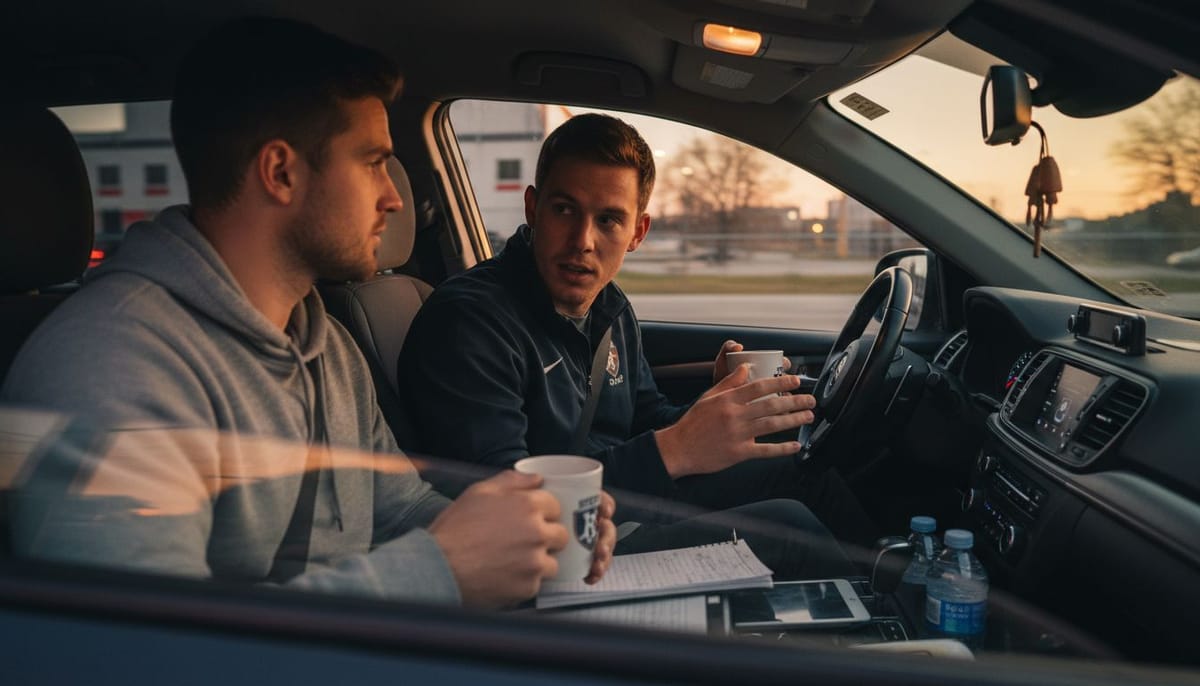
Most coaches have never heard of the Center for the Ecological Study of Perception and Action at UConn. I hadn't either, not really — not until I listened to this episode of the Transforming Basketball Podcast and felt something shift in how I think about player development. Alex Sama and Gray Thomas recorded this one live in the car, fresh off an extraordinary few days at Brown University and an evening with some of the most respected minds in ecological psychology. What followed was one of the most honest, intellectually alive conversations I've come across in a long time. No fluff. No simple coaching tips. Just two people genuinely wrestling with big ideas and what they mean for the game we love.
A Room That Made an NBA Front Office Look Easy
This is the part that stopped me cold. Alex mentioned that he was more nervous presenting to the ecological psychology department at UConn than he's been presenting to NBA front offices. Think about that for a second. These are people who have devoted their entire careers to rigorously understanding how perception and action actually work — not just how we assume they work. When I heard this, I immediately thought about how rare that kind of intellectual honesty is in basketball spaces. Most people, when they get to the pro level, feel like they've arrived. Alex felt the opposite. He felt the weight of genuine expertise in the room, and that humility is something I find deeply refreshing.
Gray Thomas did a brilliant job explaining why the pioneers of this field — people like Michael Turvey, Bob Shaw, Claudia Carello, and James Gibson before them — deserve more credit than they typically get. It's not just that they proposed a different theory of perception. It's that they articulated the problem correctly first, then went about trying to prove themselves wrong at every turn. That's real scientific rigor. And apparently it came at a cost. Gray described these researchers being met at traditional cognitive science conferences with people pointing in their faces and yelling. Not metaphorically — literally. The resistance was fierce.
When I heard that, I didn't find it surprising. I've seen this play out personally in far smaller stakes conversations about basketball. Tell a traditionally minded coach that your team should never run set plays and you'll get a reaction that's not entirely different in spirit, if a bit quieter in volume. Challenging deeply held paradigms is uncomfortable. People don't like it. But the discomfort is usually a sign you're onto something real.
The Lineage That Gets Lost in Translation
One thing Gray kept coming back to — and it's something I think about a lot — is how much of the foundational work behind ecological dynamics gets treated as common sense in hindsight, which strips away the actual intellectual achievement involved. Someone discovers something profound, decades pass, the idea spreads and gets watered down, and eventually people say "well obviously that's how it works." But that "obviously" came from somewhere. It came from people like Turvey synthesizing Gibson's affordance theory with Bernstein's work on movement, doing it with rigor, testing it empirically, and standing in rooms full of hostile academics defending it anyway.
This matters deeply for basketball coaching. The ecological dynamics framework — the whole idea that perception and action are coupled, that skill is about attuning to information in the environment rather than executing stored motor programs — this isn't just a trendy rebranding of common sense. It's a genuinely different way of seeing the game. And understanding where it came from, really understanding it, changes how you apply it. That's why posts like how one coach walked away from the NBA to understand basketball from the ground up resonate with me so much. Intellectual humility — going back to the foundations — isn't weakness. It's the whole point.
Gray also made a point about how the Transforming Basketball project faces the same kind of resistance today, mostly on social media, that those early ecologists faced in conference rooms in the 1970s and 80s. The criticism looks different — fewer people yelling in your face, more dismissive comments in threads — but the underlying dynamic is the same. A dominant paradigm protecting itself. And I think that resistance, rather than discouraging the people doing this work, is actually emboldening them. You could hear it in both their voices.
The Hardest Question — And Why It Matters So Much
Here's where the conversation gets really interesting for me. Gray raised something that I don't think gets addressed honestly often enough in these spaces: how do you actually know what you're doing is working, as opposed to just giving good common sense advice to people who were already going to improve?
That's a sharp question. And it's one the traditional cognitive side of coaching can answer more easily, because their metrics are obvious — drill repetitions, movement pattern checklists, skill tests with measurable outputs. The ecological approach is messier to evaluate precisely because it's trying to measure something more real. It's trying to measure whether players can actually read the game and respond to what's in front of them, not just whether they can reproduce a technique in isolation. That's harder to quantify.
I don't fully agree with the framing that this is a weakness of the ecological approach, because I think the traditional metrics are measuring the wrong things in the first place. Counting how many perfect free throws a player shoots in an empty gym tells you almost nothing about how quickly they make decisions under real game pressure. But Gray's honesty about the challenge is exactly right — if you can't show empirically that your approach produces better players, the skeptics will never take it seriously. And the skeptics, annoying as they can be, deserve an answer.
This is why the announcement buried in this part of the conversation is actually a big deal. Alex and Gray are moving beyond theoretical position papers toward producing empirically informed research. Real data. Real comparisons. Not just "here's why ecological dynamics makes sense philosophically" but "here's evidence it works." That shift — from articulating the theory to testing it — mirrors exactly what those early pioneers did. And if the results are what the Transforming Basketball community believes they'll be, it could genuinely change how coaches at every level think about player development and what modern basketball actually demands.
I find myself genuinely invested in seeing that research come out. Not because I need to be convinced the ideas are right — watching players improve in environments built around these principles is convincing enough for me — but because the broader coaching world deserves to see it. And honestly? The skeptics deserve to have their minds changed with something they can't dismiss.
The Resistance to Research Is Real — And I've Felt It Too
There's a moment in this conversation that stopped me cold. One of the speakers essentially says: even if you handed certain critics a perfect paper proving glaciers exist in basketball, they'd still find something wrong with it. And honestly? That's one of the most accurate things I've heard said about the coaching world in a long time.
I've seen this play out personally. Coaches who dismiss research not because they've engaged with it, but because engaging with it might mean changing something. And change is uncomfortable. It threatens identity. If your entire coaching philosophy is built on a foundation that new evidence challenges, your first instinct isn't curiosity — it's defense.
What struck me most was the distinction they drew between approaching ideas with curiosity versus approaching them to poke holes. Both involve reading the same paper. But one person comes away having learned something. The other comes away having "won." That's a hollow victory. And it slows the whole field down.
This is something I think about a lot — especially when I see coaches reject ecological dynamics out of hand because there isn't a study titled "Ecological Dynamics in Basketball, Ages 14-18, Published Last Year." As one of the speakers points out, that's genuinely missing the point. Ecological dynamics is a framework for understanding movement across all living systems. Asking for a basketball-specific paper before you'll engage with it is like refusing to believe gravity applies to you until someone drops a basketball specifically.
The Bman and Maloney paper they reference — on representativeness in jump shots — is a great example of something I've thought about since reading about why training with a defender changes everything. Just adding a defender changes multiple components of the jump shot. That's not subtle. That's enormous. And yet people still run closed drills in empty gyms and wonder why players can't replicate it in games.
Why Aren't NBA Teams Hiring These People?
This is the question that kept nagging at me through this whole section. One of the speakers asks it out loud: why hasn't an NBA team hired any of these researchers as consultants? And I genuinely don't have a satisfying answer.

The quality of thinking being described — the rigor, the willingness to stress-test ideas at the highest academic level, the genuine intellectual curiosity — that's exactly what you'd want in a front office, on a coaching staff, somewhere in the building. The conversation they're describing, with directors of leading departments in ecological psychology being "blown away" by the evidence, tells you something important. The ideas hold up. They hold up in rooms full of people who are professionally trained to find the weaknesses.
So why the gap? I think it comes back to what they said about resistance. Fear, insecurity, time constraints — coaches building walls between themselves and research that might actually help them. It's not always malicious. Sometimes it's just the pace of a season. There's no time to read, no time to build the bridge, as one of them puts it. But that excuse only lasts so long before it becomes a choice.
What I find genuinely exciting is that this is slowly changing. Coaches who are curious, who approach their own development the way they want their players to approach learning — open, adaptive, willing to be wrong — those coaches are pulling ahead. I've written before about one coach who literally walked away from the NBA to rebuild his understanding from scratch, and that story keeps coming back to me in conversations like this one. That level of intellectual humility is rare. It's also probably why he became one of the most interesting voices in the game.
The broader point — that ecological psychology has enormous, largely untapped potential in sports — feels genuinely exciting to me. Not because it's new for newness's sake, but because the ideas actually explain things coaches have intuited for years without the language to describe them. When you finally get the language, everything snaps into focus. That's what these researchers are offering.
What Affordances Actually Mean for How You Design Practice
The question raised in the room by Steven Harris — about how you actually build a list of affordances in basketball — is the one I kept circling back to. Because it moves this from theory into something a coach can act on tomorrow.
It's not just "is this shot open?" or "is this pass on?" It goes deeper than binary. They're talking about exploring the full solution space — the functional variability that different players with different body types and action capacities are going to find in the same situation. That's a much more interesting design question. And it's why the same drill, run with ten different players, should probably look ten different ways if it's working correctly.
The term "rate limiter" came up and it clearly resonated in the room. I think because it gives coaches a concrete way to think about why one player thrives in a situation and another struggles. It's not just talent. It's not just effort. There's a specific constraint — a rate limiter — that's capping what that player can access in that moment. When I heard this, I immediately thought about decision-making under pressure, which is one of the areas where I see this play out most visibly. Some players aren't slow decision-makers. They're operating under a rate limiter — maybe it's spatial awareness, maybe it's body positioning, maybe it's just lack of exposure to variability in practice. Fix the limiter, the decisions improve.
What I don't fully agree with, or at least want to push back on slightly, is the implicit suggestion that critics who approach this work with skepticism are simply closed-minded and not worth engaging. I think there's a version of healthy skepticism that should be welcomed — the speaker actually says this themselves, that they welcome the criticism, that it's an opportunity to learn. But I wanted to name that distinction more clearly, because there's a difference between someone who reads your paper looking to poke holes and someone who genuinely doesn't understand the framework yet. The second person deserves patience. The first one, honestly, might too — because sometimes the most resistant people become the most committed once something finally clicks for them. And how you respond when someone pushes back says a lot about whether you actually believe what you're teaching.
The Misinformation Problem Is Real — And It's Hurting Coaches
Here's something that genuinely unsettles me: it's faster to spread bad information than it is to correct it. They talked about this directly — the Zimmerman principle — and when I heard it framed that way, I immediately thought about how many coaches I know who are operating from outdated, pseudoscientific frameworks and don't even realize it. Not because they're lazy. Because they don't have time. They're running practices, managing rosters, communicating with parents, trying to win games. Who has time to dig into motor learning research?
That's what makes the misinformation so dangerous. It fills the vacuum. Whole books get written, adopted as gospel, passed around coaching circles — and they're built on shaky foundations. The example they gave about working memory having no real relevance to motor movement? That hit me hard. I've read coaching guides that lean heavily on exactly that kind of premise. And coaches, myself included at points, just accepted it because it came from an authoritative-looking source. This is why I think the conversation around moving from set plays to genuine player development matters so much — the theory underneath what we teach has to actually hold up, or we're just passing bad habits down the line.
What frustrates me most is watching ecological language get misused. People are borrowing the vocabulary of the approach without understanding what it means. That's almost worse than outright rejection, because it creates confusion and muddies the water for coaches who are genuinely trying to learn. I don't think there's a quick fix for this. It takes time, patience, and a willingness to go deep on the theory — which is uncomfortable for a lot of people.
Humility Is the Whole Thing
I'll be honest — the part of this conversation that stuck with me most wasn't about research or constraints theory. It was the moment where they talked about humility. Specifically, the observation that virtually everyone operating seriously within the ecological dynamics community is a humble person. That's not a coincidence.
Think about it. If you genuinely commit to an ecological framework — one that acknowledges how complex movement and learning actually are — you're forced to reckon with how much you don't know. That reckoning tends to make you humble. You can't sit inside a worldview that respects complexity and still walk around acting like you've got all the answers. It doesn't work that way.
What struck me most was the story about Rob opening his presentation by essentially saying: I'm here to learn more than I'm here to teach. Update me. Tell me what I'm getting wrong. That takes real confidence, actually — the kind that doesn't need to perform certainty. I've seen coaches who've been in the game for decades who still can't do that. And I've seen coaches walk away from elite positions just to understand the game better from the ground up — and that same spirit is alive in what Rob was describing here.
The shoutout to Chris was a perfect illustration of this. A seasoned coach, older than the presenter, making time to show up and learn from someone younger. No ego. Just curiosity. That's rare. And honestly? That's the model. That's who we should all be trying to be in this game.
The Brown University project sounds like something worth watching closely. Introducing a constraints-based approach across more than 16 Division One programs simultaneously — that's ambitious in the best possible way. The fact that an athletic director championed it from the top down matters enormously. Culture change in sport almost always has to start somewhere with authority, and when it does, it can move fast. I'm curious to see what the data looks like a few years from now, what coaching behaviors actually shift, and whether this becomes a model other universities try to replicate. Because if it works at scale — and from what they described about the coaches' engagement and willingness to actually change mid-season — it sounds like it already is. The coaches who commit to making real changes to how they train players are the ones whose athletes end up thriving, and what's happening at Brown feels like exactly that kind of commitment. The detractors will keep doing what they do. But conversations like this one, and projects like this one, are where the real work is happening. And that gives me a lot of hope.
Want the complete picture? Read our full guide: The Complete Guide to Ecological Learning Approach in Basketball Coaching