From Science to Art: How the Constraints-Led Approach Is Quietly Revolutionizing Basketball Coaching

Five national championships. That's what Liam Jefferson helped build over 12 seasons at Loughborough University before walking into a completely different coaching philosophy — and having to rebuild his understanding of the game almost from scratch. When I heard that detail in this conversation, I immediately thought about how rare it is for a proven, decorated coach to say, "actually, let me question everything I know." Most coaches with that kind of résumé don't do that. They double down. They protect their system. Liam did the opposite — and what he's discovered on the other side of that discomfort is genuinely fascinating.
This episode of the Transforming Basketball podcast features host Alex sitting down with Liam to unpack what it actually looks like to coach inside a Constraints-Led Approach (CLA) framework — not theoretically, but in real sessions, with real players, in a real academy environment. I'm going to be honest: some of this stuff challenged my own assumptions in ways I wasn't fully expecting.
The Biggest Misconception About the Constraints-Led Approach
Let me start here because Liam nailed something that I think gets in the way of coaches even giving this approach a fair shot. The most common criticism you hear — and I've heard it too — is that CLA just means rolling the ball out, throwing some cones down, and letting kids figure it out while the coach basically stands there with a whistle. Glorified recess, essentially.
Liam pushes back on that hard. And I agree with him completely.
What struck me most was how he described it: you're learning the science of ecological dynamics so you can turn it into art. That framing really landed for me. The science is understanding how the environment, the task, and the individual interact to surface specific affordances — the opportunities for action that you actually want players to recognize and exploit. The art is in how deliberately you design the scaffolding around that exploration.
This is not passive coaching. It's arguably more demanding than traditional instruction because you have to think several layers deeper than "run this drill, do this rep." You're essentially building a maze — and you're designing it so that when a player hits a fork, the right path feels natural to choose. That takes serious intentionality. I've seen this play out personally when watching coaches who are new to CLA get frustrated because they designed a constraint that pushed players in entirely the wrong direction. The science has to come first, or the art falls apart.
If you're curious about what it looks like when a coach fully commits to rethinking their practice design from the ground up, the story of a coach who walked away from the NBA to understand basketball from the ground up covers that kind of radical philosophical reset in a way that I keep coming back to.
Watching Constraints Stack in Real Time: The Wall Pick and Roll Example
This is where the conversation got really good for me. Alex asked Liam to just describe a recent practice — put it in concrete terms. And Liam walked through a small-sided game built around the side pick and roll that was genuinely eye-opening.
Here's what he did. He placed cones along the lane line to create an imaginary wall — instantly constraining the space available. Why? Because in a real game, that space doesn't exist the way it does in a wide-open two-on-two drill. Then he started layering. First, defense can only drop. Now offense has to see the opportunity in that coverage. Then he restricts the offense: no rejecting the screen. Suddenly players are forced to explore the hostage dribble — holding the ball handler in space to manipulate the defender. Then he introduces scoring incentives tied to executing the Gortat screen or seal, which opens the lane for a finish at the rim.
Seven or eight constraint variations. Ten minutes. A to D, not A to B.
I don't fully agree that every session needs to move this fast through progressions — sometimes players need to sit inside one constraint longer and really own it before you add another layer. But I understand what Liam is saying, and the efficiency of that kind of designed exploration is hard to argue with. Becoming truly elite in the pick and roll requires players to read coverage and react — not just execute a memorized action. That's exactly what this constraint structure is trying to build.
What I keep thinking about is the difference between a player who's been drilled on the pick and roll and a player who's been forced to solve it repeatedly under pressure. The second player understands why the action works. The first player just knows the pattern. And patterns break down in games. Solutions don't.
Shared Language as the Hidden Foundation of Everything
Here's the part of this conversation that I think coaches most often overlook when they get excited about CLA: none of it works at scale without a common language.
Liam and Alex spent significant time — phone calls, dinners, coffee chats — building a shared vocabulary across every age group at Lions Academy. Not just terminology for terminology's sake. Language that fits their style of play, their philosophy, their players. Language that makes the principles of play feel owned rather than imposed.
This is something I think about a lot. Because what's the point of building a beautifully designed constraint environment in one session if the players hear completely different language in the next one with a different coach? Confusion is the enemy of decision-making. And fast, clean decisions are the whole point. The example Liam gives is perfect: instead of calling it "drop coverage," they call it "get through." Two words. Purposeful. Succinct. Now a coach can say it in a timeout and every player — regardless of age group — knows exactly what it means and what they're supposed to do.
This idea connects directly to something I find really underrated in coaching conversations: how players make quicker decisions isn't just about reading the game faster — it's about having a clear internal language for what they're seeing. When the words your coach uses match the actions you need to take, the cognitive gap between recognition and response shrinks dramatically.
What Liam describes playing out at the EBL tournament in Poland — players using the academy's terminology on the floor, in real time, without prompting — that's not a small thing. That's the entire system working. And it only happens when every coach in the building is aligned, from the youngest age group up. Moving away from rigid set plays toward genuine player development demands exactly this kind of structural consistency — because you're not giving players scripts anymore. You're giving them a language to solve problems with.
Teaching the Language of Basketball, Not Just the Plays
What struck me most was this idea of basketball as a language. Not a playbook. Not a system. A shared language that players carry with them wherever they go.
When I heard the coaches talk about players subbing out of a game and immediately communicating — "don't forget to jam up on our shots" — I immediately thought about how rare that actually is. Most teams I've watched, even at higher levels, fall apart the second a timeout ends. Players nod on the bench, walk back onto the floor, and then completely revert to instinct. The language never stuck because it was never really internalized.
That's the difference here. These coaches weren't just teaching terminology for the sake of it. They were building a shared vocabulary that gave players a framework to think in. And once you have that, the game slows down. Decisions become clearer. Communication stops being reactive and starts being proactive.
I've seen this play out personally watching youth teams operate in chaos — not because the kids aren't talented, but because nobody's ever given them a common language to organize around. The best coaches understand that timeouts are moments for players to speak, not just moments for coaches to diagram. But that only works if players actually have the words to use.
This is something I think about a lot — how much coaching time gets wasted simply because players and coaches aren't operating with the same vocabulary. The coaches here solved that problem intentionally, and you can see the results.
Less Is More — And This Team Is Proof
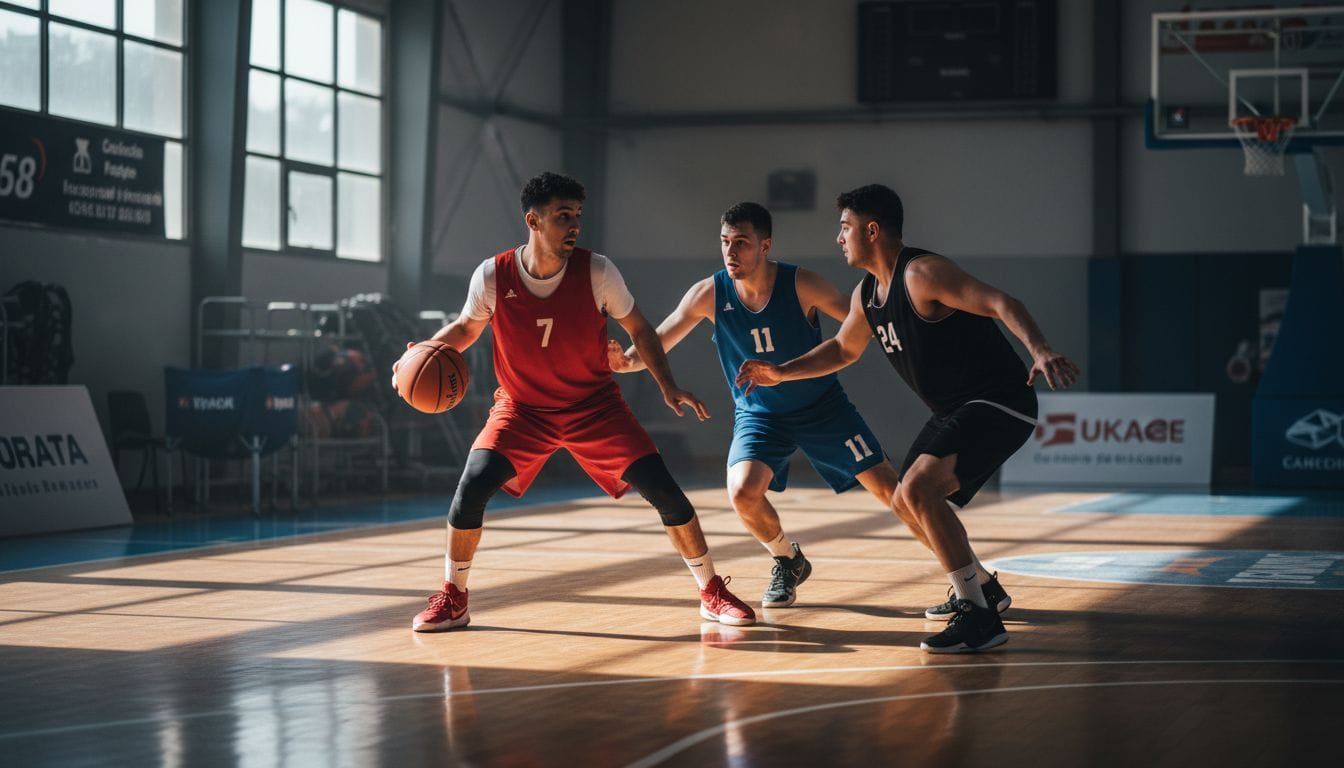
Four pick and roll spacings. A handful of coverage solutions. Eight months without a single set play.
That's it. That's the offense.
And yet, listening to how sophisticated this under-16s team became, I couldn't help thinking — most professional teams would struggle to execute at this level of coherency. That's not an exaggeration. That's kind of a damning statement about how we usually approach basketball development, isn't it?
The pick and roll matrix concept genuinely fascinated me. The idea that there might be ten coverage solutions for a single middle pick and roll situation, but you only teach three right now because that's what your personnel is ready for — that's elite-level coaching thinking applied to youth basketball. It's constraint-based. It's intentional. And it forces you as a coach to actually know your players deeply enough to make those decisions.
I don't fully agree with the idea that more sets automatically equals more sophistication, and this conversation reinforced that. Running set plays as your primary offensive identity often masks the real problem — players who can't read the game. What these coaches built instead was a team of problem solvers. Fifteen-year-olds who could identify a switching defense mid-game, huddle together without a timeout, and execute a relay pass to the roller followed by a ghost cut for an easy lay-up. In Poland. Against a Romanian team they'd never played before.
That's not a system win. That's a development win. And there's a massive difference.
When Players Self-Organize, You've Done Your Job
The Poland moment. That's the one that got me.
Five players, 15 years old, huddling at a dead ball without being told to. Recognizing the switching defense. Identifying the relay pass as the solution. Executing it. Perfectly. On the very next possession.
I've been around enough basketball to know how hard that is to manufacture — and how impossible it is to fake. You can't script that. You can't drill that in a vacuum. The ability to make quick decisions under pressure in a real game comes from training environments that actually mirror real game problems. These coaches built exactly that.
What really resonated with me was the coach saying — forget the results, forget what we achieved in the tournament — that moment was the reward. Players thinking at an elite level and finding their own solutions. That's the whole point. That's what development is supposed to look like.
And honestly? The fact that they were playing out of only four pick and roll spacings makes it even more impressive. There's something to be said for depth over breadth. Becoming truly elite in the pick and roll isn't about knowing every possible action — it's about mastering the reads within the actions you do run. These players had that. Deeply. At 15.
The coaching staff acknowledged they haven't yet seen a full academy program in Europe go all-in on this approach from under-12s through to under-16s. I genuinely want to see that. Because if this is what eight months with a U16 group looks like, I can only imagine what a multi-year, whole-program commitment to this philosophy produces.
The Systems Behind the Success: Google Drive, Game Day Checklists, and Coaching Workshops
Okay, this part of the conversation genuinely stopped me in my tracks. Because when we talk about elite coaching, we always jump straight to tactics — schemes, sets, reads, progressions. Nobody ever talks about the boring stuff. The Google Drive. The checklist. The 20-minute Zoom call. And yet, if I'm being honest with myself, I think the boring stuff might actually be what separates good programs from great ones.
The shared Google Drive idea — where every practice plan lives in one place, accessible to every coach across every age group — sounds almost embarrassingly simple. But think about what it actually does. It creates continuity. It kills duplication. It sparks conversations between coaches about what's working and what isn't. When I heard this, I immediately thought about how many youth programs I've seen where the under-12 coach and the under-16 coach are basically running completely separate organizations under the same club name. No shared language. No shared principles. No shared anything. That's not a program. That's just a collection of practices.
And the game day checklist? I love this more than I expected to. Something as specific as the angle you sit at during a timeout — making sure you're not turning your back on half your roster — is the kind of thing an experienced coach might take for granted, but a newer coach might genuinely never think about. If you've ever wondered why coaches should actively listen to players during timeouts, the physical positioning part of that is something most people completely overlook. You can't hear what you can't see. You can't lead who you've already lost.
The coaching workshops hit differently too. Meeting twice a week — virtually or in person — to deep dive into problems, share what's not working, and bring in external voices like nutritionists or soccer coaches? That's a genuine learning culture. Most clubs don't have that. Most coaches are operating in near-total isolation, figuring things out on their own, reinventing the wheel every single season. I've seen this play out personally. Coaches who never talk to each other, never compare notes, never challenge each other's assumptions. And then they wonder why the program feels inconsistent year to year.
What struck me most was the mention of learning from soccer coaches and how they've implemented constraints-led approaches. This isn't a new idea, but it's still underused in basketball circles. If you're curious about that crossover, the conversation around what basketball coaches can learn from soccer's evolution goes much deeper into why other sports are sometimes ahead of us on this stuff — and what we should be borrowing.
Creating a Unified Coaching Framework Isn't Easy — But It's Worth It
The final question raised here is probably the most honest and practical one in the whole conversation. Can you actually create a unified coaching framework across a club when every coach has their own ideas, their own personality, their own preferred way of doing things? And I think the answer is yes — but only if you're intentional about it from the start.
This is something I think about a lot. The instinct a lot of clubs have is to just hire good coaches and let them do their thing. And that's fine at one level. But if you actually want a development pathway — if you want a 10-year-old coming through your program to build on what they learned at 12, 14, 16 — you need shared language, shared principles, shared processes. Otherwise, every time a player moves up an age group, they're essentially starting over with a new coach who has completely different ideas about how basketball should be played.
The work being done at Lions around embedding these processes — shared practice templates, game day checklists, regular workshops, external speakers — is a model that I think any club could learn from, regardless of size or level. It doesn't require being a fully funded academy. It requires commitment and consistency. Something as simple as one training switch that changes how a coach approaches their work can ripple outward and shift an entire program's culture over time.
And honestly, this conversation reinforced something I keep coming back to — the coaches who are obsessed with getting better, who build systems around continuous learning, who aren't too proud to sit in a Zoom call for 20 minutes and admit they're struggling with something, those are the coaches who build programs that actually last. The tactics matter. But the culture and the processes underneath them? That's the foundation. Without it, everything else is just noise. If you're a coach at any level trying to build something sustainable, the takeaway here is simple: stop waiting until you have the perfect staff or the perfect resources. Start building the system now. The players — and the coaches — who come through your program will be better for it. That's the whole point.
Want the complete picture? Read our full guide: The Complete Guide to Ecological Learning Approach in Basketball Coaching