Basketball Nutrition Is Being Done Wrong — And a Sports Nutritionist Just Proved It
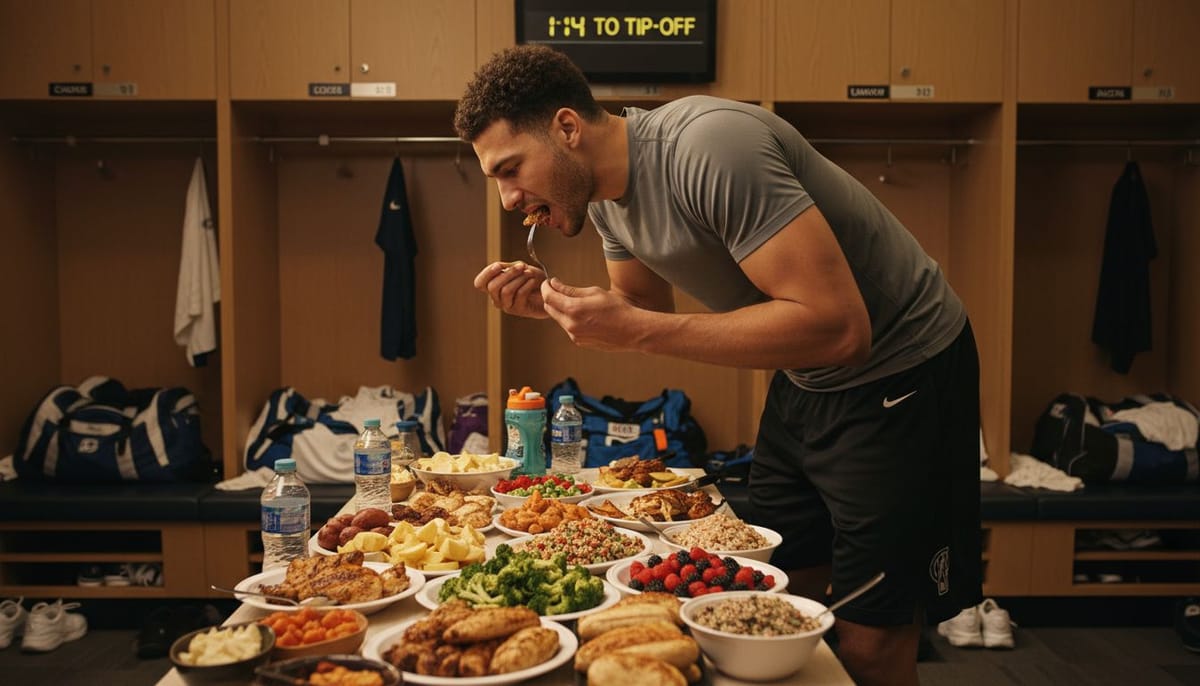
Most basketball programs spend thousands on play design, film sessions, and conditioning equipment — and then hand players a granola bar before tip-off. I've been sitting with that thought ever since I listened to this episode of the Transforming Basketball podcast, where host Alex Sama brought on Patty Bernett, an applied sport and exercise nutritionist, to talk about something the basketball world almost never discusses seriously: nutrition. Not supplements. Not protein shakes. The actual, evidence-based science of fueling players — and why almost everyone, even at the highest levels, is getting it wrong.
What struck me most was how quickly the conversation went somewhere I didn't expect. This wasn't a generic "eat your vegetables and stay hydrated" discussion. It was a genuinely sharp breakdown of why one-size-fits-all nutrition advice fails basketball players specifically — and how a constraints-based framework, the same kind being applied to skill acquisition and coaching, can completely reshape how we think about fueling athletes. I wasn't expecting to have my thinking challenged this much by a nutrition conversation. But here we are.
A Full Circle Moment That Made the Whole Conversation Feel Real
Before we get into the ideas, I want to say something about how this episode opened — because I think context matters here. Alex and Patty grew up in the same town in the UK. Alex was an 18-year-old coach. Patty was one of his under-14 players. And now, years later, Patty is a qualified sports nutritionist who flew out to Italy to work with Alex's college prep basketball program. That's a wild arc. When I heard that setup, I immediately thought about how many coaches I've met who started exactly that way — young, enthusiastic, absolutely no idea what they were doing — and how those early, messy experiences end up shaping everything that comes later. Alex even laughed and said if you'd told either of them back then what they'd both be doing now, they wouldn't have believed it.
There's something grounding about that kind of relationship between a guest and a host. It meant the conversation never got too abstract or too polished. These are two people who genuinely know each other, and that showed in how honestly they talked about the gaps in basketball nutrition — including at the professional level.
The NBA Is Ahead — But Not by as Much as You'd Think
Here's the part that genuinely surprised me. Patty made a point that I keep coming back to: even in the NBA and Euroleague, a lot of the nutrition guidance being given to players is not fully aligned with contemporary evidence. There's pseudo-science involved. There are ideas being applied that simply don't hold up when you examine them closely. And if you compare basketball to American football in terms of how seriously nutrition infrastructure is taken? It's not close. Football is operating at a different level entirely.
I don't fully agree that this is purely a knowledge gap — I think it's also a culture gap. Basketball has historically been a sport where physical gifts and skill were seen as the main variables. The marginal gains mentality that drives nutrition investment in sports like cycling, football, or swimming just hasn't taken hold to the same degree. But that's exactly why conversations like this one matter. And I've seen this play out personally — even at semi-professional and high-level amateur programs, nutrition is an afterthought. It's the last thing to get a budget line and the first thing to get cut.
What Patty said that really landed for me was this: you don't need a massive budget to introduce evidence-based nutrition into a program. You need organization. You need someone who knows where the opportunities are hiding. That reframe — from "we can't afford it" to "we haven't looked for it yet" — is genuinely powerful. It's the same mental shift that happens when coaches start rethinking player development from the ground up, asking not what resources they lack but what they're not yet seeing. I've read about coaches who walked away from professional environments entirely just to rebuild their understanding of the game from scratch, and that same spirit of intellectual humility seems to be at the heart of what Patty is doing in nutrition.
Why Basketball's Nutrition Research Has a Serious Problem
This is the section where Patty said something that I think should genuinely alarm anyone working in player development. The majority of basketball-specific nutrition research has focused almost entirely on supplementation. Not fueling strategy. Not individualization. Supplements. And even where broader nutritional principles exist — like carbohydrate intake recommendations — they've largely been borrowed from endurance sports research.
Think about what that actually means. Endurance sport guidelines are being applied to a stop-and-go, intermittent-effort sport where one player might log 35 minutes of intense action and another player on the same roster might see two minutes of court time. Their energy demands are completely different. Their recovery needs are different. The timing of their fueling around games is different. Applying the same carbohydrate loading framework to both of them isn't just imprecise — it's actively wrong.
This is something I think about a lot in relation to how basketball coaching has evolved. We've spent years borrowing frameworks from other sports and other disciplines and trying to make them fit, when the reality is that basketball has its own specific demands that require its own specific thinking. The same thing has happened in nutrition. The evidence base just hasn't caught up yet — and in the meantime, players are being guided by principles designed for marathon runners. That's a problem.
Applying the Constraints Model to Nutrition — and Why It Actually Works
Here's where the episode really hit its stride for me. Patty came out to Italy, spent time with the players at training and at dinner that first night, and started identifying nutritional problems she wouldn't have anticipated just from reading a profile sheet. Because every case is different. That's not a platitude — it's a methodological principle.
The framework Patty brought in to make sense of all these individual differences was Newell's constraints model. If you've spent any time in the ecological learning space, this model will be familiar — it's the same lens being applied to skill acquisition through the ecological learning approach in basketball coaching. But Patty applied it to nutrition in a way I genuinely hadn't seen before, and Alex even acknowledged that nobody in the nutrition field has quite done it this way.
The breakdown goes like this. Individual constraints include things like a player's rate of energy expenditure, their daily caloric needs, food preferences, cooking ability, and even what phase of preparation they're in. Environmental constraints cover things like the training facility, hotel accommodations, whether the team travels by bus or plane, and what food access looks like on the road. Task constraints deal with the actual game demands — fueling before tip-off, recovery windows between games, hydration during practice, and how the practice schedule itself shapes nutritional timing.
What I love about this is that it immediately kills the idea of a universal nutrition plan. Two players at the same position — Patty used Luka Dončić and LaMelo Ball as the example — can have wildly different nutritional needs even though they're both guards. Same role on paper. Completely different physical profiles, movement patterns, court time, and recovery demands. Treating them identically isn't just lazy — it's leaving performance on the table.
When I heard this, I immediately thought about how often coaches apply the same strength and conditioning principles to every player on a roster, and how the best frameworks for basketball athletic performance across strength, conditioning, and movement training have moved toward individualization for exactly the same reasons. The logic is identical. The athlete is the unit of analysis. Not the position. Not the team. The individual player, in their specific context, with their specific constraints.
And that's what Patty picked up on just by sitting with the players at dinner that first night in Italy. No questionnaire. No lab test. Just attention, curiosity, and knowing what to look for. That's the skill — and it's more transferable than most people realize.
When Two Players Are the Same Height but Completely Different People
One thing that hit me hard early in this conversation was the comparison between Luka and LaMelo. Same height, roughly. Both the centerpiece of their respective teams. But wildly different body types, energy demands, hydration needs — everything. When I heard this, I immediately thought about how often we reduce players to their position or their size and assume the rest is the same. It's not. It's never that simple.
Luka's more solid, more muscular. LaMelo's long and lean. If you're 20 kilos different from someone standing at the exact same height, the way your body burns fuel during a game, recovers between quarters, responds to fatigue — it's a completely different equation. And that's not a marginal difference. That's a fundamental difference in how you should be fueled, trained, and managed across a season. I've seen this play out personally watching guys who look similar on paper get treated identically in training, and one thrives while the other breaks down. Now I understand a little more of why.
This is something I think about a lot — how much of what we call "player development" is actually just applying the same template to every athlete and hoping it sticks. The best coaches I've ever watched operate more like detectives. They observe, they adapt, they treat each player as a unique problem to solve. That same philosophy, applied to nutrition, is exactly what Patty was describing here. It's not a one-size-fits-all industry. It never was. We just haven't fully caught up to that yet, especially in basketball.
What struck me most was the point about how few basketball teams — even at relatively high levels — actually have a dedicated nutritionist on staff full time. A lot of practitioners are spread across multiple sports simultaneously: basketball one day, American football the next, soccer the weekend after. That's an enormous cognitive load, and it makes genuine individualization almost impossible. I don't say that as a criticism of those professionals — they're doing remarkable work under real constraints — but it does expose a gap that the sport needs to close. If you're serious about basketball athletic performance across strength, conditioning, and movement training, nutrition has to sit at that same table with the same level of investment, not as an afterthought bolted on when the budget allows.
The Dependency Problem Nobody Wants to Talk About
This is where the conversation got really interesting to me. And honestly, a little uncomfortable.

There's a trend at the elite level where players are becoming increasingly dependent on performance chefs and support staff to make every single food decision for them. Meals are prepared. Snacks are timed. Hydration is managed. On the surface, that sounds like the dream setup. But what happens when a player travels, or the chef isn't there, or the budget shifts, or they're in a pizza restaurant in Torino two and a half hours before a game with limited options and nobody to hold their hand?
That's the real test. And a lot of players fail it — not because they're lazy or careless, but because nobody ever taught them how to think for themselves in that context. The system created the dependency. I don't fully agree with the idea that this is purely the nutritionist's fault, because often they're operating within structures that don't give them enough time or access. But the outcome is the same either way: players who can't self-regulate. And self-regulation, whether it's making quicker decisions in basketball under defensive pressure or choosing the right pre-game meal without a chef present, is ultimately what separates good athletes from great ones.
There's also the communication breakdown between performance chefs and nutritionists that was raised here. If a player has a chef at home and a dietitian at the facility, but those two people aren't talking to each other, the player could be consuming way too much of something or critically missing something else. It sounds obvious that communication should happen. But in practice, with busy schedules, different employers, and fragmented staff structures? It breaks down constantly. And the player is the one who pays for it with their performance.
Gold, Silver, Bronze — And Why This Pizza Story Is Actually Brilliant
Okay. This is the part of the podcast that genuinely stopped me in my tracks.
A nutritionist walks into a pizza restaurant before a game, screenshots the menu, and categorizes every single item as gold, silver, or bronze based on how well it would fuel the players for what was coming. Not lecturing. Not handing out a 10-page PDF. Just a shared language the players already understood from their training — the same medal system used for improving shot selection on the court — applied directly to what's on the menu.
That's genuinely elegant. And it works for a reason that goes way beyond nutrition.
Players don't need more information. They need better frameworks. When you're an athlete with a thousand things already running through your head before a game — matchups, plays, nerves, travel fatigue — the last thing you want is a complicated nutrition briefing. But if someone tells you "look for the gold option," and you already know what gold means because you've been hearing it on the court for weeks? You make the right call almost automatically. The cognitive load collapses.
What I love most is that this wasn't passive. The players weren't just told what to eat. They were given a decision-making tool and trusted to use it. That's the opposite of dependency. That's building independence through a shared framework — the same principle that underpins the ecological learning approach in basketball coaching, where the environment and the constraints guide behavior rather than constant direct instruction.
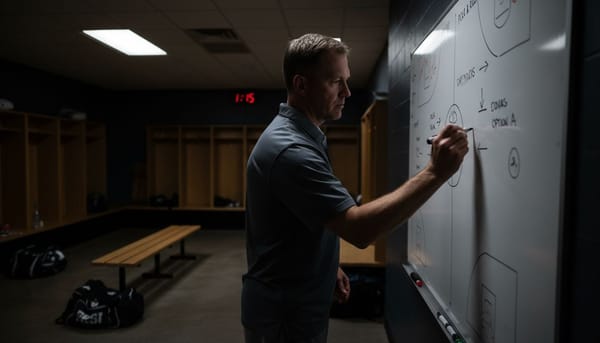
And the results backed it up. Energy levels were better tracked. Fatigue hit later than it had in previous observations. They won the game. None of that is a coincidence. That's what happens when an entire organization starts speaking the same language — from the head coach drawing up actions on the whiteboard, to the nutritionist highlighting menu items on her phone in the corner of a restaurant in Italy.
That kind of integration is rare. But it shouldn't be.
Nutrition Is Just Another Rep — And That "Eat the Rainbow" Cue Proved It
Most basketball programs treat nutrition like a lecture. Print out a sheet, hand it to the players, done. When I heard the conversation shift toward applying ecological principles to what players eat, I stopped and genuinely thought — why hasn't anyone talked about this more openly?
The "eat the rainbow" cue hit me hard. Not because it's revolutionary science, but because it works exactly the way good coaching cues work on the court. You're not asking players to memorize micronutrient profiles. You're giving them a simple, visual, external reference they can use in a grocery store, at a buffet, anywhere. The more colorful the plate, the better the coverage. That's it. Clean, transferable, no manual required.
And what struck me most was the deeper point underneath all of it — that teaching players to eat like robots, the rigid rice-chicken-broccoli approach, doesn't just limit performance. It can genuinely harm people. I've seen this play out personally, watching athletes obsess over "perfect" nutrition plans the same way some coaches obsess over teaching perfect shooting form — rigidly, mechanically, with zero room for individuality. Both approaches miss the human being in front of you.
The connection to JJ Gibson's "knowledge about" versus "knowledge of" is something I think about a lot. You can sit players down and walk them through the science of antioxidants and phytonutrients. They'll nod. They'll forget it by Thursday. But give them a real experience — a colorful plate at a team meal, a hydration station they actually use during practice — and suddenly it becomes theirs. That's knowledge of. That's the whole point.
The hydration station example is almost embarrassingly simple, but that's what makes it powerful. It's not about the water bottles. It's about attention. Having someone who understands the physical demands of basketball actually watching practice — not passively standing courtside, but engaged, tracking intake, noticing when a player is skipping breaks to get extra shots up — that changes outcomes. It's the same reason the full picture of basketball athletic performance, from strength and conditioning to movement training, matters so much. You can't silo nutrition away from everything else and expect it to stick.
Practical Steps Any Program Can Start Tomorrow
This is the part I appreciated most about this whole conversation. Because it's easy to talk about ecological learning, marginal gains, and holistic development in abstract terms. But when it gets practical — hydration stations, food label literacy, eating the rainbow — suddenly it's accessible at every level. You don't need a professional budget. You need intention.
I don't fully agree with the idea that these things are only being ignored because of limited resources, though. I think a bigger problem is that most practitioners aren't empowered by a shared framework. A nutritionist who doesn't understand basketball, a strength coach who's never watched film, a skills trainer who's never spoken to the medical staff — they're all working in parallel, never intersecting. What made this approach different is that everyone was working from the same theoretical foundation. That's rare. And honestly, that's the real marginal gain.
This also connects to something I feel strongly about when it comes to the ecological approach to basketball coaching more broadly — constraints don't just apply to dribbling or decision-making drills. They apply to how you set up a practice environment, what's on the table near the water bottles, how a player learns to fuel themselves for a second session. The environment shapes the behavior. Every time.
And the electrolyte piece teased at the end? That's where it gets even more interesting, because basketball is one of the most physically demanding intermittent sports on the planet. But we'll save that for another conversation.
My Final Takeaway
What this podcast reminded me — and genuinely reinforced — is that the best programs don't separate basketball from the human being playing it. They understand that one shift in how you approach development can ripple through everything: how players move, how they decide, how they recover, how they eat. It's all connected. And the coaches and practitioners willing to build those bridges — between sport science and court time, between nutrition and ecological learning, between theory and a colorful plate at a team meal — those are the ones I find genuinely exciting to learn from. That's what this conversation was. And I'll be thinking about it for a while.