How to make quicker decisions in Basketball

Here's something that'll make you rethink everything: the best offensive players in the world aren't thinking about plays at all. They're reacting in zero seconds. No mental processing. No running through their checklist of moves. Just pure, instinctive basketball. And according to a recent podcast episode that's been making waves in the coaching community, this "zero seconds" concept might be the missing piece in how we're developing players at every level.
The premise is simple but profound: basketball isn't about following a script. It's about creating advantages in real time, adapting to what the defense gives you, and making decisions faster than your opponent can react. Sounds obvious, right? Yet most of our training methods do the exact opposite — they teach players to think, calculate, and execute predetermined patterns.
The Goal Isn't Following a Script — It's Creating Offensive Advantages
The episode opens with this foundational idea: basketball's ultimate goal is creating offensive advantages, not running plays perfectly. The hosts argue that too many players get caught up in executing the "right" move or following the play as drawn up, rather than reading what the defense is actually doing.
This is spot on because we see it every single week in the leagues we work with. A guard brings the ball up, the defense switches or shows a different look, and the offensive player... keeps running the play anyway. Why? Because they've been conditioned to execute, not to exploit.
Think about it. When does your team look best? It's probably in transition, early offense, or scramble situations — exactly when there's no set play to follow. Players are just hooping. Reading and reacting. Creating advantages naturally.
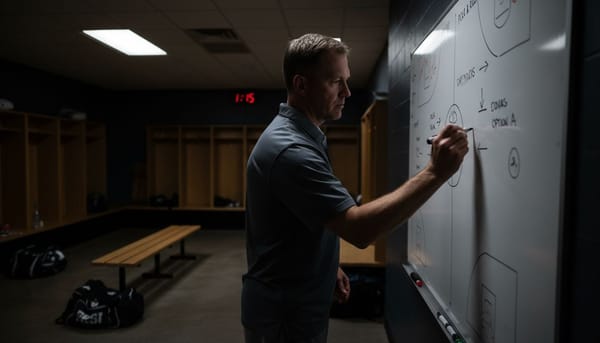
In our experience working with leagues, the teams that dominate aren't necessarily the ones with the most complex playbooks. They're the ones whose players can recognize a mismatch, exploit a bad closeout, or punish a lazy rotation without their coach having to diagram it on a whiteboard. The basketball IQ isn't about memorizing plays — it's about seeing opportunities.
We'd add to this that the "zero seconds" mindset also applies to shot selection. Players who are thinking too much often pass up good looks waiting for "great" ones that never come. Or they force bad shots because "that's my spot" rather than reading what the defense is actually giving them.
React in Zero Seconds — Not After Processing
Here's where it gets interesting. The podcast dives deep into this idea of "zero seconds" — the ability to react instinctively rather than going through a mental processing sequence. The hosts explain that elite players aren't thinking "he went under the screen, so now I should shoot" or "he's playing me tight, so I'll drive." They just do it.
The reaction happens before conscious thought kicks in.
Now, is this realistic for recreational league players? For youth players? We think yes, but with an important caveat: you can't train zero-second reactions with stationary drills and predetermined patterns. You need chaos. You need live competition. You need situations where training with a defender forces you to read and react in real time.
The part that really stood out to us was the comparison to language. When you're fluent in a language, you don't translate in your head — you just speak. Basketball fluency should work the same way. You see a hard closeout, you attack it. You see help coming, you kick it out. No translation required.
But here's what most training gets wrong: it builds the basketball vocabulary without creating fluency. Players learn moves in isolation, practice them against cones or no defense, and then wonder why they can't execute under pressure. It's like learning French from a textbook and expecting to have a conversation in Paris.
Why Traditional Training Creates "Processing Delays"
The episode doesn't shy away from calling out conventional training methods. Too many drills, they argue, actually create the processing delay we're trying to eliminate. When you practice a move 100 times against zero resistance, you're not building instinct — you're building a habit that requires the perfect conditions to execute.
We've seen this firsthand. A player looks amazing in warmups, hitting every move smoothly. Then the game starts, and suddenly everything falls apart. Why? Because there's an opponent now. There's pressure. There's unpredictability. And all that muscle memory built in sterile conditions doesn't know how to adapt.
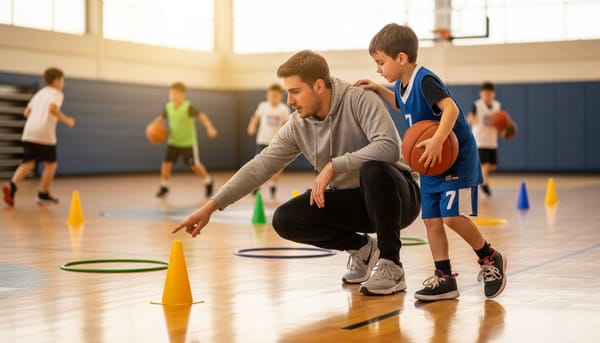
The hosts specifically mention cone drills as a culprit here, which aligns perfectly with what we've heard from NCAA coaches about why these drills don't transfer to actual games. Cones don't react. They don't close out too hard or too soft. They don't make mistakes you can exploit. So the "decisions" you're practicing aren't really decisions at all.
How Elite Players Actually Process the Game
So if elite players aren't running through mental checklists, what are they doing? The podcast breaks down how top-level players process basketball, and it's fascinating stuff.
First, they're reading the defense before they even catch the ball. They already know what they're going to do because they've seen how their defender is positioned, where the help is, and what gaps exist. By the time the ball hits their hands, they're already executing.
Second, they're playing with extreme body control and pace manipulation. This isn't about speed — it's about rhythm changes. Fast, slow, fast again. Get your defender leaning one way, then exploit the opposite. Look at how Luka plays so slow, yet still destroys everyone. He's not faster than his defenders. He's just processing faster and manipulating pace better.
Third — and this is crucial — elite players have done the reps in chaotic environments. They've seen every defensive look hundreds of times in games and competitive situations. Their "zero seconds" reaction isn't magic; it's pattern recognition built through thousands of hours of live play.
In our experience working with leagues, we notice this most in the players who've played the most competitive basketball. Not necessarily the ones who've done the most individual training or attended the most camps. The ones who've played in high-pressure games where they had to figure it out on the fly.
That's the paradox, isn't it? You can't think your way to zero seconds. You have to play your way there.
The Zero-Second Decision: Why Hesitation Kills Your Advantage
Here's where things get really interesting. The podcast breaks down what it means to play in "zero seconds" — and no, it doesn't mean playing recklessly.
Playing in zero seconds means making your decision to shoot, drive, or pass in less than one second. That's it. You catch the ball, you read the defense, you attack. The moment you hesitate? The advantage evaporates.
This is spot on because we see this play out constantly in the leagues we work with. Watch any rec league game and you'll spot the difference immediately between players who attack advantages and those who overthink them. The guy who catches in rhythm and goes? He's getting quality looks. The player who catches, pumps twice, checks his options, then drives into a collapsing defense? He's forcing bad shots.
In our experience working with leagues at every level, shot selection dramatically improves when players commit to faster decisions. Sounds counterintuitive, right? But hesitation doesn't create better options — it gives the defense time to recover and eliminate them.
Think about the best players you know. They're decisive. They might not always make the right play, but they make a play. And honestly? That's coachable. You can correct a bad decision much easier than you can teach someone to stop overthinking.
The part that really stood out to us was the emphasis on keeping advantages alive. An advantage in basketball has a shelf life measured in fractions of a second. Your defender closes out too hard? You have maybe 0.8 seconds before help arrives. The hedge on the pick-and-roll is late? You've got one second, maybe less, before the recover happens.
We'd add to this that it's not just about individual decision-making — it's about team rhythm. When one player hesitates, it disrupts the timing for everyone. The cutter expecting the pass stops cutting. The shooter in the corner relaxes. The whole offensive flow stalls out.
Training This Skill: It Has to Be Competitive
So how do you actually develop this zero-second decision-making? The podcast makes a crucial point: it has to be trained in competitive, game-like situations.
You can't drill this into players with cone drills. You just can't. Cones don't recover. They don't help. They don't communicate. They give players all the time in the world to make decisions, which is literally the opposite of what we're trying to teach.
This is why training with a defender is non-negotiable if you want to develop real decision-making speed. The defender creates the time pressure. The defender forces the read. The defender punishes hesitation.
In our experience, the coaches who get this right are running small-sided games constantly. 1v1. 2v2. 3v3. Situations where every player touches the ball frequently and has to make quick decisions under pressure. Not once or twice per practice, but as the foundation of their player development.
Short sentences work here.
Because quick decisions require quick reps. Lots of them. You need volume. You need immediate feedback. You need the ball in players' hands constantly, forcing reads, punishing delays, rewarding decisive action.
The podcast emphasizes keeping these games competitive, and we couldn't agree more. When there's something on the line — even if it's just pride or running for the losing team — players naturally make faster decisions. The competitive element removes the luxury of overthinking. It simulates the pressure of real games where hesitation gets punished immediately.
Design Constraints That Force Decision-Making
The podcast wraps up with what might be the most practical takeaway: using constraints to build adaptability. Instead of isolating skills in sterile drills, coaches should design environments that force players to read, react, and decide under pressure.
This is spot on because it mirrors what actually happens in games. Players don't get to practice a move in isolation and then execute it perfectly when it matters. They need to process defensive pressure, recognize spacing, and adjust on the fly.
In our experience working with leagues, the teams that consistently outperform their talent level are the ones that practice this way. They don't run endless cone drills that never translate. They create constraints that simulate game chaos.
Here's what that looks like practically:
- Limit dribbles to force quicker decision-making
- Add defenders to create authentic pressure during training
- Use uneven numbers (3v2, 4v3) to teach advantage recognition
- Shrink or expand court dimensions to change spacing reads
- Add time constraints that mirror real possession clocks
The constraint becomes the teacher. When you limit what players can do in one area, they're forced to develop solutions in another. That's where real basketball IQ gets built.
We'd add to this: track these constraint-based scenarios in your practice planning. When you're managing a league or running a program, it's easy to default to what's comfortable. But the coaches who intentionally design these environments—and stick with them even when they look messy—are developing players who can actually handle adversity in games.
The Bigger Picture: Developing Thinkers, Not Robots
What ties all of these concepts together? They're all pushing back against the cookie-cutter approach that dominates youth basketball.
We don't need more players who can execute a perfect crossover in an empty gym. We need players who can think. Who can adjust when their first option isn't there. Who understand that pace isn't always about speed—sometimes it's about manipulating tempo and reading what the defense gives you.
The part that really stood out to us was the underlying philosophy shift required here. It's not just about changing a few drills. It's about fundamentally respecting players as decision-makers rather than treating them as programmable robots who need to execute your system perfectly.
That's uncomfortable for some coaches. It means giving up some control. It means practices might look less polished. It means accepting that players will make mistakes as they learn to think for themselves.
But isn't that exactly what we need them to do in games anyway?
Here's the reality: The coaches who embrace this approach early will develop players who dominate not because they're more athletic, but because they're smarter. They'll see opportunities others miss. They'll adjust when plans break down. They'll make their teammates better because they understand the game at a deeper level.
And honestly? Those are the teams that are the most fun to watch. The ones where you can see players actively thinking, communicating, and solving problems together rather than just running plays on autopilot.
So if you're coaching or running a league, ask yourself: Are you developing basketball players or basketball thinkers? Because in 2025 and beyond, the thinkers are going to win.