Alive Movement Problems: Why Most Basketball Drills Are Slowly Killing Your Players' Development
Most basketball drills are dead. I don't mean that as a metaphor. I mean it literally — if your player can walk into a drill knowing exactly where they start, exactly where they finish, and exactly what movement they need to execute from beginning to end, there's almost no real learning happening. When I heard Shawn Miska from Emergence describe this concept of "alive movement problems" on the Transforming Basketball podcast, I had one of those moments where something you've felt for a long time finally gets a name. And once you hear it, you can't unhear it.
This episode hit differently for me. Shawn is clearly someone who has done the deep intellectual work — pulling from ecological dynamics, referencing Nikolai Bernstein, and even tracing these ideas all the way back to Bruce Lee and Jeet Kune Do. That's not the kind of intellectual range you usually get in a basketball coaching conversation. But what struck me most was how practical it all is once you understand the core idea. So let me break down what was discussed and share my honest reaction to it.
What Is an Alive Movement Problem — And Why Does It Matter?
Shawn's definition here is elegant. A movement problem is "alive" when it requires emergent decision-making, genuine information detection, and adaptable action in the moment. It can't be static. It can't be predetermined. The athlete has to actually interact with an environment that is dynamic, complex, and often chaotic — because that's exactly what basketball is.
He credits Bruce Lee directly for the concept, which I love. Lee famously said fists don't hit back — meaning you can't train for a real fight against an imaginary opponent. You have to grapple with something that actually responds to you. The same logic applies here. If a drill doesn't push back, doesn't shift, doesn't surprise — it's not preparing anyone for the game.
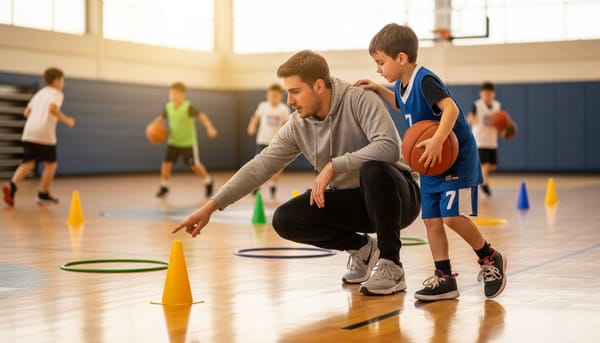
This is something I think about a lot when I watch practice sessions, whether in person or on film. How often do we see players going through choreographed footwork sequences that feel impressive to watch but don't transfer to anything real? The ladder drills. The cone patterns. The on-air finishing moves. Shawn didn't hold back on this — he called those things "dead" movement problems, and honestly, I think he's right. There's a reason the case against cone drills and isolated footwork patterns keeps coming up across coaching conversations at every level. It's not that movement training is bad — it's that the movement has to actually mean something in context.
The deeper point Shawn makes is this: when you do a drill where you already know every step from A to Z, you're not solving a problem. You're executing a script. And games are never scripted.
Bruce Lee, Bernstein, and Why Basketball Is a Problem-Solving Activity
I'll be honest — when Shawn started referencing Bruce Lee in the context of skill acquisition theory, my first instinct was to wonder if it was a stretch. But the more he explained it, the more it clicked. Lee's whole philosophy in Jeet Kune Do was about responding to what is actually there — not to a pre-imagined version of the situation. He used the phrase "the finger pointing at the moon" — the finger isn't the thing. You have to look at what it's pointing toward.
In basketball terms, we're so often teaching the finger. We're teaching the mechanics, the footwork, the technique — and we're calling it development. But the moon is the game itself. The chaos. The defender who doesn't follow the script. The passing angle that appears and disappears in half a second. That's where learning actually needs to happen.
This connects directly to Bernstein's idea — and it's one that serious coaches are increasingly drawing on — that skilled movement isn't about repeating the same pattern but about solving a movement problem differently every single time. Because you're never in the same situation twice. The court isn't the same. The defender isn't the same. You aren't even the same. Shawn quoted it directly: "We never stand in the same river twice, and we're not the same man either." There's real wisdom in that.
I've seen this play out personally watching players who looked technically flawless in drills completely fall apart when a real defender was introduced. Their technique was fine. Their problem-solving ability had never actually been trained. Understanding this reframes the entire purpose of practice — and it connects to broader ideas around basketball athletic performance and how strength, conditioning, and movement training should actually transfer to live game situations. The physical development has to be tied to real decision-making environments. You can't separate them.
The Trap of "Constraining to Constrain"
Here's where it gets really interesting — and where I think Shawn makes his most important point in this section of the conversation. He noticed something happening after the 2022 Emergence paper on ecological approaches in American football. Coaches started adding opponents to drills, started tweaking constraints, started thinking they were creating alive movement problems. But something was still off.
He called it "constraining to constrain." Coaches were adding a defender, adding a rule, adding some dynamic element — and then immediately removing the athlete's agency in how they responded to it. They were still scripting the solution. They were just adding a more elaborate prop.
That's a sharp observation and I don't fully disagree with it, but I do want to push back slightly. I think some coaches do this not because they misunderstand the concept but because they're scared of what happens when you actually give athletes full agency. There's a real vulnerability in letting go of control in practice. What if it looks messy? What if the athlete makes the wrong read ten times in a row? The temptation to step in and correct, to constrain more tightly, to guide the outcome — that temptation is real and understandable.
But Shawn's point is that by over-constraining, you're robbing the athlete of something critical: the opportunity to explore their own perceptual degrees of freedom. Not just their physical options, but what information they notice, what they attend to, what intentions shape their decisions. Two athletes facing the same situation will perceive it differently and that's not a problem to be corrected — it's the whole point. Individual problem-solving is the skill. This is why the ecological learning approach in basketball coaching goes so much deeper than just adding a defender to a drill. The environment has to be designed to invite genuine exploration — not channel every athlete toward a single predetermined solution.
What also grabbed me here was the mention of the Alive Movement Problem Setting Checklist that Shawn, Tyler, and Keith David put together in their 2023 paper. That's exactly the kind of practical tool coaches need. Because the philosophical framework is compelling — but coaches need to walk into their next practice with something concrete. Saying "make it alive" isn't enough if coaches don't know what that actually looks like or how to audit whether their drills genuinely qualify. The shift in training philosophy that transforms a coach's entire approach rarely happens in one session — it comes from having a framework rigorous enough to apply consistently over time.
And that checklist idea — I keep coming back to it. Because the problem isn't that coaches don't want better practices. Most coaches I've talked to genuinely want their players to develop real game intelligence. The problem is the gap between the philosophy and the Monday morning practice plan. That gap is exactly what this conversation starts to close.
Constraining to Afford vs. Constraining to Constrain — Why the Difference Matters More Than You Think
When I heard the distinction between "constraining to constrain" and "constraining to afford," I immediately thought — this is the single most important coaching concept most people have never heard of. And I mean that seriously. Not hyperbole. Just fact.
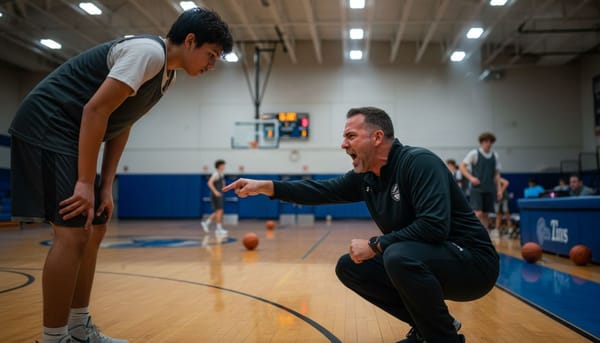
Because here's what I kept coming back to: how much of what we call "coaching" is actually just us telling athletes what to do, what to see, and exactly how to move? I've seen this play out personally at every level — youth leagues, high school, even some college programs — where the entire session is essentially the coach narrating the athlete's experience for them. The athlete never actually solves anything. They just execute instructions.
That's constraining to constrain. And it robs players of something irreplaceable — their own agency.
Constraining to afford is the opposite. It's designing a richer landscape of problems and letting the athlete discover how they want to interact with it. The example that hit me hardest was the point guard dribbling downcourt, scanning the full width and depth of the floor, seconds ticking down, down by one. That's not a drill. That's a living, breathing movement problem nested inside a larger context. And the athlete has to couple their movement to the situation in their own authentic way.
What struck me most was this idea of successive affordances — how one decision opens up a whole new set of opportunities. You drive past the defender, and suddenly the floor shifts. New reads. New angles. New decisions. The problem is always changing, so the solution has to keep changing with it. That's basketball. That's the game. And if our training doesn't reflect that constant context-condition variability, what exactly are we preparing players for?
I think about this every time I watch a player who looks incredible in practice but completely freezes in a real game. They've been trained to execute, not to problem-solve. This connects directly to why so many coaches are rethinking how they structure skill development — the ecological learning approach in basketball coaching is built on exactly this principle: that the environment itself is the teacher, not the coach's voice.
The deeper I get into this idea, the more I realize we've been designing training environments that feel productive but actually strip out everything that makes the game hard and real.
Bruce Lee, Bernstein, and the 10,000 Kicks Myth
Okay. This section of the conversation genuinely floored me.
Everyone knows the Bruce Lee quote — "I fear not the man who has practiced 10,000 kicks once, but I fear the man who has practiced one kick 10,000 times." I've heard coaches use this to justify boring, repetitive, isolated skill work. And honestly? I've nodded along without questioning it. That quote feels wise. It sounds like mastery. It validates grinding the same motion over and over until it's automatic.
But here's the problem. That quote doesn't represent what Bruce Lee actually believed.
His own emblem — the Jeet Kune Do logo — reads: "To use no way as the way." His philosophy was literally the opposite of rote repetition. He said his technique was the result of your technique. His movement was the result of your movement. That's reactive. That's adaptive. That's deeply ecological.
And what blew my mind was learning that Nikolai Bernstein — the Soviet biomechanist who gave us the concept of "repetition without repetition" — was working at roughly the same time, reaching the same conclusions from a completely different direction. Two people, different worlds, probably never read each other's work. Both saying: mere repetitive rehearsal of a fixed pattern is not skill. It's the process of solving the problem, over and over, in varied and unpredictable conditions, that actually builds a capable athlete.
So what should we fear instead? Not the player who practiced one move 10,000 times. We should fear the player who faced 10,000 different movement problems across 10,000 different situations, opponents, and conditions. That's dexterity. That's what Bernstein meant — the ability to solve any emerging movement problem, in any situation, under any condition.
This is something I think about a lot when I watch how players are developed at the youth level. We're so obsessed with technical repetition that we forget the game is fundamentally unpredictable. I don't fully agree with the idea that repetition has zero value — but context-free repetition? The kind that never asks the player to read, react, and adapt? That's where I think we're doing real damage. If you've ever wondered why NCAA coaches are pushing back against cone drills, this is exactly the reasoning behind it — those drills remove the variability and unpredictability that makes practice actually transfer to games.
And here's what no one wants to admit: the reason coaches keep doing it isn't because it works. It's because it looks like it works. The player hits the same move cleanly, ten times in a row, coach feels good, player feels confident. But you've just trained them to solve a problem that will never exist in a real game.
What "Movement Behavior as Problem Solving" Actually Looks Like in Practice
This is where the conversation started shifting from theory to application, and I was leaning in hard.
The concept of a "movement problem" sounds abstract until you frame it the way it was framed in that 2023 paper — a point guard scanning the court isn't just dribbling. They're simultaneously managing a local problem (what's directly in front of them) and a global macro problem (the score, the clock, the positioning of everyone on the floor). The context is shaping the content of every single action. Every. Single. One.
And here's the thing that really got me: when we design training that strips out context — isolated footwork drills, choreographed ball-handling sequences, scripted shooting repetitions — we're not just making practice less realistic. We're actively teaching players to ignore context. We're training them to focus on executing a movement rather than reading a situation. That's the exact opposite of what elite basketball demands.
What would it look like to train differently? It means designing problems, not patterns. It means the athlete owns the exploration. It means the coach is not narrating the answer but setting up an environment rich enough in affordances that the player discovers answers themselves — and builds the capacity to find new ones under pressure. This is a big part of why basketball athletic performance training has to go beyond physical conditioning and account for the perceptual and decision-making demands players face in live competition.
I've seen coaches make this shift and watch their players completely transform. Not because they learned new moves — but because they learned how to read and respond to what the game is actually presenting them. That's the fruit of this approach. And once you see it, you can't unsee it.
The idea that decision-making speed is trainable — and that the environment itself is the primary teacher — changes everything about how you structure a practice. If your players struggle with making quicker decisions in live situations, it might not be a basketball IQ problem. It might be that they've spent years training in environments that never required them to make real decisions in the first place.
That's a hard thing to sit with. But I think it's true.
The Skill Acquisition Specialist: The Role Professional Sports Desperately Needs
This is something I think about a lot. How does a professional sports organization have six water boys, a social media coordinator, a brand ambassador liaison — and nobody whose entire job is to make sure players are actually learning skills in a way that transfers to a real game? When I heard this part of the conversation, I immediately thought: of course. Of course that role doesn't exist in most organizations. And of course that's a massive problem.
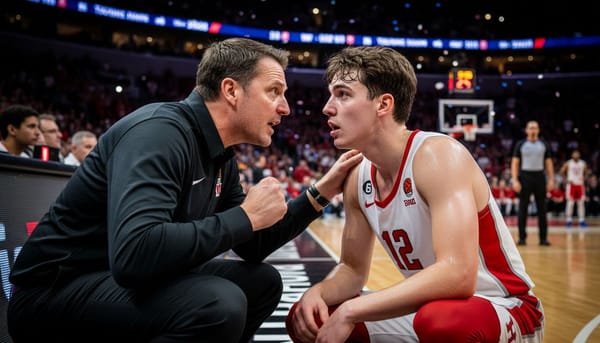
The guest lays out what a skill acquisition specialist would actually do, and it's not abstract. Assess the practice environment. Identify rate limiters — not just physical ones, but perceptual and cognitive ones too. Design tasks that match the real challenges athletes face. Help coaches communicate in ways that give players ownership rather than treating them like puppets. That last one hit me hard. The phrase "joystick coaching" is something I've seen play out personally more times than I can count. A coach standing on the sideline, pulling invisible strings, telling a player exactly where to cut, how to move, what to do — and then wondering why that same player freezes up in a real game when no one's feeding them instructions.
What struck me most was the honesty here. He admits he used to be that coach. The puppeteer. And that self-awareness is rare. Most coaches operating that way don't even realize they're doing it, because it's been normalized across decades of traditional practice design. The problem, as he puts it, is that we keep doing what we've always done because that's how we were coached 30, 40, 50 years ago. Nothing's changed. And if you want to understand just how deep that problem runs in basketball specifically, the basketball athletic performance and conditioning principles shaping modern player development tell a very different story than what most practice floors actually look like.
Australia and New Zealand are already doing this. They have skill acquisition specialists embedded in high-performance programs. America is lagging. Badly. And the argument that players won't respond well to this approach? He addresses it directly — and I agree with his answer completely. Players don't push back on ecological training. They love it. Because it feels real. It feels like the game. The mistakes that happen during that kind of practice aren't signs of failure, they're the actual mechanism of learning. That's literally why practice exists.
The Bridge Between Theory and the Practice Floor
There's a moment in this conversation where the tone shifts from analytical to almost emotional. The guest talks about how for too long, there's been this enormous gap between what skill acquisition research says and what actually happens on practice floors every single day. Theory on one side. Outdated, dogmatic tradition on the other. And almost nobody in the middle connecting them.
I don't fully agree with the idea that nobody has been trying — but I do think the people trying have struggled to make it digestible enough for working coaches to actually use. That's the real barrier. A coach running a youth program five nights a week doesn't have time to read academic papers. They need practical frameworks they can apply tomorrow. Things like understanding the ecological learning approach in basketball coaching shouldn't require a PhD to access — and increasingly, they don't.
What I appreciate about this whole conversation is that it doesn't stay theoretical. The skill acquisition specialist idea is concrete. It has four clear functions. It has a real-world model in other countries. It has a logical entry point — start at the pro or Division I level, then let it trickle down. And the downstream effect matters enormously, because coaches who step back from elite environments to rebuild their understanding from the ground up often describe exactly this kind of awakening — realizing that what they were doing before wasn't actually developing players, it was just running them through motions.
The other thing worth sitting with is what this means for how we evaluate players. If your practice isn't designed to reveal real skill — if it's just tactical reps in rigid structures — then your assessment of a player's ceiling is probably wrong. You're not seeing their true capability. You're seeing how well they follow instructions in a controlled, artificial environment. That's a scouting and development problem, not just a coaching philosophy one.
My Honest Takeaway
I came away from this conversation genuinely convinced that the skill acquisition specialist role isn't a luxury — it's a gap that's actively costing teams wins and costing players development they'll never get back. The entrenched culture in professional sports, especially football but absolutely basketball too, is going to resist this. Front offices will worry about optics. Veteran coaches will feel their authority is being questioned. Players will make mistakes in practice and someone in the building will panic. But here's the thing — those mistakes are the point. Training in conditions that mirror real competitive pressure, with real constraints and real variability, is exactly what produces players who can actually perform when it matters. The science isn't ambiguous on this anymore. The only question is whether the people running organizations are willing to let go of the way things have always been done. Based on this conversation, I'm hopeful. Slowly, the bridge is being built.