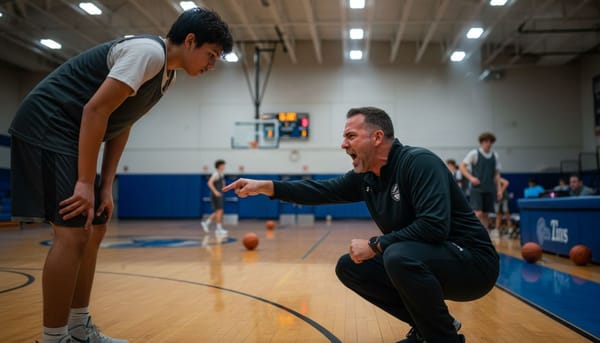
This is why its important to train with a defender👀

A Clippers player went viral this week. Not for a highlight dunk or a clutch three-pointer. For standing up and cheering from the bench during a game. Think about that for a second. We've reached a point where basic teammate support — the absolute minimum of basketball culture — is now considered noteworthy content.
We heard about this moment and honestly? It made us uncomfortable. Not because celebrating your teammates is bad. It's great! But because the fact that it went viral reveals something deeply troubling about where basketball culture has drifted. Here at CourtClok, we work with hundreds of youth leagues and clubs every season, and we're watching this cultural shift happen in real time at every level of the game.
The reaction to this clip wasn't just "nice moment." It was shock. Genuine surprise that a professional athlete would visibly support his teammates. What does it say about our sport when the bare minimum of team culture becomes viral-worthy?
When Did We Stop Celebrating Each Other?
Let's be honest about what's happening. Basketball has become increasingly individualized over the past decade. AAU culture prioritizes individual stats and highlight reels over team success. Social media rewards personal brands, not team accomplishments. College recruitment focuses on individual measurables. The NBA has become a superstar-driven league where players build personal empires.
None of this is inherently wrong. But there's a cost.
We see it constantly in the leagues using CourtClok. Coaches tell us about players who won't pass to teammates. Parents who only care about their kid's scoring average. Teams that fall apart the moment adversity hits because there's no genuine bond holding them together. The infrastructure of team culture has been eroding for years, and we're finally seeing the consequences play out at the highest level.
This viral moment with the Clippers player isn't really about him at all. It's a mirror being held up to basketball culture as a whole. When basic teammate support becomes exceptional, we've normalized selfishness. We've made isolation the default setting.
And here's the thing that frustrates us most: building genuine team culture isn't complicated. It doesn't require expensive facilities or elite talent. It requires intention. Consistency. Leaders who actually model the behavior they want to see.
The Silent Bench: A Problem at Every Level
Walk into most youth basketball games and watch the benches. Really watch them. How many players are engaged when they're not on the court? How many are celebrating defensive stops? How many are locked in, ready to contribute the second they're called?
The answer is usually depressing.
Instead, you'll see kids on phones during timeouts. Players sulking because they're not starting. Teammates who won't make eye contact with the player who just missed a crucial free throw. It's not because these are bad kids. They're just mirroring the culture they see modeled everywhere else in basketball.
We've talked to league organizers who've implemented specific "bench culture" standards — requiring vocal support, engaged body language, positive reinforcement. You know what they tell us? It completely transforms their programs. Not just the atmosphere, but actual game outcomes. Teams with active benches win more. They handle pressure better. They develop players faster.
Why? Because basketball is ultimately a game of energy and momentum. Five players on the court can't generate that alone. They need their entire team feeding them belief, support, and enthusiasm. Modern basketball demands more than just technical skill — it demands emotional intelligence and collective buy-in.
What NBA Culture Teaches Our Kids
Here's an uncomfortable truth we need to address: youth basketball coaches are fighting an uphill battle against NBA culture. Kids watch the pros. They see the body language. They notice when stars sulk after teammates take shots. They absorb the narrative that great players should be frustrated when they don't get the ball.
The Clippers moment going viral might actually be a turning point. Not because one player did something extraordinary, but because the collective reaction revealed our hunger for something different. People want to see team culture. They're starving for it.
We see this hunger in our own community. When coaches post about team bonding activities or culture-building exercises in our forums, the engagement is through the roof. When leagues implement team awards beyond just MVP and scoring leader, participation skyrockets. Parents and players are desperate for basketball to feel like a team sport again, not just five individuals sharing a court.
The Harsh Reality of "Next Man Up"
We heard this discussed recently and it really resonated with us because it's exactly what we see happening at every level of basketball. Isaiah Thomas's perspective cuts right to the heart of something most people don't want to acknowledge: when a star player goes down, the impact is massive.
Think about your own league for a second. What happens when your best player misses a game? The whole dynamic shifts. The team struggles. Other players try to step up but it's not the same. And honestly? That's completely normal.
Here at CourtClok, we track stats across thousands of games, and the data backs this up every single time. When a team's leading scorer is absent, win percentages drop significantly. It's not about effort or heart or wanting it more. It's about talent and experience and the countless hours that elite players have put into their craft.
The "next man up" mentality sounds great in press conferences. It makes for inspiring locker room speeches. But in reality, replacing an All-Star caliber player isn't just about filling a roster spot—it's about replacing production, leadership, defensive assignments, and the gravity that elite players create on the court.
Why League Organizers Need to Think Differently
This is where things get interesting for those of us managing leagues and tournaments. If we accept that star players truly are irreplaceable in the moment, what does that mean for how we structure competitions?
We've built tools specifically for tracking player availability and managing rosters because we know how critical this information is. When you're running a league, you need to know who's actually going to show up. Not who might show up. Not who said they'd probably be there. Who's confirmed.
The impact goes beyond just one game, too. When coaches adapt their approach based on who's available, the entire team's development can shift. Maybe that's not always a bad thing—sometimes it forces role players to grow—but league organizers need to understand these dynamics when creating schedules and playoff formats.
And here's something we don't talk about enough: competitive balance. If your league has teams that rely heavily on one or two stars, what's your contingency plan when those players can't make it? Do you reschedule? Do you play anyway and accept a blowout? These aren't just theoretical questions—they're decisions league organizers face every single week.
That's exactly why we built flexible scheduling features into CourtClok. Because basketball isn't played in a vacuum where everyone's always healthy and available. It's messy. Players have jobs, families, and injuries. Modern basketball demands flexibility, and so does modern league management.
Why No Two Moves Are Ever the Same
This insight hit us hard when we first heard it. No two moves are ever the same.
Think about that for a second. You're teaching a crossover, a spin move, a euro step. You break it down. You drill it. Your players run through it fifty times. But in a game? Every single rep looks different.
Because the defense is different. The angle is different. The speed is different. The floor spacing changes everything.
This is exactly what we see with leagues using CourtClok — coaches who obsess over perfect form in practice get frustrated when their players can't execute "correctly" in games. But here's the thing: there is no correct. There's only effective in that specific moment.
The best players aren't the ones who memorize moves. They're the ones who understand principles. They read the defense. They adjust on the fly. They make decisions based on what's actually happening, not what they practiced happening.
We've written before about why teaching perfect form can actually make players worse, and this concept applies to everything. Footwork, finishes, decision-making — it all needs to adapt to game reality.
Building Adaptive Players, Not Robotic Executors
So what does this mean for how we coach?
It means creating practice environments that force adaptation. Variable defense. Different angles. Unpredictable spacing. Games that challenge players with aggressive contact so they learn to adjust their moves under pressure.
Here at CourtClok, we've built tools specifically for this kind of player development approach. Our league management system helps coaches track not just stats, but player growth over time. Are your players making better decisions? Are they adapting their game based on different opponents?
The scoreboard tells you who won. But understanding how your players are developing? That requires a different lens entirely.
Traditional set-play basketball treats players like chess pieces. Move here, cut there, shoot from this spot. But modern basketball demands a new approach — one that values decision-making over memorization.
Your players need permission to be imperfect. They need to understand that the move that worked last game might not work this game. And that's not failure. That's basketball.
The Bottom Line
No two moves are ever the same because no two moments in basketball are ever the same. The sooner we embrace that as coaches, the sooner our players become truly adaptive, creative, and unstoppable.
Stop drilling perfection. Start building decision-makers who can read, react, and create in real time. That's where the game is going. Actually, that's where the game has always been — we've just been too focused on our clipboards to notice.