Why Athletic Performance and Basketball Coaching Must Stop Living in Separate Worlds
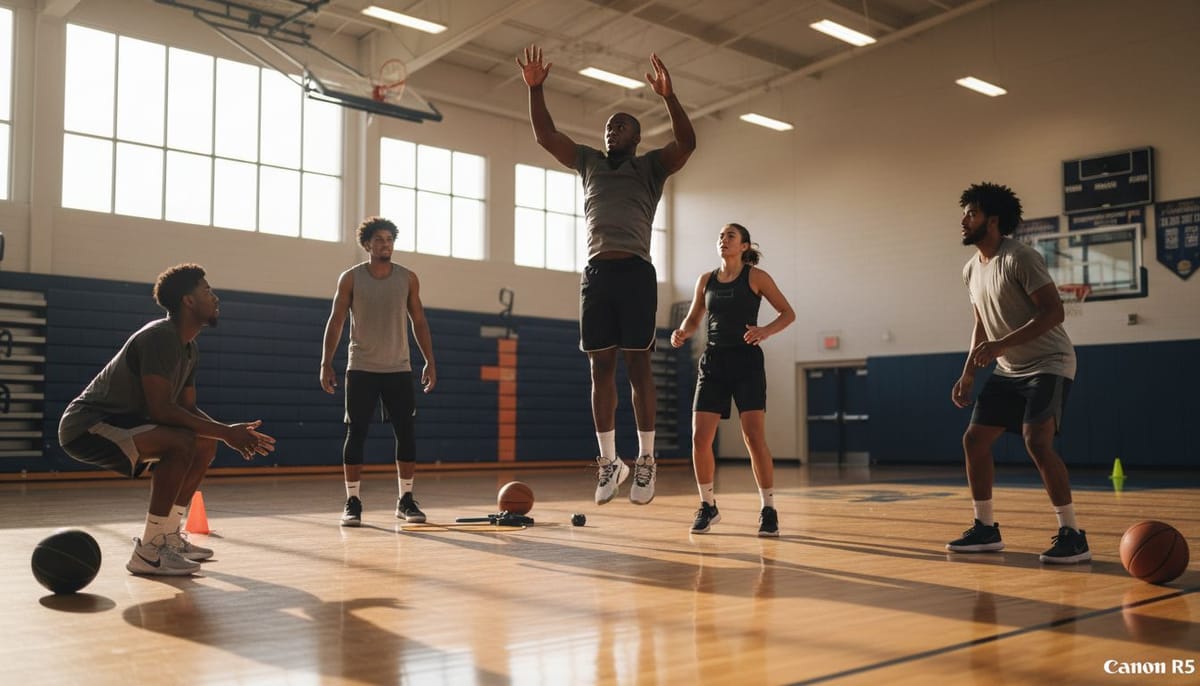
Most athletes spend the first twenty minutes of practice doing agility ladders, foam rolling, and dynamic stretches — then the whistle blows and suddenly none of that carries over to anything that actually happens in the game. I've watched this play out at every level, and for a long time I just accepted it as the way things work. Then I came across a conversation between two coaches who are genuinely trying to blow that system up, and honestly? It stopped me in my tracks.
The podcast was a conversation with Jamie Smith — an athletic performance coach who spent time working with a friend and fellow coach in Italy, applying ideas that most traditional strength and conditioning programs would never touch. What came out of that conversation challenged some deep assumptions I didn't even realize I was holding about how we prepare basketball players. I want to share what hit me hardest, and where I think they're onto something really important.
Tradition Isn't the Same as Truth
One of the first things Jamie said stopped me cold. He basically pointed out that just because coaches have been doing something for the last fifteen or twenty years doesn't make it right. It just makes it familiar. When I heard this, I immediately thought about how many routines exist in basketball not because someone tested them and found them superior, but because that's what the previous coach did, and the coach before that, and so on.
We do this constantly. Agility ladders. Static warm-up sequences. Isolated weight room work. None of it is inherently wrong. But Jamie's argument — and I think it's a strong one — is that we've mistaken repetition for validation. Just because something is routine doesn't mean it's working as well as it could be.
He made this point about the word "strength" that genuinely caught me off guard. He said strength is a weight room term. Getting an athlete's deadlift up by 20% is measurable, sure. But what does it actually mean for the basketball player standing on the court? If that raw strength doesn't translate into more forceful, more robust, more responsive movement in game situations, then it's just a number. That's a hard truth for a lot of coaches to sit with, especially ones who've built their identity around traditional performance metrics.
This is something I think about a lot. There's a version of player development that looks very impressive on paper — the weights are going up, the sprint times are improving, the athletes are checking all the boxes — and then you watch them in a real game and the whole thing kind of falls apart under pressure. The environment changed. The context changed. But the training never prepared them for that.
The Problem With Silos — And Why They Get Worse at Higher Levels
Here's the part of the conversation that I think will resonate with anyone who's spent real time inside a basketball program. Jamie and his co-host made the point that athletic performance and sport coaching don't just operate separately — they often operate in active ignorance of each other. Strength coaches stay in their lane. Basketball coaches stay in theirs. And somewhere in the middle, the athlete is trying to stitch it all together on their own.
What struck me most was the observation that this problem actually gets worse at higher levels. You'd think the opposite would be true — that more resources means more coordination, more communication, more integration. But the reality is that specialization breeds separation. The more expert each department becomes, the more defensively they guard their territory. "Stay in your lane" becomes the operating principle, even when crossing those lanes would clearly serve the athlete better.
I've seen this play out personally, not at the NBA level, but even in well-organized club programs where the conditioning coach and the head coach barely spoke. The players would come out of conditioning work physically taxed in ways that made the basketball sessions less effective, and nobody ever thought to coordinate the timing or the intent of either. It wasn't malicious. It was just siloed thinking that had calcified into habit.
Jamie talked about how athletic performance coaches are often the "low man on the totem pole" — undervalued, underinvolved, and underutilized in the actual basketball decision-making. That's a real structural problem. Because the truth is, if a strength and conditioning coach doesn't understand the offensive and defensive demands of the sport, how can they possibly design preparation that actually serves those demands? And if the basketball coach doesn't understand what the performance staff is trying to build, how do they reinforce it on the court?
This connects to something broader that good coaches are increasingly recognizing — that the ecological learning approach in basketball coaching demands that we stop treating physical, cognitive, and technical development as separate pipelines and start designing environments where all of those things are happening at once. Jamie is essentially making the same argument from the athletic performance side of the room, which tells me this idea is gaining real traction from multiple directions.
What Integration Actually Looks Like
So what does the alternative look like in practice? Jamie describes it as "bridging" — building a seamless transition between what happens in the performance space and what happens on the basketball court. Not a handoff. Not a relay race where one coach tags out and another tags in. A genuine continuum where the movement language, the physical demands, and the decision-making environment are all pointing in the same direction.
What this means practically is that the warm-up, the athletic preparation work, and the basketball session shouldn't feel like three different classes taught by three different teachers. They should feel like one coherent experience. When a player practices explosive force production in an athletic context, they should be doing it in a way that has clear, recognizable echoes in the movement problems they're going to face when the basketball comes out. This is the kind of thinking that basketball athletic performance training that truly integrates strength, conditioning, and movement is built around — and it's miles away from just running athletes through a standard weight room circuit before handing them a ball.
I don't fully agree with the implicit suggestion that traditional strength work is somehow obsolete — I think there's still a real place for structured resistance training in a basketball program. But the point I think Jamie is making, and the one I find compelling, is that it can't exist in isolation. The context has to be there. The sport has to inform the preparation.
There's also a motor learning dimension to this that's worth pausing on. If an athlete only ever practices force production, speed, or agility in a decontextualized setting — a ladder with no defender, a sprint with no decision at the end of it — then they're developing a skill set that only partially transfers. The moment the context changes, they're rebuilding the connection from scratch. That's not efficient, and an NCAA head coach has made exactly this argument about why decontextualized drills like cone work often fail players when it counts most.
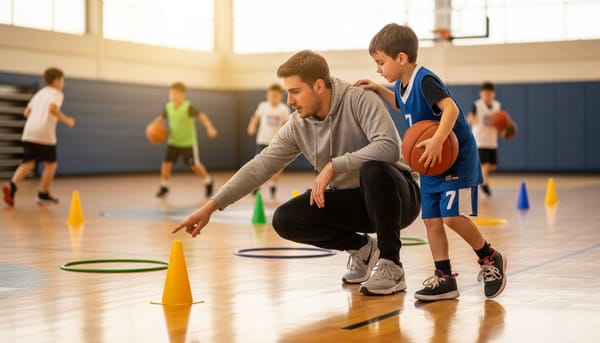
Jamie's work — the small-sided games, the unorthodox activities, the things he describes as looking "messy and chaotic and foreign" at first glance — is essentially an attempt to solve this transfer problem. Make the preparation environment close enough to the game environment that the body and brain don't have to make a giant leap when the real thing begins. That's not radical. That's just good learning design. And the coaches who've made this kind of shift in their training philosophy tend to describe it as one of the most important changes they ever made.
The Warm-Up Is a Learning Window — And We're Wasting It
This part of the conversation hit me harder than almost anything else. We're talking about the warm-up. That five to ten minute window at the start of every practice that, if I'm being honest, most coaches — myself included at times — treat like a checkbox. Get the body moving, hit the same eight movements, blow the whistle, move on.
When I heard Jamie push back on the traditional dynamic warm-up, I immediately thought about how many times I've watched players sleepwalk through those lines. High knees, butt kicks, hip circles — done perfectly, mechanically, completely disconnected from anything they're about to face. And then the second you throw them into a competitive drill, they look like different people. Because they are. They've been warming up their bodies but doing nothing for their minds.
Jamie's argument is simple but genuinely powerful: that pre-practice window is a learning window. It's not just about getting the heart rate up. It's about preparing the whole system — perceptual, psychological, physical — for what's coming. Why wouldn't you start coupling perception and action from the very first minute? Why do we keep separating the body from the brain and then wonder why players freeze in chaotic moments?
His low-high model is something I think more coaches need to hear. Easy days, you might start with a simple 1v1 tag game. Something light, playful, but still putting players in offensive and defensive roles immediately. Hard days, you push that complexity up. But in both cases, you're not just going through the motions — you're already training decision-making, already building the movement vocabulary that actually transfers. This connects deeply to what I'd call the broader shift in how we think about basketball athletic performance through strength, conditioning, and movement training — it's not isolated physical prep anymore, it's integrated from the first whistle.
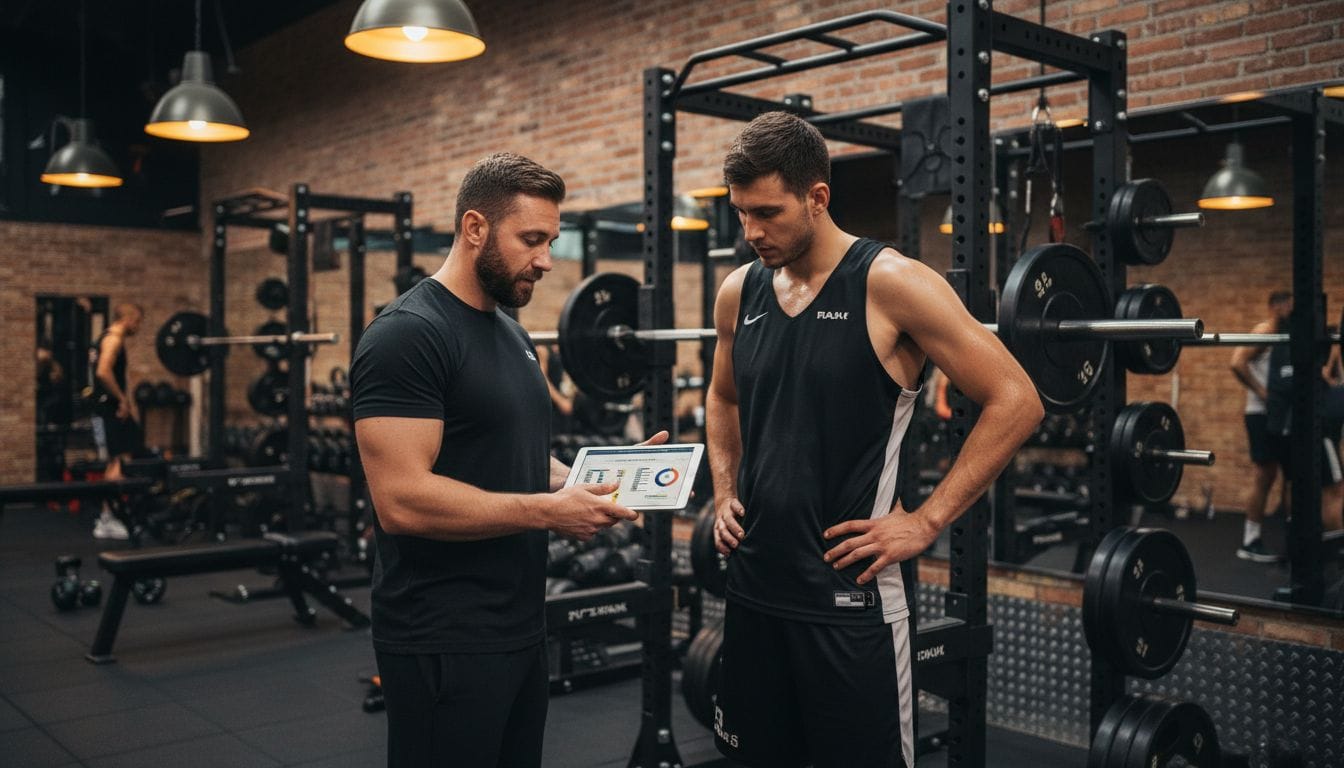
I've seen this play out personally. The players who warm up with purpose — who are already reading a defender, already making micro-decisions — they're sharper when practice actually starts. It's not magic. It's just context. And we keep leaving it on the table.
The Movement Toolbox — Why "More Options" Changes Everything
There's a phrase Jamie used that I haven't been able to stop thinking about: expanding the affordance landscape. It sounds academic, but the idea underneath it is incredibly practical. All he's saying is — give your players more movement options. More tools in the toolbox. So that when a situation arises that no one rehearsed, they're not frozen.
And that's the thing, isn't it? Basketball is chaotic. It's uncertain. It's a constant stream of problems that don't have pre-packaged answers. Yet so much of how we train — especially on the athletic performance side — is built around closed environments, predictable patterns, repeatable sequences. You do the drill. You do it again. You do it a third time. You've now trained a very specific movement response to a very specific stimulus that may never appear in an actual game.
What struck me most was when Jamie made the point that traditional athletic performance coaches — especially ones he encountered in Italy — genuinely didn't know you could use small-sided games instead of closed cone drills as part of athletic development. That blew their minds. Because the assumption has always been: physical preparation happens in the weight room and on the track, and skill development happens on the court. Those worlds don't mix.
But why not? If I'm running a small-sided game that forces lateral acceleration, deceleration, direction change, explosive first steps — all in an unpredictable environment — haven't I just trained athleticism and decision-making at the same time? Haven't I actually done more than the ladder drill ever could?
I don't fully agree with dismissing traditional methods entirely — and to his credit, Jamie doesn't either. He's not saying stop lifting. He's not saying closed environments are worthless. He's saying stop limiting yourself to that world. The athletes who can only function inside rehearsed patterns are the ones who struggle the minute a defense changes or a scheme shifts mid-game. The athletes with an expanded movement toolbox? They adapt. They find solutions. That's what resilience actually looks like in a basketball body.
Bridging the Gap Between Athletic Performance and the Court
What I find genuinely exciting about this conversation is that it's pointing toward something the basketball world has been slow to accept: the physical side and the skill side of development don't have to live in separate rooms anymore.
For years, the pipeline looked like this — athletic performance coach builds the body, basketball coach teaches the game, and the two barely speak to each other. The player gets strong in the weight room and then has to figure out how to make that strength usable on the court. Sometimes it transfers. A lot of times it doesn't. And no one asks why.
The ecological approach — the idea of training movement in context, of building perception-action links from day one — is the bridge. And I think it's especially powerful at the youth level, where players are still forming their entire relationship with movement and sport. A high school coach doesn't need a PhD in sports science to apply this. You just need to rethink what the first ten minutes of practice are actually for. You need to understand, as Jamie put it, that you're not just preparing bodies — you're preparing human beings. And human beings need context to learn.
There's a reason the ecological learning approach in basketball coaching keeps coming up in conversations like this. It's not a trend. It's a fundamental rethinking of how learning actually happens — and it applies just as much to a strength coach designing a warm-up as it does to a head coach designing an offense. The coaches who get that are already pulling ahead. And the ones still running the same eight warm-up movements in a straight line? They're leaving development on the floor every single practice.
One more thing Jamie said that I keep coming back to: "If you understand movement, you understand sport, you understand learning — then you look at the individuals in front of you as human beings, it's limitless." That's not a training philosophy. That's a coaching philosophy. And it applies at every level, from a coach making a single training switch that changes their entire career to an NBA performance staff rethinking their entire preseason model.
The Weight Room Is Just One Tool — Stop Treating It Like the Whole Toolbox
There's a moment in this conversation that really stuck with me. The guest talks about the weight room being "one tool" — and honestly, when I heard that, I immediately thought about how many programs I've seen where the weight room is the athletic development program. Full stop. That's it. You lift, you run cone drills, you do ladder work, and somehow that's supposed to translate into better basketball. It doesn't. Not fully. Not even close.
What struck me most was how clearly he laid out the distinction between hard days and easy days within this ecological framework. On easy days, you're running 1v1 games with an individual focus — letting movement problems emerge naturally, letting the athlete read and react. On hard days, you're still in a game-like environment, but you're directing attention toward something specific — deceleration, acceleration, curve speed patterns. The key thing? Even on the hard days, he's not forcing athletes into robotic, predictable movement sequences. He's managing information, not manufacturing outcomes. That's a genuinely different way of thinking about basketball athletic performance and how strength, conditioning, and movement training actually develop real on-court ability.
I've seen this play out personally — the coach who hands everything over to the strength and conditioning staff, blows a whistle, watches everyone do the same drill in a line, and then steps back on court like those are two completely separate worlds. They're not. They never were. The movement problems a player faces in a 1v1 situation — reading spacing, anticipating a defender's next step, deciding when to accelerate — those are the same cognitive and physical demands happening in the weight room context when you design it right. Keeping those worlds siloed is one of the most costly mistakes in player development.
Communication Between Coaches Isn't Optional — It's the Whole Game
This is something I think about a lot, and the podcast hits it directly. He talks about coaches showing up with their printed spreadsheet, their perfect Excel plan, and refusing to deviate no matter what's actually happening in front of them. I don't fully agree that structure is the enemy — you need objectives, you need principles — but I completely agree that clinging to a plan when reality is telling you something different is a failure of coaching, not a sign of discipline.
The idea that athletic performance coaches and basketball coaches need to be in genuine dialogue — before, during, and after practice — sounds obvious when you say it out loud. But it almost never happens in practice. There's a hierarchy, there are egos, there are defined roles, and those roles become walls. What he's describing is something much more fluid and honest: both coaches watching what's actually emerging from the athletes, asking better questions together, and being willing to go off script when the moment calls for it. That takes trust. It takes transparency. And frankly, it takes a level of coaching maturity that a lot of people haven't been taught to develop. If you're thinking about how this kind of collaborative, adaptive mindset gets built over time, the ecological learning approach in basketball coaching gives you a real framework for understanding why the environment — and the relationships inside it — shape everything.
What also resonated with me here was the point about decision-making being "absolutely vital to sporting performance" and yet almost completely ignored at the development level. He's right. If your practice design doesn't force players to read, anticipate, and respond to another human being making unpredictable choices, you're not actually training decision-making. You're training pattern repetition. And those are two very different things. I've written about how players can develop quicker decision-making skills — and the thread connecting all of it is the same: you have to train in environments that actually demand decisions, not simulate the idea of them. Small-sided games, 1v1 problem-solving environments, constrained scenarios where the athlete has to figure it out — that's where the real learning lives. A cone never made anyone a better decision-maker. Another human being trying to take something from you? That changes everything.
Look — the big takeaway from everything discussed in this podcast is deceptively simple. Stop separating things that belong together. The weight room, the court, the tactical session, the conditioning block — they're not different subjects. They're different angles on the same problem. And the coaches who figure that out, who build genuine communication across those roles and design environments where athletes are always solving real movement problems against real human opponents? Those are the coaches whose players actually get better. Not just stronger. Not just faster. Actually, genuinely better at basketball. That's the whole point.