What a Real Strength Coach Actually Builds Into a Basketball Program (And What Most Coaches Miss)
Most basketball players land wrong. Every single game. Every single practice. And nobody's training them to fix it. When I heard strength coach Matt Bruce break this down on a recent podcast with coach Mark, I immediately thought about how many ACL tears, ankle sprains, and knee injuries I've watched happen — not on a drive to the basket, not in contact, but just on the way down. The landing. That's where bodies break. And according to Matt, that's exactly what most programs aren't training for.
This conversation hit me hard because it's not just about injury prevention — it's about rethinking what "athletic development" actually means for basketball players. Mark and Matt worked together at Catholic High School, where Matt served as the head strength coach while Mark ran the basketball program. What they built together sounds like exactly the kind of thoughtful, athlete-first approach that's missing in a lot of gyms I've been in. I want to break down the highlights of what they talked about, share where I agree, where I pushed back a little in my own head, and why I think every basketball coach — not just strength coaches — needs to hear this.
The Three Pillars Matt Says Every Basketball Program Needs
Mark asked a simple, direct question to open the conversation: if you're building a strength and conditioning program for a basketball team from scratch, what are the two or three non-negotiables? Matt's answer was clear, specific, and honestly pretty different from what I hear most coaches talking about.
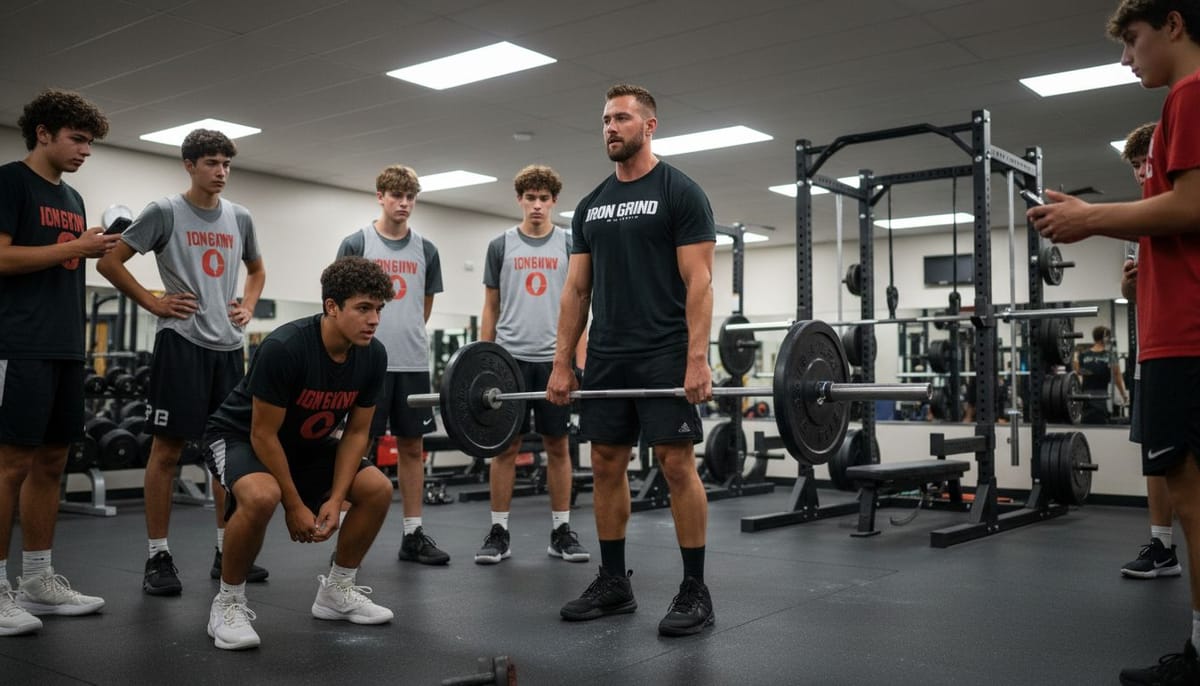
First: Olympic lifting. Matt's argument here is compelling. A lot of coaches avoid power cleans and similar movements because they either don't know how to teach them or they're scared of injuries. Matt pushes back on that hard. When taught correctly, he says, Olympic lifts are among the safest things you can do in a weight room. And the stimulus is unique — you can't replicate it with a trap bar jump. Here's why that matters: the clean doesn't just train explosive power going up. It trains the catch. The deceleration. The ability to absorb force. And in basketball? That's everything. When I heard this, I immediately thought about how much we obsess over vertical jump training but almost never talk about what happens when you come back down.
Second: Deceleration work. This is the one that stopped me cold. Matt said most basketball injuries happen during landing or direction changes — not because players aren't strong enough, but because they've never been trained to slow down properly. Their bodies literally don't know how to decelerate safely. We drill explosive first steps, change of direction, finishing at the rim — but the stopping? The absorbing? That's just assumed. It shouldn't be. This connects directly to something I think about a lot when it comes to basketball athletic performance and the physical qualities that actually reduce injury risk and build more complete players. Deceleration isn't a soft skill. It's a trainable athletic quality that most programs are flat-out ignoring.
Third: Base strength through full range of motion. Front squats, back squats, presses — the slower, foundational movements. But here's where Matt made a point that I thought was genuinely underappreciated: for taller players, coaches often let them get away with half-depth squats because "their limbs are too long." Matt's response? Lighten the weight and do it right. A full range of motion squat at lighter weight is superior to a partial rep under heavy load. The partial rep creates muscular imbalances. Over time, those imbalances lead to exactly the injuries we're trying to prevent. It sounds obvious when you say it out loud, but I've seen it happen on courts and in weight rooms more times than I can count.
Why Form and Technique First Isn't Weakness — It's the Strategy
One of the things Mark mentioned that resonated with me personally was how surprised he was, early on, at how slowly Matt moved when he first came into the program. No rush to add weight. No Day 1 heroics. Just form, technique, safety, and education.
I don't fully agree with the culture that equates early-program intensity with seriousness. That instinct — to push hard immediately — can actually undermine the whole goal. What Matt and Mark described instead sounds like genuine buy-in. Players understood what they were doing and why. That knowledge creates ownership. And ownership in the weight room transfers to ownership on the court. I've seen this play out personally with younger players especially — when they understand the purpose behind a drill or a lift, their effort quality changes completely.
This connects to a broader coaching philosophy that comes up in conversations about the ecological learning approach in basketball coaching — the idea that athletes perform better and develop faster when they're given context, not just commands. Matt's approach to strength training is essentially ecological in nature: teach the athlete to understand their body, understand the movement, and the performance outcomes follow naturally.
There's also something important here about injury prevention that goes beyond just "don't overtrain." It's about progressive exposure. The body adapts to what it's regularly asked to do. If you've never trained deceleration, your tendons, ligaments, and stabilizing muscles haven't been conditioned for it. You can have a great vertical and still be fragile on the landing if nobody ever made that a training priority. That's not bad luck — that's a program gap.
Explosive vs. Strong: Why You Actually Need Both
Mark made a great point midway through this section of the conversation that I want to highlight because I think it often gets glossed over. He described what they're building in their player development course — the ability to combine speed and power in finishing situations. And he mapped that onto Matt's framework: Olympic lifts as dynamic strength, squats and presses as absolute strength.
That distinction matters. A player who's explosive but not strong gets pushed off their line in the paint. They've got the vertical but can't finish through contact. Conversely, a player who's strong but not explosive is slow off the catch, late on closeouts, and can't generate force quickly enough in game situations. You need both. And the Olympic lifts, according to Matt, are uniquely positioned to develop the bridge between them — because they demand that you produce force and absorb it, rapidly, under load.
What struck me most was how naturally this maps onto what we already know about basketball skill development. Training with a defender present forces players to apply their athleticism under real game constraints — and strength training should work the same way. Build the physical qualities, then make sure those qualities are being developed in ways that actually transfer to competition. That's the through-line of everything Matt was saying.
And it raises a question I keep coming back to: how many programs are doing explosive work in isolation without ever pairing it with the strength to back it up? Or doing strength work without ever developing the rate of force development that makes that strength usable in a split-second game situation? The answer, based on what I've seen, is a lot of them. More on Matt's background and what elite program design actually looks like — that's coming next.
Build Athletes First — Sport-Specificity Is Overrated at the Youth Level
When I heard this part of the conversation, I immediately thought about how many youth coaches I've seen obsess over basketball-specific drills from day one. Every movement has to mimic a game scenario. Every exercise has to look like basketball. And I get the instinct — you want everything to transfer. But what this coach said stopped me cold: a football player who hasn't touched a basketball in months can step into a varsity starting rotation in a week. Why? Because he's an athlete first.
That's the whole argument right there.
The idea that middle schoolers should be doing tumbling, handstands, pull-ups, and gymnastics-style bodyweight work before they ever touch a barbell — I think that's genuinely underrated advice. We're so focused on getting kids "ready for basketball" that we skip the part where we just build functional, coordinated human beings. Spatial awareness. Body control. The ability to absorb force and redirect it. Those things matter more at 12 years old than whether your triple threat position looks right.
I've seen this play out personally watching young players who were incredibly "basketball-trained" fall apart physically the moment the game got physical. No base. No real athleticism underneath the skill work. And then you've got the kid who played three sports and just moves differently — reacts faster, recovers better, absorbs contact without crumbling. That's what general athletic development does for you.
The benchmark system mentioned here — where a player can't increase weight until they've hit five perfect reps at the current load — is something I think more youth programs should steal immediately. We're so obsessed with progression that we skip the quality check entirely. This is something I think about a lot when I watch why overly mechanical, repetitive drills actually slow athletic development down rather than speeding it up. Same principle. Perfect the movement first. Then add load.
And the point about high school being more of the same — just with more load, more plyometrics layered in, still avoiding single-rep maxes — makes complete sense to me. The juice isn't worth the squeeze on a one-rep back squat for a 16-year-old. I'd never really framed it that way before, but it's obvious once you hear it. Triple-rep minimums give you three chances to catch a problem before someone gets hurt. One rep gives you zero.
Male vs. Female Programming — The Physical Differences Are Smaller Than You Think
This was one of the parts of the conversation that genuinely surprised me. I expected a long breakdown of anatomical differences, different loading protocols, separate periodization models. Instead, the answer was basically: at the high school level, the physical programming barely changes at all.
The real difference? Psychology.
And honestly, that tracks. The number of female athletes — at every level — who put a ceiling on their own development because they don't want to "get too big" is staggering. I've watched it happen. A girl who is clearly strong, clearly athletic, clearly benefiting from the work... and she quietly starts doing less because she's afraid of what the mirror might show her. That's not a strength and conditioning problem. That's a culture problem. And it starts way earlier than the weight room.
What struck me most was the coach's point that his female athletes were squatting full range of motion, same technique model, same core movements — because when your teaching is technique-centered first, the anatomical nuances sort themselves out naturally. Lower hips, wider Q-angle, whatever the differences are — good coaching accounts for them without needing a completely separate program.
The basketball-specific version of this myth is the old "lifting will mess up your shot" line. I heard that for years. And yet, as this coach pointed out, the best teams he was ever part of were always his strongest teams. That's not a coincidence. Physical strength is a foundation, not a limitation. When I think about what it actually takes to build a complete player — the kind who can handle contact, finish through pressure, and stay durable through a long season — it all connects back to what's covered in a comprehensive basketball athletic performance and strength training guide. The research is pretty clear on this. Stronger athletes perform better. Full stop.
The psychological barrier with female athletes is real, though, and I don't think coaches talk about it enough. It's not just about reassurance in the moment — it's about building a weight room culture where strength is celebrated the same way for everyone. That takes time. And it takes coaches who actually believe it themselves, not just coaches who say the right things and then subtly reinforce the same old fears.
How Long Do You Actually Need to Be in the Weight Room?
Forty-five minutes. That's it.
I'll be honest — part of me wanted to push back on this. We've all seen those programs that treat a two-hour lifting session as a badge of honor. More is more, right? Grind culture is deeply embedded in basketball, especially at the high school and college level. Coaches who brag about how hard their players work. Players who equate exhaustion with improvement.
But the science keeps pointing in the same direction. You don't need more time. You need better time. A well-structured 45-minute session with appropriate intensity, smart exercise selection, and real recovery beats a two-hour slog almost every single time. The fatigue you accumulate in those extra 75 minutes isn't building you — it's just tearing you down without a proportional benefit.
The "we don't have time to lift" excuse that coaches use? I have less patience for it now after hearing this. You have 45 minutes. Almost everyone has 45 minutes. The question is whether you're using it intelligently. And the frequency piece matters too — the goal of never dropping below two days per week is something I think every program, even those with limited facility access, can realistically hit. Four days is better. But two days maintains what you've built. That matters across a long season.
What I keep coming back to is that the coaches who've really figured this out — the ones whose players are visibly more durable, more explosive, more composed under physical pressure — aren't doing more. They're doing smarter. There's a real connection here to how one simple training switch can completely change a coach's approach to development. Sometimes it's not the volume. It's the intention behind the work.
And for any coach who's still skeptical about whether strength training actually translates to the court — the answer is yes, and the mechanism is pretty simple. Stronger players finish better under contact. They don't fade in the fourth quarter. They recover faster between games. If you want players who hold up when finishing under pressure matters most, the weight room is where that resilience starts getting built.
Weight Room Culture, Conditioning, and What "Ready" Actually Looks Like
What struck me most was this idea of the weight room as a mirror. You can tell everything about a team's culture just by watching how they operate between sets. Are guys ready with the weights before the next person even racks? Are they rotating like a pit crew? Or are they slumped in the corner, phone in hand, shoulders already defeated? I've seen both. And honestly, the second version is almost painful to watch because those athletes have no idea what they're leaving on the table.
The pit crew analogy hit me hard. It sounds military on paper, but it's actually the opposite in practice — it's energetic. Loud. Everyone locked in. The way they described it: one guy lifting, one spotting, two prepping the next load without being asked. That's not discipline imposed from the outside. That's a team that genuinely wants to be there. And you either have that or you don't. You can feel it the second you walk in the door.
I think about this a lot when it comes to the way coaches try to manufacture effort through punishment. You can't punish your way to good weight room culture. At some point, players have to want it. And the teams that want it? They're the ones where you see guys moving between supersets like they're getting to the next play in a game. That's exactly the language used here — treating the superset like a "next play" moment. Finish the rep, recover fast, get to the next thing. That's a basketball brain operating in the weight room. I love that framing.
On timing — 45 minutes max, sometimes 30 if you're truly locked in — I completely agree. I've always been suspicious of the three-hour "grind session" culture because it usually means people are resting too long, distracted, or doing work that doesn't transfer. Efficiency is the point. Four days in summer, three in fall, two to three in season. That structure makes total sense. And the concept of a "flow day" — kettlebell halos, banded walks, something you could genuinely do on game day without affecting performance — is something I wish more coaches at the high school level knew about. Active recovery isn't soft. It's smart.
The Conditioning Question Nobody Agrees On
This is something I think about a lot, especially as sport specialization keeps increasing. Kids playing one sport year-round, going straight from school season to club ball, never really having an off-season — how do you even begin to structure conditioning in that environment? The honest answer given here might frustrate some coaches: if you're practicing right and playing enough pickup, you probably don't need to add extra conditioning on top of that.
That's a bold claim. But I think it's mostly correct. The problem is most teams aren't practicing with enough intensity or movement volume to hit those conditioning thresholds naturally. If they were, you wouldn't need to drag players out to the track. Conditioning through well-designed basketball practice — the kind that's grounded in understanding basketball athletic performance through proper strength, conditioning, and movement training — is almost always more transferable than running laps anyway.
The cross country runner example was fascinating to me. Yes, he was in incredible shape. But the follow-up question is the one that actually matters: could he have been stronger if he ran a little less? Could he have been more of a physical force? Maybe. That's not a knock on him — it's just an honest acknowledgment that every training choice is a trade-off. You optimize for one thing, you potentially sacrifice another. Conditioning is not a single dial you just turn up. It's a balance. And the GPS-style wearable technology they mentioned — tracking actual mileage so a strength coach can say "they've hit their number today, we're done" — that's the kind of precision most high school programs will never have access to, but it illustrates the point perfectly. There's a right amount of running. More is not automatically better.
I don't fully agree with the idea that conditioning outside of basketball is always unnecessary, though. I think there's a version of an athlete — especially a younger one still developing their aerobic base — who genuinely benefits from some dedicated running work. Not miles and miles of long slow distance, but short, high-intensity work that mirrors the explosive bursts you need in transition situations. The mental toughness argument for things like a mile run isn't totally wrong either. There's something about pushing through discomfort in a non-basketball context that can build a kind of grit that carries over. I've seen it. But I'd keep it minimal and intentional — not the cornerstone of conditioning.
What I take from all of this is actually pretty simple. Culture drives everything. A team with great culture will maximize a 30-minute weight session. A team without it will waste 90 minutes and leave weaker than they arrived. Conditioning isn't about finding the perfect protocol — it's about building athletes who are sharp, quick, and mentally ready to compete. And if your players' shoulders drop when you say "weight room," that's not a conditioning problem. That's a culture problem. Fix the culture first. Everything else follows.