Does the Coach Make the Player — or Does the Player Make the Coach? A Researcher Breaks Down 17 Seasons of College Basketball Data
Two thirds. That's the number that stopped me cold when I heard it. Two thirds of Division I college basketball coaches — across 17 seasons and nearly 29,000 player observations — showed no statistically significant impact on player performance. Not "a little impact." Not "modest impact." No significant impact. When I heard this, I immediately thought about every heated debate I've ever had about whether a great coach is defined by their players or their coaching. Turns out, the data has something pretty uncomfortable to say about that.
This is something I think about a lot — what coaching actually does at the highest levels of the game. And Chris Croft, an associate professor at the University of Southern Mississippi who spent 20 years coaching Division I college basketball before moving into academia, just handed us some of the most honest, rigorous answers I've seen. He and his colleagues spent two to three years building this study, and the results are genuinely hard to ignore.
Who Is Chris Croft — and Why Does His Opinion Actually Matter Here?
Before getting into the data, I want to say something about why I found Croft's perspective so credible. This isn't a theorist who watched games from a press box. He played coaching Monopoly — his words, not mine — moving through eight jobs in 20 years across programs like Oklahoma State under Eddie Sutton, Nebraska, Washington State, Maryland, and UTEP. He was a head coach. He's been on the elevator going up and he's been fired. He knows exactly what it feels like to live and die by a roster.
That background matters because when someone like that steps back and says "let's actually measure what we're doing," it carries weight. He didn't leave coaching bitter or disillusioned — he left curious. And that curiosity drove a serious, multi-year academic study. He came back to Southern Miss, his alma mater, put the professor hat on, and started asking questions that most coaches are probably too close to the game to ask. I respect that enormously.
He also acknowledged something coaches rarely say out loud: recruiting might be the whole game. He called it "the lifeblood of the program." And the study's numbers back that up in ways that should make every coach — at every level — sit with some real discomfort.
What the Study Actually Measured — and How They Did It
Let me break down the methodology, because I think it's important to understand what they were actually testing before we react to the results. The study covered 17 seasons of NCAA Division I men's basketball, from 2002-03 through 2018-19. That endpoint is deliberate — right before COVID and the transfer portal era completely rewired how college basketball works. They looked at 80 coaches and just under 29,000 player observations.
The core question was this: does the coach make the player, or does the player make the coach? One side of that equation is about management — leadership, development, motivation, the things a coach actively does to improve someone. The other side is about recruiting — going out and finding players who were already going to be good and then riding their talent to wins. To separate those two things, they tracked individual players across multiple seasons at the same program, comparing a player's freshman stats to their sophomore stats, and so on. If you only played one year, you were out of the sample. Smart design, actually — it's the only real way to isolate growth that's attributable to coaching rather than just talent coming in the door.
The variables they tracked were the standard productivity markers: scoring, rebounding, assists, minutes played, games played. Nothing exotic. These are the numbers that tell you whether a player is genuinely getting better as a contributor on the floor. I appreciate that they kept it grounded in observable output rather than trying to quantify something fuzzy. If you want to understand what skill acquisition research really means for basketball coaches, you have to start with what you can actually measure — and this study does exactly that.
The Results — and What I Think They Actually Mean
Here's where it gets genuinely interesting to me. About 65% of coaches — roughly two thirds — showed no statistically significant effect on player productivity over time. That doesn't mean they were bad coaches. Croft was careful to say it doesn't mean they didn't help at all. It means the needle didn't move in a way the data could confirm. Those are different things, but still — 65% is a big number.
Of the remaining coaches, 13 showed a significant positive effect at the less-than-5% threshold. Five more clustered around that five percent line. Six coaches showed roughly a 10% impact. And four — four coaches — actually had a negative significant effect on player development. Players got measurably worse under them. That's the part that genuinely surprised me. I've seen coaches I thought were just treading water, but actively making players worse? That's a hard thing to sit with.
Jay Wright came up as one of the top performers in terms of player productivity improvement. But Croft immediately flagged the obvious caveat: that Villanova team also had five future NBA players and won a National Championship. So even in the best-case example, you can't fully untangle the coaching from the talent. That's kind of the whole point of the study — and it's a point the data keeps reinforcing no matter which angle you look at it from.
What struck me most was how this reframes the entire conversation about what it takes to succeed in college basketball — from recruiting pipelines to development philosophy to how programs actually build sustainable winning cultures. The study suggests we've been crediting coaches for outcomes that might be more about their ability to identify and land talent than their ability to transform it. That's not a small distinction. That's kind of everything.
I don't fully agree with the idea that recruiting explains all of it, though. And I think Croft would say the same. There's nuance here that raw productivity stats can't fully capture — defensive impact, culture-building, player confidence, mental development. Those things are real even if they're hard to quantify. But I also think too many coaches hide behind that complexity to avoid the harder question: am I actually making my players better, or am I just good at finding ones who already are? The coaches who are honest enough to ask that question — like the ones I've read about in pieces exploring what it really means to develop the whole player — tend to be the ones who push the profession forward.
And honestly, the negative impact finding deserves more attention than it probably gets. Four coaches in the sample actively suppressed player development. What were they doing — or not doing — that produced that outcome? Were they playing veterans over developing sophomores? Were their systems too rigid? Were they burning out young players with the wrong kind of pressure? Croft mentioned they'd get into some of that later in the conversation, and I'm genuinely curious where that thread leads. Because understanding what accepting reality rather than imposing rigid expectations looks like in practice might be exactly the antidote to that negative-impact coaching style.
The Recruiting vs. Coaching Debate Is a False Choice — And This Conversation Made Me See Why
When I heard the host frame it as two possible interpretations — either recruiting is everything, or there's a massive untapped opportunity in coaching development — I immediately thought: why does it have to be one or the other? That binary framing is something I've fallen into myself, and it took hearing Chris lay it out so clearly to realize how unhelpful it actually is.
His answer was refreshingly honest. You go get the best players you can. Full stop. But then you still have to coach them. You still have to fit the pieces together. The Lego analogy he used stuck with me — you can have an incredible pile of Lego pieces, but if nobody's building anything intentional, you just have a pile of plastic on the floor. And I've seen this play out personally watching college programs that stockpile talent but look completely disorganized every third game. It's real. Rolling the ball out isn't a coaching strategy.
What struck me most, though, was the point about basketball being fundamentally different from other sports when it comes to roster construction. All five players play both ends. There's one ball. You can't just plug in a dominant left fielder and let everyone else work around him. The interdependence is total — and that means the coaching challenge is proportionally harder. This is something I think about a lot when people compare coaching impact across sports. The numbers from a baseball study would look completely different, and that context matters.
The idea of coaching that develops the whole player, not just runs plays and hopes talent does the rest, is exactly what separates that 35% who made a measurable impact. At least that's my theory. And I think Chris would agree, even if the data couldn't prove it directly.
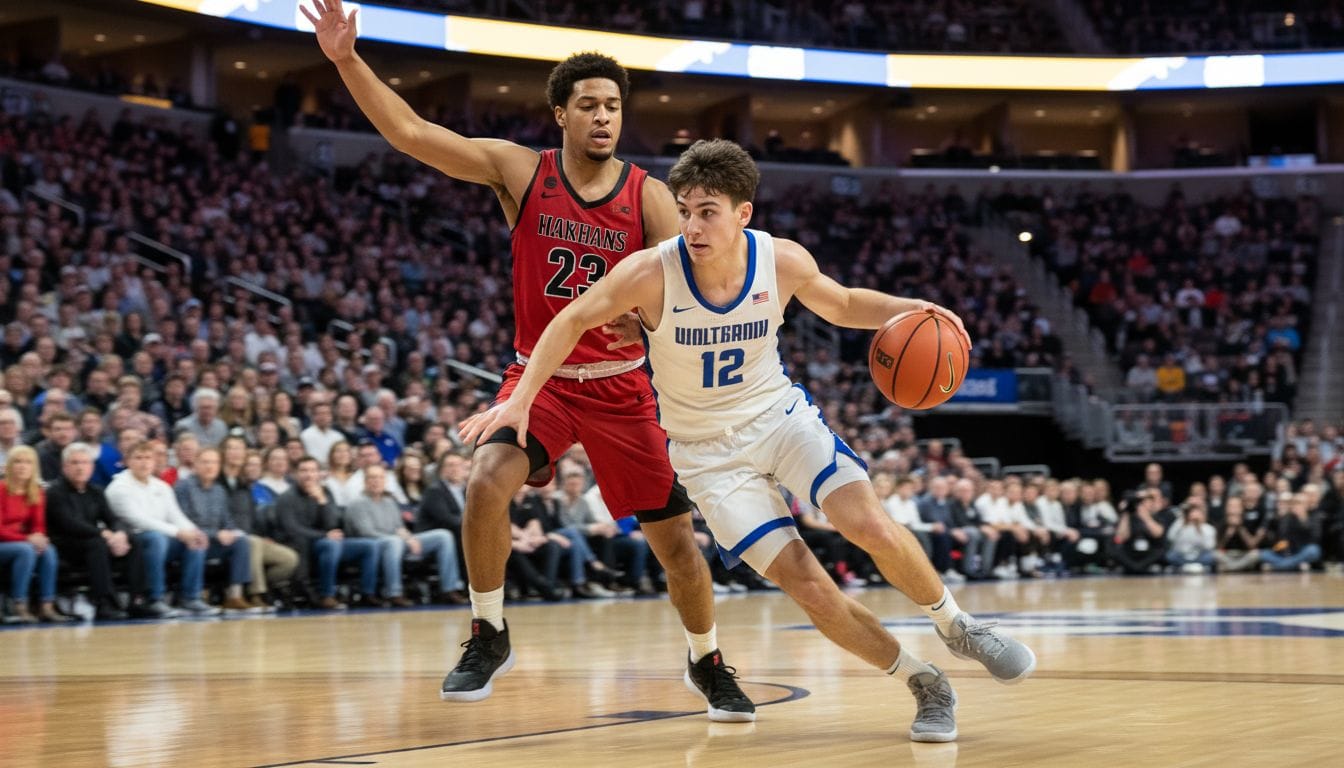
The Transfer Portal Has Basically Broken the Study's Core Assumption — And Nobody Wants to Admit It
This is where the conversation got genuinely uncomfortable, in the best way. Chris pointed out something that I hadn't fully sat with before: the entire foundation of the study — tracking the same coach with the same player over two consecutive seasons — is almost impossible to replicate now. The transfer portal has shattered that continuity.
And he's right. Players leave for money. For playing time. For better situations. You can't blame them. That's the American dream working exactly as advertised. But it means the research design that gave us this data simply can't be reproduced in the current era. The dataset is already becoming a historical artifact, and the sport is only a few years into this new reality.
I don't fully agree with the implicit nostalgia in parts of this discussion, though. The old system wasn't fair either. Players were locked into situations with no leverage and no recourse. NIL and the portal gave them something real. The fact that it also creates chaos for researchers and coaches is a secondary problem, not a reason to roll anything back. Still, the complexity Chris described — 23-year-olds competing against 18-year-olds, experienced transfer veterans dominating freshmen who are still figuring out road trips — is genuinely worth examining. The maturity gap is enormous. If you've ever watched a grizzled fifth-year player guard an 18-year-old in a one-on-one competitive situation, you already know how lopsided that can be. It's not always skill. It's composure, experience, and knowing how to handle pressure.
The basketball camp analogy Chris used landed perfectly. You wouldn't put an 8-year-old against a 13-year-old and call it a development opportunity. Scale that up to 18 versus 23 and you have the same problem wearing an ESPN jersey.
The 35% Who Actually Made a Difference — What Was Really Going On?
This is the question I can't stop thinking about. Sixty-five percent of coaches showed no significant impact on player development across seasons. That's a striking number. And Chris was admirably honest about the study's limits — they couldn't watch practices, couldn't interview players or coaches, couldn't get inside the walls of what was actually happening day to day. The data told them what, not why.
But that question — why did 35% actually move the needle — is where I think the most interesting coaching conversations live. My instinct is that it comes down to the environment those coaches built, not the systems they ran. The qualities that make a basketball environment truly transformational are notoriously hard to quantify. Trust, challenge, psychological safety, the willingness to let players struggle through problems rather than just executing instructions — none of that shows up in a box score. But it almost certainly shows up over two seasons of statistical tracking.
I've also been thinking about what this means for the broader picture of college basketball as a whole ecosystem — where development actually happens, who's responsible for it, and whether the sport's current structure even allows coaches the time and stability to do it well. Transfer portal churn and NIL pressure mean coaches are increasingly managing rosters in motion. Sustained development requires sustained relationships. Right now, the system is actively working against that — and I'm not sure enough people are being honest about the cost.
The 35% who made a real difference probably built something that survived turnover. That's the working theory I'm landing on. And it's a harder thing to teach than any play or drill.
Talent, Recruiting, and the "Jimmies and Joes" Reality
What struck me most was when Chris dropped this line: "It's not about the X's and O's, it's about the Jimmies and Joes." Short. Blunt. And honestly? Hard to argue with. I've heard variations of that quote for years, but hearing it in the context of an actual statistical study — one spanning 17 seasons — gave it a completely different weight.
The finding that 65% of coaches showed no significant impact on player development doesn't mean coaching is irrelevant. It means recruiting might be doing more heavy lifting than most coaches are willing to admit out loud. And I think that's uncomfortable for a lot of people in this space. When I heard this, I immediately thought about how much energy gets poured into designing the perfect system, drilling the perfect play, optimizing every practice minute — and yet if the talent isn't there, none of it converts into wins. The play works perfectly. The shot still doesn't go in.
Chris made this point so clearly it almost hurt: you can design a beautiful set play, run it to perfection, and still get zero points if your guy can't make the shot. Do that a few possessions in a row and you're down six before you've even adjusted. That's the brutal honesty that a lot of coaching culture tries to dance around. And it connects to something I think about a lot — the ongoing shift from running set plays to genuinely prioritizing player development, because ultimately the player still has to make the play.
Retention came up too, and I thought it was an underrated point. If a player comes in year one and stays into year two, you'd expect growth — not just because of coaching, but because they understand the system, they think like the coach on the floor, they're no longer learning everything from scratch. Separating "the coach made him better" from "he got more comfortable and confident in a familiar environment" is genuinely difficult. It probably explains a lot of the noise in the data.
The Thing Nobody Can Measure: Heart
And then came the moment that I think was the most honest thing said in the entire conversation. Kareem raised the possibility that some coaches — Jay Wright was the example — might just be exceptional at identifying players who were always going to develop, guys who were overlooked or hadn't physically matured yet. Which means what looks like a coach's developmental impact could actually just be elite talent identification. That's a massive distinction.
Chris's response hit differently though. He said: "You can never measure the heart." No study, no stat sheet, no recruiting service has ever cracked that. And I've seen this play out personally — a kid who looked unimpressive at 16 absolutely catches fire at 19 because something internally flipped. And a highly recruited kid coasts because, deep down, he already feels like he made it the moment he got the scholarship.
This is something I think about a lot in the context of athlete-centered coaching and what it really means to accept players as they are rather than project onto them what you think their motivation should be. Intrinsic drive is invisible on a spreadsheet. But it shapes everything.
The progression from ninth grade to high school, from high school to college — each step resets the hierarchy. The best player on every high school team suddenly becomes one of many. Does he respond by working harder? Or does his effort quietly drop because the feedback loop he depended on — being the obvious standout — has disappeared? That's not something any study can control for. And honestly, it might be the most important variable in the whole equation.
Final Thoughts
This conversation left me genuinely unsettled in the best possible way. Not because it tore down coaching — it didn't. But because it forced a more honest conversation about what coaching actually controls versus what it merely inherits. The "soup or stew" metaphor Chris used — where everything's moving, nothing's fixed, and there's no single ingredient that determines the outcome — is probably the most accurate description of elite basketball development I've ever heard. Coaches matter. Players matter more. The environment, the conference, NIL, retention, intrinsic motivation, heart — it all goes into the pot. And for anyone who wants to go deeper into how all these forces intersect at the highest level, the complete guide to college basketball is worth your time. The coaches who are honest enough to sit with that complexity — rather than oversimplifying their own role — are probably the ones doing the most genuine good. I don't have a clean takeaway. I don't think there is one. But I'm thinking about this differently now, and that's exactly what a good conversation should do.