Alex Sarama on Coaching Without a Plan: What Happened When He Threw Out the Practice Script in Italy
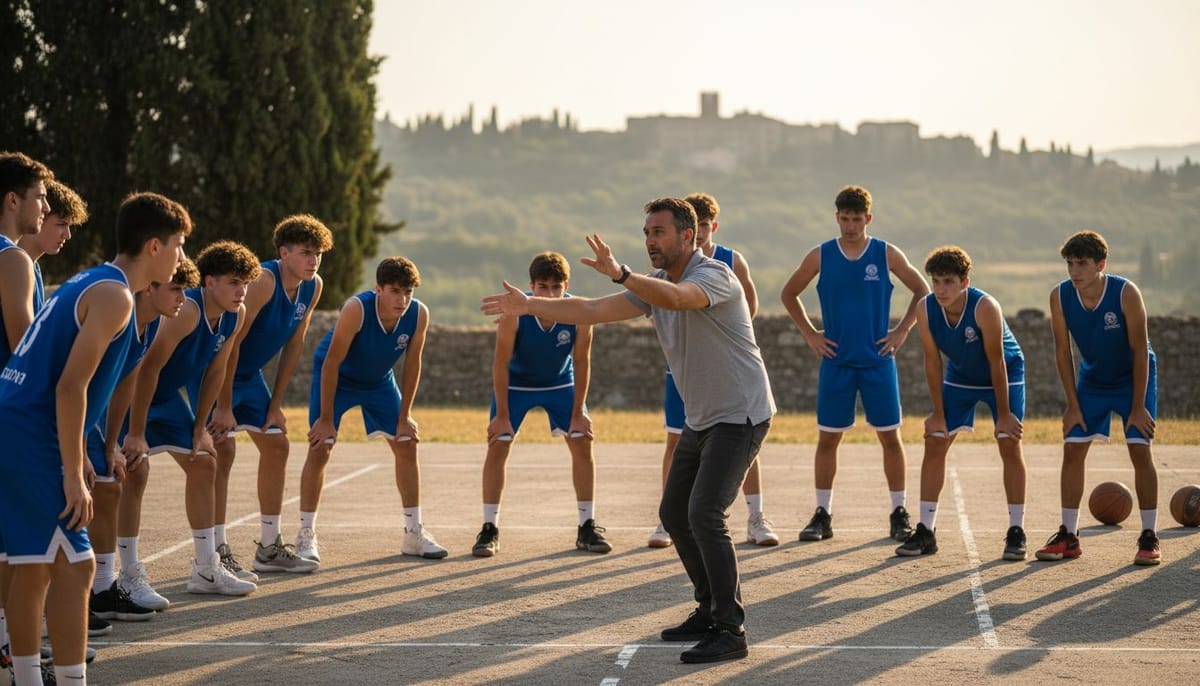
Sixty players. Fifty coaches. One week in Italy — and not a single written practice plan. When I first heard Alex Sarama describe how he ran the Transforming Basketball summer camp in Rosetto, I honestly had to sit with that for a second. No plan. Just principles. Most coaches I know would break into a cold sweat at the thought of walking onto the court with a group of mixed-ability players and no structure to fall back on. But the way Alex talked about it — like it was liberating rather than terrifying — genuinely made me rethink what preparation actually means in coaching.
This conversation came from the We Talking About Practice podcast, recorded while Alex was literally walking past the White House in Washington, Felix was somewhere in Bochum, and it was 11:30 at night in Berlin. Chaotic energy. And yet the ideas that came out of it were some of the sharpest I've heard on coaching philosophy in a long time. Let me break down what stuck with me most.
The Skill Series and What It Actually Captured
Before getting into the deeper coaching philosophy, the crew spent some time talking about the Blindside Skill Series — a content release built from footage recorded at the Italy camp. Over 120 exercises. Three hours of content. And what struck me most was how they described it: not as a polished instructional package, but as an authentic behind-the-scenes look at a real coach doing real coaching in real time.
That distinction matters more than it sounds. There's a huge difference between watching a coach demonstrate a pre-rehearsed drill and watching a coach actually figure things out on the fly with a live group of players. The second one teaches you something the first one never can. It shows you how a coach thinks, not just what they know.
I've seen this play out personally — some of the best learning moments I've had watching coaches work came from watching them adapt mid-drill, not from watching a clean, scripted walkthrough. The messy version is often the more honest version. And apparently that's exactly what the Skill Series captured.
Alex also mentioned that Sasha Prügl brought his entire NBBL team to the camp, and there's already a strong contingent of German coaches and players signed up for the 2025 edition. Two weeks this year — boys and girls. The thing is clearly growing, and when you hear why it was built in the first place, it makes sense that it's resonating.
Why Alex Built the Camp He Wished He'd Had
When asked about the origin of the Transforming Summer Camp, Alex was pretty direct about it: he wanted to create the experience he wished existed when he was younger. Not babysitting with a basketball. Not a week of drills disguised as development. Something genuinely transformative — hence the name — in an environment that players would actually remember.
Rosetto, Italy. Right by the beach. Beach time deliberately factored into the schedule. And Alex was unapologetic about that. His exact words were something like: "I don't believe in all this nonsense like doing seven hours a day. It's quality over quantity." I don't fully agree that volume is always the enemy — there are times when extended reps matter — but the core idea here resonates with me. Fatigue kills learning. A burnt-out player is not an engaged player. And if the goal is genuine development, the environment has to support that.
This connects to something broader I think about a lot, which is the difference between training that looks productive and training that actually is. The NCAA head coach argument against cone drills hits the same nerve — just because a drill fills time and looks structured doesn't mean it's doing anything useful. Alex is clearly running from that philosophy entirely.
No Practice Plan — and Why That Might Actually Be a Feature, Not a Bug
This is the part that really got me thinking. When asked how he handles a camp full of players with wildly different skill levels and backgrounds, Alex said he didn't go in with a single practice plan. He had principles — things his team had pre-discussed, like which concepts they wanted to touch on each day — but the actual execution? Completely improvised based on what the group needed in the moment.
His framing was really interesting: being adaptive as a coach rather than adapted to your plan. That's a subtle but meaningful distinction. A coach who's adapted to their plan is going to deliver that plan no matter what's in front of them. A coach who's adaptive is reading the room, reading the players, and making decisions in real time. One of those coaches is serving themselves. The other is serving the players.
When I heard this, I immediately thought about all the coaches I've watched cling to a practice agenda even when it clearly wasn't working. The drill isn't landing. Players are confused. Energy is flat. And the coach just... keeps going, because it's on the plan. Alex is describing the exact opposite of that instinct.
He also said something I found genuinely refreshing: he doesn't repeat sessions even when he could, because it's boring for him. I respect that honesty. When a coach is genuinely engaged and experimenting, that energy transfers to the players. And when they're not — when they're just running the same session they ran last week — the players feel that too. This lines up with everything I've read about the ecological learning approach in basketball coaching, which pushes coaches to stop over-scripting and start designing environments where real learning can emerge organically.
What he described — hitting principles like "Dominos on day one, Gets on day two" but letting the actual activities take shape on the floor — is a form of structured improvisation. You have guardrails. You know where you're going. But the path there is open. And Alex made the case that walking into a session without a rigid plan is itself a useful constraint. It forces creativity. It forces you to respond to what's actually in front of you rather than what you imagined would be in front of you.
This is something I think about a lot when considering the broader range of coaching tools available to modern basketball coaches — because the most underrated tool might just be the willingness to put the clipboard down and trust your own read of the room. Structure and spontaneity don't have to be opposites. The best coaches seem to hold both at once.
He described his favorite practices as the ones where he enters a "flow state" — experimenting, merging different constraints, trying things he's never tried before. And crucially, not just running a drill he invented six months ago, but genuinely inventing something new in the moment. That takes confidence. It also takes a deep enough understanding of what you're trying to achieve that you can build toward it from multiple directions.
The Same Brain, Whether You're 12 or in the NBA
Here's something that genuinely stopped me mid-listen: the idea that Donovan Mitchell and a 12-year-old kid at a camp in Italy are essentially learning the same way. Same self-organization mechanisms. Same response to constraints. Same underlying wiring.
When I heard this, I immediately thought — wait, so all those coaches who say "CLA only works with kids" or "you can't do that stuff with pros" are just... wrong? And apparently, yes. That's exactly what's being argued here, and honestly, it holds up. The ecological learning approach in basketball coaching isn't age-specific. It's human-specific. We all perceive affordances. We all self-organize under constraints. That doesn't stop being true once you get a professional contract.
What I found really refreshing was the honesty about where the age difference actually matters. It's not in how players learn — it's in how you scale the constraints. Younger players might need simpler versions. That's it. That's the whole difference. And I think a lot of coaches dramatically overcomplicate this because they're looking for a reason to not change their approach.
I've seen this play out personally watching coaches work with mixed-age groups. The ones who treat youth players like they can't handle complexity tend to underestimate them constantly. And the ones who think NBA players are too sophisticated for game-based learning tend to just... run boring spot shooting drills forever. Both camps are protecting a comfort zone, not serving the player.

What struck me most was the point about youth coaching essentially being a proving ground. Experimenting at the youth level, figuring out what works, refining it — and then bringing that same toolkit into a professional environment. That's a coaching development arc you don't hear described very often. Most people assume the knowledge flows top-down. From the pros to the grassroots. But here it's the opposite, and there's something really honest about that.
Getting Buy-In When Players Just Want to Be Told What to Do
This part of the conversation hit differently for me. Because the challenge being described — players who've been coached one way their whole careers suddenly being asked to figure things out themselves — that's not a basketball problem. That's a psychology problem.
Think about it. If every coach you've ever had stood in front of you and said "do this, then this, then this," your entire expectation of what practice is gets shaped by that. Then someone walks in, sets up a two-player agility drill with a four-second shot clock and a constraint about defending with a bump, and just... says go. Of course people freeze. They're not being difficult. They're confused because this doesn't match their mental model of what coaching looks like.
I don't fully agree with the idea that you just need to "trick" players into buying in, though. I think that framing — while I understand the spirit of it — can backfire. If players feel like they've been manipulated once the method becomes obvious, you lose credibility fast. Especially at the professional level where relationships are everything. What I think works better is transparency. Show them the video. Let them see their own shot variability. Make the case directly. Trust the players to understand the logic when it's explained well.
The point about showing players actual examples of professional teams succeeding with this approach was something I think about a lot. Coaches who've been pushing this methodology for years suddenly have receipts. And while it's a little frustrating that people need winning teams to validate good science, that's just sport culture. Use what works. If a championship team doing this is what opens the door, then fine — walk through it.
There's also something worth sitting with here around the dynamic between coaches and players when it comes to trust. You can't ask someone to be vulnerable — to problem-solve in front of their peers, to potentially "fail" during an unfamiliar exercise — if you haven't built the relationship that makes that safe. The coaches who struggle to implement CLA with experienced players often haven't done that relationship work first. The methodology is sound. The trust isn't there yet.
MAYA — The Most Advanced Thing That's Still Acceptable
Of all the ideas in this section, this one is the one I keep coming back to. MAYA. Most Advanced Yet Acceptable. It's not a basketball concept — it's actually an old design principle — but applying it to coaching methodology is genuinely smart.
You don't always get to run the ideal session. Sometimes players aren't ready for different-sized basketballs. Sometimes the differential learning stuff feels like too big a leap. And if you push past what's acceptable, you lose them entirely. You get blank stares. You get passive compliance without engagement. You get players tolerating practice rather than growing from it.
But there's still a massive gap between "ideal" and "what most coaches are doing." And MAYA lives in that gap. If you can get a professional player off the spot-shooting treadmill and into contested shooting games with real variability — even if you never get to the differential learning work — that's still a profound shift. That still matters enormously for how that player develops. The complete guide to coaching tools speaks to exactly this kind of decision-making: choosing your interventions strategically based on where your players actually are, not where you wish they were.
This is something I think about a lot when watching coaches try to implement new ideas too aggressively. Change is a negotiation. You push a little, see what holds, build trust, push a little more. The coaches who blow the whole thing up and try to install a completely new system overnight almost always regret it. The ones who find the most advanced thing that's currently acceptable — and do that thing really well — are the ones who end up being able to do everything they wanted eventually.
And honestly? The one-on-one and two-on-one variability work being described here as a baseline — that's not a consolation prize. If you look at how elite players manipulate space and time in small-sided situations, you start to see why even "basic" constraint-based work at the professional level is building something real. The ceiling on this approach is much higher than most coaches have even started to explore.
Rate Limiters: The Most Underused Concept in Player Development
When I heard the definition of a rate limiter laid out this clearly, I immediately thought — why isn't every coach talking about this? A rate limiter isn't "this player needs to get better at shooting" or "their ball handling is weak." That kind of feedback is basically useless. It's too vague to act on. A rate limiter is something far more precise — a specific situation where a player can't find a functional solution. A specific moment where their ability to self-organize just breaks down.
What struck me most was the distinction drawn between technique and skill. The quote from Rob Gray's book nails it. Technique is one possible solution to a movement problem. Skill is how well an athlete can adapt that technique when the situation demands it. I've seen this play out personally — a player who looks beautiful in a drill but completely falls apart the moment a defender gets in their face. That's a technique without the skill to back it up. And honestly, most traditional player development programs are building technique while ignoring the skill entirely. If you're curious how this connects to broader development philosophy, the complete guide to coaching tools covers how to build systems that actually address both sides of that equation.
The conversation around finding rate limiters was something I think about a lot. Because here's the uncomfortable truth — if your player is dominating their league, you might never see their real limitations. The environment isn't hard enough to expose them. That's a genuine problem. You can go an entire season thinking a player is complete, and then they step up a level and everything unravels. So how do you surface those cracks before they become disasters?
The answer offered here was film. Deep, specific, intentional film work. No analytics required — just honest observation. Create a simple sheet, identify three rate limiters per player, track whether your interventions are actually moving the needle. I don't fully agree that analytics should play second fiddle even at the youth level forever — as more accessible data tools emerge, that will shift — but the core logic is sound. You need to actually watch your players in contested, pressure situations to see what breaks. Box scores won't tell you that. A five-spot shooting drill definitely won't tell you that.
This is also where the individual session piece becomes so important. The conversation touched on how one-on-one time with a player — especially in rehab or early-season returns — builds the kind of trust that makes them open to constraint-led activities later. That resonates with me completely. You can't ask a player to embrace ambiguous, exploratory training if they don't trust you yet. The individual session is how you earn that. And once you've identified their specific rate limiters together, they're far more bought in because it feels personal — because it is personal. That shift in dynamic is something the ecological learning approach in basketball coaching speaks to directly — it's not just a methodology, it's a relationship-first philosophy dressed in science.
One moment from this conversation that genuinely made me smile was the observation about pros and their shooting habits. Show up with no structure and they default immediately to five spots, moving in a perfectly linear loop around the three-point line. Every single time. It's muscle memory from a system, not from understanding. So when those same players start naturally varying their range, changing angles, moving non-linearly — without being told — that's a real behavioral shift. That's skill emerging. And that's what you're actually chasing.
What I'm Taking Away From All of This
There's a version of basketball coaching that's been dominant for decades — prescriptive, drill-heavy, technique-obsessed, built on compliance. And there's a version that's slowly taking over — one that's messier on the surface, harder to explain to skeptical parents or administrators, but far more aligned with how learning and performance actually work. This conversation lives firmly in that second world. The shift from thinking about what a player does wrong to identifying what specific situation they can't navigate yet is subtle but enormous. The shift from running players through cone drills — and if you haven't seen what an NCAA head coach has to say about why players should stop doing cone drills, it's worth your time — to designing small-sided games that target exact rate limiters is not just a methodology change. It's a philosophy change. I left this conversation with more questions than answers, honestly. But the good kind. The kind that make you want to go back to the film, look harder, design better, and stop settling for generic feedback dressed up as development.