What a Skill Acquisition Specialist Actually Does Inside a Basketball Organization — And Why Most People Get It Wrong
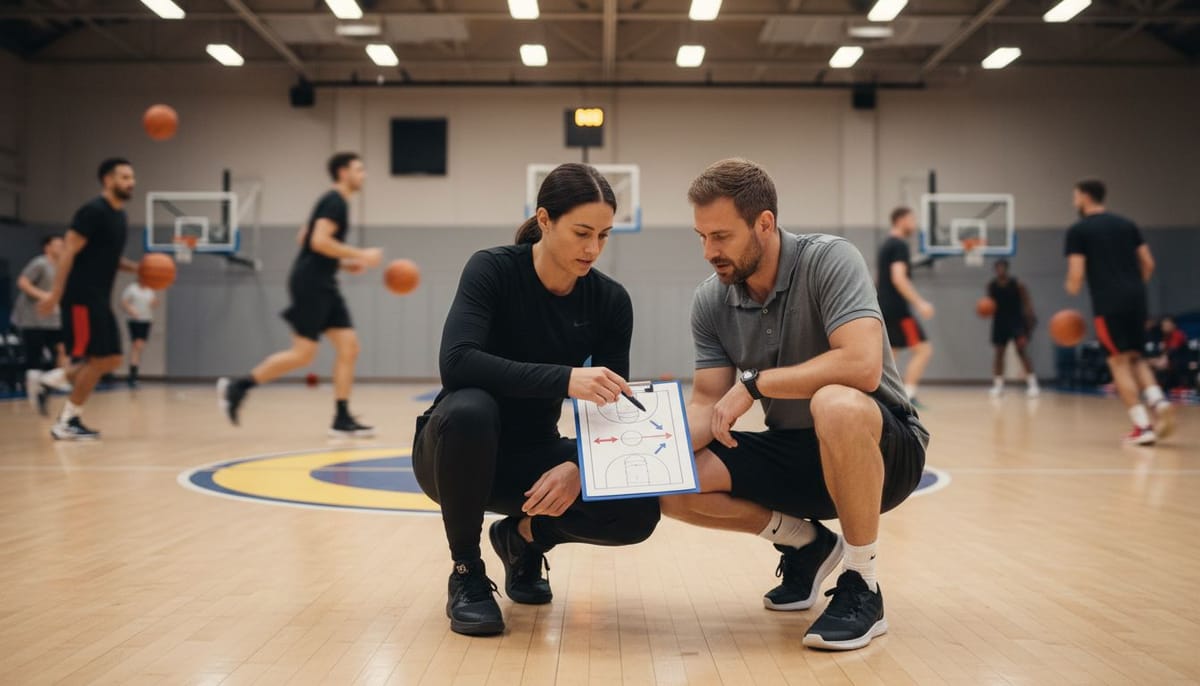
Most coaches have never worked with a skill acquisition specialist. And the ones who have? A surprising number of them started out skeptical, arms crossed, shoulders raised — exactly the posture Tyler Yby describes in this conversation. I've been sitting with this podcast episode for a few days now, and I keep coming back to one central idea: the biggest barrier to better basketball development isn't knowledge. It's ego. Not in a mean way. Just in the very human, very understandable way that happens when someone who has spent twenty years doing things a certain way suddenly has a new voice in the room questioning the design of their drills.
Tyler is a skill acquisition specialist who contributes to the work coming out of Emergence — a group that has been genuinely pushing the boundaries of how we think about coaching and player development. This conversation is a follow-up to an earlier episode with Sean, and it goes deep. Really deep. I want to break down what stood out to me, where I agreed, where I pushed back a little in my own head, and what I think every coach — at any level — can take from this.
The "Empty Cup" Philosophy — And Why It's Harder Than It Sounds
When I heard Tyler open with the Bruce Lee "empty cup" idea, I immediately thought — yes, but how many people actually do this? Like genuinely. Not performatively. We've all been in rooms where someone says "I'm open to feedback" and then spends the next forty minutes defending every decision they've ever made. That's not an empty cup. That's a cup with a lid on it.
What Tyler is describing is something much more honest. He's saying that when a skill acquisition specialist enters an organization, the goal isn't to walk in and declare that everything is broken. It's to come in curious. To ask questions. To sit beside coaches — not above them — and look for small opportunities to make activities "more alive," as he puts it. That phrase stuck with me. More alive. What does a drill look like when it's alive versus when it's dead? I think we all know the difference intuitively, even if we've never articulated it. A dead drill is mechanical, predictable, disconnected from the chaos of a real game. A live one forces the player to read, react, and decide.
This connects directly to something I've been reading a lot about lately — the idea that ecological learning in basketball coaching isn't just about changing your drills, it's about changing your entire philosophy of what learning is. And Tyler is essentially describing how you introduce that philosophy into an organization without blowing the whole thing up on day one.
I think the "empty cup" framing is genuinely powerful — but I'll be honest, I don't fully agree that it's always enough on its own. Some environments are so entrenched that even the most humble, curious, non-threatening approach will hit a wall. Culture matters. Leadership from the top matters. An SAS who has buy-in from the front office has a very different experience than one who was hired as a compromise or a tick-box exercise. That context shapes everything.
What the Role Actually Looks Like Day-to-Day
This is the part of the conversation I found most practically useful. Tyler describes the SAS role as starting, above everything else, with observation. Not workshopping. Not presenting slide decks full of research. Just watching. Quietly documenting. Noting what's working, what the positives are, and — crucially — framing everything else not as weaknesses but as "areas of opportunity." I've seen this play out personally in coaching environments, and the language really does matter. Nobody wants to be told they have weaknesses. But almost everyone can engage with the idea that there's room to explore something differently.
What I love about Tyler's description is how collaborative it is. He's not positioning the SAS as the smartest person in the room. He uses the word "co-pilot" — someone whose voice is heard, who steps in with a question, steps back, nudges, and lets the coach lead. Something like: "Out of curiosity, what's the task intention here?" That's such a low-stakes, non-threatening way to open a conversation. And yet that single question, asked consistently, starts to shift how coaches think about the activities they're designing.
He also mentions film review — watching practice film and game film together with coaches, and starting to pull apart what he calls the "performer-environment relationship." This is where things get really interesting to me. Because most film sessions in basketball are about schemes, reads, rotations — tactical stuff. What Tyler is describing is something different. He's watching film and asking: why did the player move that way? What in the environment caused that response? And then: how do we design the next practice to give them different information to respond to?
That's a fundamentally different lens. And it's one that I think most coaches — even good ones — have never been given. It reminds me of what one coach described after walking away from the NBA to rebuild his understanding of basketball from scratch — sometimes you have to strip everything back before you can see clearly again.
Theory First or Practice First? Tyler's Answer Is More Nuanced Than You'd Expect
The host asks a great question here: do practitioners need to understand the theoretical underpinnings of the constraints-led approach before you can start working with them? Or can you come in through the back door — through observation, informal questions, practical nudges — without ever opening a textbook?
Tyler's answer is genuinely nuanced, and I respect that he doesn't just pick a side. He says it depends entirely on the individual. Some coaches have that empty cup. They're curious, they're open, and with those people you can actually start with a little bit of the "why" — because if they understand the theory, even loosely, they have a foundation to stand on when they start changing how they design sessions. The theory gives the new behavior roots.
But with coaches who are more guarded — who want to lead, who might feel threatened by an unfamiliar framework — Tyler takes a completely different approach. He doesn't lead with theory at all. He just shows up. He asks positive questions. He lets trust build before he ever introduces the language of skill acquisition. And honestly? I think this is the smarter move in most cases.
What strikes me most here is that Tyler is essentially describing a coaching philosophy — applied to coaches. He's reading the environment. He's adjusting his approach based on the constraints in front of him. He's doing, in his interactions with practitioners, exactly what he'd want those practitioners to do with their players. There's something almost poetic about that. And it connects to broader questions about why modern basketball development demands a completely different approach to how we think about teaching the game — not just on the court, but in the conversations we have around it.
The physical side of development matters too. Building players who can actually express skill under pressure requires the kind of basketball athletic performance work — strength, conditioning, and movement training — that has to be designed with the same intentionality Tyler is describing here. You can't separate the body from the environment it's performing in.
Why Athletic Performance Coaches Need to Think More Like Game Designers
When I heard this part of the conversation, I immediately thought — how many strength coaches have I seen run the exact same warmup for an entire season? Every single practice. Same lunges. Same dynamic stretches. Same order. Players going through the motions on autopilot before they've even touched a ball. And nobody questions it.
What Tyler and the guest were unpacking here is genuinely exciting to me. The idea that an athletic performance coach shouldn't just own the weight room — they should be a creative partner in how players move, sense, and interact on the court. That reframe is huge.
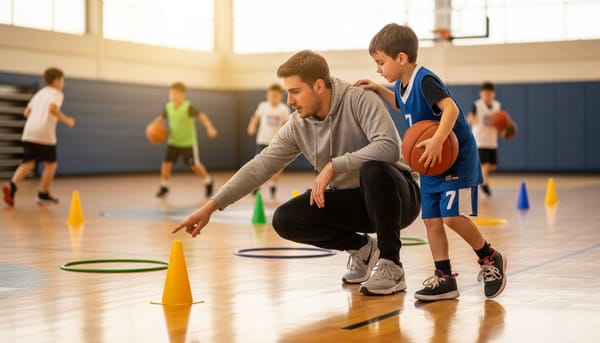
The bucket game example? I love it. Two buckets from a hardware store, a 2v2 or 3v3 invasion game, no basketball required. But players are still reading defenders, adjusting angles, processing interpersonal distances, reacting to relative velocities. They're doing everything their nervous system needs to do in a real game — just in a different costume. And the sport coach doesn't feel like anyone's stepping on their toes because nobody's calling plays or correcting shooting form. It's clean. It's smart.
This is something I think about a lot — the line between athletic development and skill development is way blurrier than most programs treat it. When you watch how an NCAA head coach dismantles the case for cone drills, you start to realize that a lot of traditional athletic training is optimizing for performance in the drill, not performance in the game. The bucket game flips that. The environment looks different but the perceptual demands are almost identical.
And the weight room stuff — that genuinely surprised me. The idea that you can take a rep-without-rep approach to squats and deadlifts by changing stances, shifting loads by two and a half pounds, altering grips, changing tempos — I hadn't thought about resistance training through that lens before. But it makes complete sense. If we're trying to build athletes who can produce force in chaotic, unpredictable positions — and basketball is nothing but chaotic, unpredictable positions — why are we always training them in the most controlled, standardized version of every lift?
The partner resistance work especially grabbed me. Shoulder-to-shoulder, creating battles, pushing against another body. That's not just strength training. That's building the kind of basketball athletic performance that integrates strength, conditioning, and movement training into something that actually mirrors what happens in the paint. It's contact. It's instability. It's real.
The Warmup Isn't Just a Warmup Anymore
The shift from calling it a "warmup" to calling it a "movement prep" — that's not just semantics. That distinction carries a whole philosophy inside it.
A warmup is about temperature. It's about synovial fluid. It's a physiological checklist. Fine. But a movement prep? That's about sensitivity. It's about priming the athlete's perceptual system, not just their muscles. And that reframe changes everything about how you design those first ten minutes of practice.
The lunge example the guest gave is so simple it almost sounds too easy. Instead of lunging down the court the same way every time, just ask players to make each lunge different. Explore. Own it at about fifty percent speed. I've seen this play out personally in different contexts — the moment you give an athlete a constraint that demands variation, they wake up. They're actually thinking. Their eyes come up. They start noticing things.
That's the whole point, isn't it? You're not just warming up the hamstrings. You're warming up the search. You're telling the nervous system — stay alert, something different might happen. And that state of mild alertness, that readiness to adapt, is exactly what you need going into a practice built around live decision-making and emergent situations.
I don't fully agree with the implication that rigid warmup routines are completely without value — there's something to be said for predictable structure giving younger or lower-confidence athletes a sense of safety. But at the higher levels? Yeah. You can do better. The guest's challenge to every performance coach — can you do more, can you do better? — is one I think a lot of people need to hear delivered that bluntly.
What struck me most was the idea that the performance coach's job should include immediately creating interactions between players from the first moment of practice. Not just physical preparation, but social and perceptual preparation. Getting players reading each other, reacting to each other, before a single formal drill starts. That connection between movement prep and developing quicker decision-making under real conditions is something I think most programs completely miss.
The Relational Foundation That Makes Any of This Work
Before all the ecological theory and the bucket games and the varied lunges — there was something said early in this section that I think is actually the most important piece. The guest talked about winning people over first. Building trust before unpacking ideas. Meeting individuals where they are.
That's not a coaching strategy. That's just being a decent human being. And yet it's so easy to skip when you're excited about an idea.
I've seen this play out personally with coaches who come in with genuinely brilliant frameworks and completely alienate their staff or their players within the first week because they led with the theory instead of the relationship. The ideas weren't wrong. The sequencing was. You have to earn the right to challenge someone's mental model before you actually challenge it.
The guest's point — that there's no one-size-fits-all approach to bringing people along, just like there's no one-size-fits-all in ecological coaching — really landed for me. Some people need to feel heard first. Some need to see results first. Some need a quiet conversation after practice. Some respond to a direct question that makes them think. The skill is reading which person you're dealing with.
This is exactly why the relational dimension of coaching is so deeply tied to everything else. You can have the best periodization philosophy in the world, but if your players or your staff don't trust you, none of it lands. And that trust — as the guest described it — comes from genuinely caring, not from performing care. Players and colleagues feel the difference immediately. If you're curious about how that plays out in hiring and professional contexts, the dynamics around building relationships through coaching interviews get into exactly this kind of authentic connection versus surface-level impression management.
What I keep coming back to is this: the ecological approach isn't just a methodology for designing drills. It's almost a philosophy for how you relate to the humans in front of you. You're not imposing a system. You're creating conditions. Whether that's on the court, in the weight room, or in a one-on-one conversation after a tough loss — you're designing an environment where growth can emerge. That's a fundamentally different posture than most coaching culture has traditionally rewarded.
Why "Does It Work?" Is the Wrong Question
Every time someone asks me how you prove this stuff works, I feel a familiar tension. I heard Tyler address this directly in the conversation, and when I heard it, I immediately thought — that's exactly the pushback every forward-thinking coach or performance practitioner eventually runs into. The GM wants a number. The front office wants a clean KPI. And honestly? I get it. But Tyler's response stopped me cold.
How do you know what you're currently doing 100% works?
That's the real question. And it's one most organizations never bother asking themselves. We've gotten so comfortable measuring isolated outputs — a force plate test, a sprint time, a shooting percentage in a sterile drill — that we've confused measurement with understanding. A number going up on a spreadsheet isn't proof. It's comfort. There's a difference.
What Tyler described instead is genuinely more honest. You overlay similar unfolding game situations. You look at whether a player is solving movement problems in new and creative ways. You track qualitative behavioral patterns across similar court interactions — a 2v2 at the elbow, a contested finish, a defensive rotation — and you ask: are they becoming more skillful? Are they adapting? You can even build a simple one-to-five scoring system around it. It's not perfect. He admitted that openly. But neither is anything else. At least this approach is looking at the right things.
What struck me most was the point about stats telling an incomplete story. A player's points might dip while their assists climb. By conventional metrics, that looks like regression. But if they're reading the game better, finding teammates earlier, making smarter decisions under pressure — that's growth. Real growth. The kind that quicker, more contextual decision-making actually produces on a live court. We just need to be willing to see it.
Shared Language Is the Bridge Everything Else Crosses
This section of the conversation is the one I keep coming back to. Not the training methods. Not the KPIs. This.
Tyler made a point that sounds simple on the surface but is actually massive in practice: you don't lead with jargon. You don't walk into a resistant coaching staff and immediately start talking about degeneracy and affordances like you're defending a dissertation. You meet people where they are. You say things like "can we turn up the aliveness a little?" and you let the concept breathe before you attach the terminology to it.
I've seen this play out personally in coaching environments — the second someone feels like they're being lectured or condescended to, the shutters go down. Doesn't matter how right you are. You've lost them. But when you use language that already resonates, that already maps onto something a coach intuitively understands, you create the conditions for genuine curiosity. The question "what does that mean exactly?" is worth a hundred forced explanations.
And the reason shared language matters so much eventually is simple: it's for the players. Tyler said it plainly and I think it deserves repeating. This isn't about the S&C coach's ego or the methodology department's research agenda. It's about giving players the best possible environment to develop. When a strength coach, a skills coach, and a basketball coach are all pulling in different directions with different vocabularies, the player is caught in the middle. When they're aligned — even loosely — everything flows better. Buy-in improves. Communication improves. Design of activities improves.
This connects directly to something I think is undervalued in player development circles: the environment itself is doing the teaching. The ecological approach to basketball coaching isn't just a philosophy for practice — it's a framework that demands integration across every role in an organization. S&C, skills, tactics. They have to speak to each other or the whole thing leaks.
What I also loved here was the point about variable lunges and opening up degrees of freedom. That image stuck with me — a player doing a different lunge variation each rep, discovering positions they'll actually find themselves in during a game, not grinding out the same perfect pattern over and over. It's not boring. Players enjoy it. And more importantly, it actually transfers. That's the whole point of training that respects the full picture of basketball athletic performance — strength, conditioning, and movement training done in a way that honors how the game actually unfolds.
There's also something refreshing about an S&C practitioner being honest about what we can't measure yet. Eye-tracking glasses tell you where attention went visually — but they don't capture what a player heard, what they intended, how their perception shifted in the moment. Technology is improving. The conversation around measurement will get sharper. But right now, talking to the player directly — asking how they're feeling in their movement, how they're reading the floor — is just as legitimate as any wearable metric. Maybe more so.
I don't fully agree with every organization's instinct to demand bulletproof data before committing to an approach like this. I think that instinct, while understandable, often protects the status quo at the expense of real development. The honest answer is: no one can guarantee 100% outcomes. But you can build systems that are coherent, purposeful, and designed around how skill actually emerges — and that's a much stronger foundation than isolated testing that makes front offices feel confident while players stay stuck in the same patterns. That's the shift this conversation is really calling for. And I think it's one worth taking seriously.