If It Matters, You Must Measure It: How Data-Driven Coaching Transforms Player Development
Only five drives with a stride stop. Twenty-nine without. That's the kind of number that stops a conversation cold — and changes how a team practices forever. When I heard that stat come up in this podcast, I immediately thought about how many coaches are out there working incredibly hard, correcting the same mistakes over and over, and still not seeing the improvement they expect. The problem isn't effort. It's that nobody's counting.
This week's episode hit on something I think about a lot — the gap between what coaches feel is happening on the court and what's actually happening. And the host's framing of it was blunt and honest: if it matters, you must measure it. If you don't measure it, it won't matter. Simple as that. But the implications of that idea are enormous, especially for coaches who are trying to build something real at the grassroots level.
Celebrating What Buy-In Actually Looks Like
Before getting into the meat of the episode, the host took a moment to celebrate Frederick High School — both the boys and girls programs — and honestly, I thought that was worth pausing on. What he described wasn't just a successful camp. It was six coaches per program, players all the way down into youth basketball showing up, asking questions, staying engaged. Over fifty players in the gym across two days.
That's not a normal pre-season camp. That's a culture.
What struck me most was how the host framed it — the systems they're running are player development first, offense and defense second. The wins and the state final four appearances are a byproduct of that commitment, not the goal itself. I've seen this play out personally in programs where the moment results become the only measuring stick, development quietly dies. Everyone's playing for the scoreboard instead of growing. Frederick sounds like the opposite of that, and it's worth celebrating exactly for that reason.
It also makes me think about what it takes to get a full staff aligned like that. If you're navigating those early conversations about philosophy and approach, the kind of groundwork covered in getting hired and building relationships as a coach is genuinely relevant — because buy-in starts before the first practice, in how you communicate your vision to the people around you.
Measurement Is Magic — And Here's Why That Framing Matters
The host repeated this line more than once: measurement is magic. And at first, I was ready to push back on that a little — because I've seen data misused in coaching settings. Numbers without context can make a player feel like a statistic instead of a person. But the more I listened, the more I understood what he was actually getting at.
It's not about the data itself. It's about what the data does to player attention.
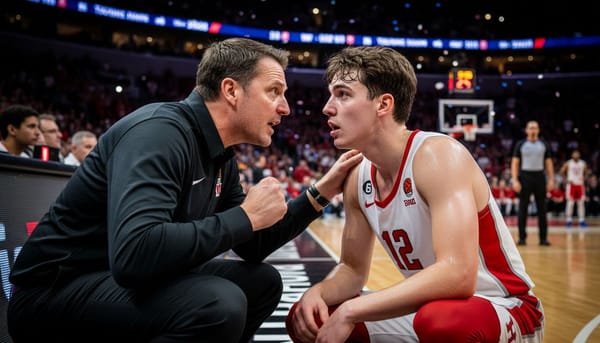
He gave the example of his mentor Mike Neighbors, who has an open-door policy on playing time conversations — but with one condition. If you want to talk about why you're not playing more, you'd better bring data. Because he'll have data. That's a fascinating coaching posture. It removes the emotional charge from those conversations and replaces it with something players can actually act on. It also shifts responsibility. The player can't just say they deserve more minutes. They have to show it.
This connects directly to something I think is underrated in modern coaching discussions: the idea that the most effective coaching tools aren't just about X's and O's — they're about creating systems that make players internally motivated to improve, rather than just responsive to external correction.
And that's the real magic of measurement. When players see their own numbers — when they know that 29 of their 34 drives didn't end in a stride stop — they care. Not because the coach told them to care. Because the evidence is right there in front of them and it's impossible to argue with.
What to Actually Measure: Stride Stops and Shot Quality
So what should coaches be tracking? The host gave two specific, immediately actionable things, and I want to break them down because they're both genuinely smart.
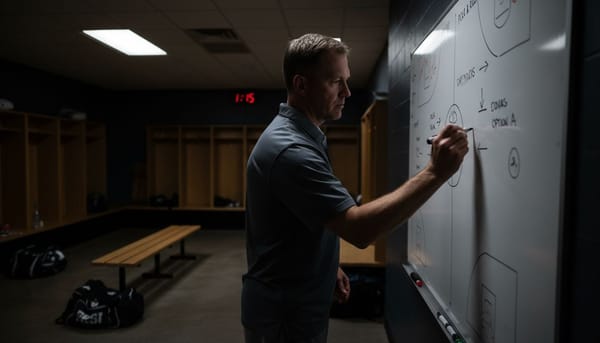
First: stride stops on drives. The idea is straightforward. Every drive — whether it ends in a shot, a pass, or a turnover — gets logged as either a stride stop or not. A simple T-chart. Tally marks. You don't need expensive software. You need one manager with a clipboard paying attention.
The default benchmark he recommends is 70%. You want at least 70% of all drives and hunts to end in some form of stride stop — a stride finish, a stride pass, a stride pivot. If you're below that, you now have a concrete target to chase. And the next time you play, you're not just telling players to stride stop. You're telling them the number went from 5 to 10. That's progress they can see.
What I love about this is that it also aligns offense and defense simultaneously. On offense, you're hunting stride stops. On defense, you're trying to prevent them — forcing early passes, closing out aggressively to disrupt balance. Both sides of the ball are pointed at the same concept from opposite directions. That kind of alignment is rare and really elegant when it works.
This is also why I think the ecological learning approach to basketball coaching resonates so strongly with this kind of methodology — because instead of isolating skills in a vacuum, you're creating measurable constraints that shape how players naturally solve problems in real game situations.
Second: shot quality tracking. Three columns. Nines. Sevens. Fives. Every shot attempt in a game or a practice quarter gets a tally mark in one of those columns. A nine is a high-percentage look you've created or hunted. A seven is a significant advantage off the catch. A five is a contested, off-balance shot that probably shouldn't have been taken.
Assign an assistant or a manager to own this. Run it for one quarter. Then one half. Then a whole game. Once you have a baseline, you can set targets. And once players know their shot selection is being logged in real time, they start making different decisions. Not because you yelled at them about shot selection — but because the data holds them accountable in a way that feels fair and objective.
This is something I don't fully agree with coaches who resist tracking shot quality — the pushback I usually hear is that it's too subjective. But the host's framework actually handles that. Nines aren't about whether the shot went in. They're about the process that created the opportunity. A missed nine is still a good decision. A made five is still a warning sign. That distinction matters enormously, and building better shot selection habits over a season comes down to exactly this kind of consistent, repeatable tracking.
The 70% benchmark applies here too. You want the majority of your shot attempts to be nines and sevens. If fives are dominating your tally sheet, you don't need to guess why your offense is stalling. The numbers tell the story — and more importantly, they tell it to your players in a language that's harder to dismiss than a coach's frustration.
The Numbers Don't Lie — But You Have to Know What to Count
Here's something that stopped me cold when I heard this part of the conversation: most coaches track points, rebounds, and assists. Standard stuff. But this coach is tracking something far more specific — the quality of the decision that led to the shot, not just whether the shot went in. And honestly? That reframing changed how I think about game data entirely.
The system he's describing assigns values to different types of shot opportunities. Nines are the best — a drive where you finish in stride. Sevens are good, a shot off a closeout. Fives are okay but not what you want to be hunting. And the target is getting 70% of your shot attempts to come from nines and sevens combined. When I heard this, I immediately thought — how many teams are even close to that? Most youth and high school teams are probably shooting way more fives than they realize.
What I find genuinely fascinating is how the offense and defense are measured against the same thing. The offense wants nines and sevens. The defense wants to force fives. So when you track this number, you're essentially running a real-time audit of how your two systems are performing against each other. That's elegant. It's not just scoreboard stuff — it's a diagnostic tool embedded into every possession.
The example he gave from one game really grounded it for me. Varsity girls: one nine, twelve sevens, thirteen fives. Roughly 50/50. His takeaway wasn't panic — it was precise. They weren't hunting nines aggressively enough. That's a coaching cue, not just a stat. And I think that distinction matters a lot when you're thinking about the full range of coaching tools available to measure and improve your team throughout a season.
I've seen this play out personally — when you give coaches vague feedback, nothing changes. But when you show them a number tied to a specific behavior? That's when adjustment actually happens.
Measurement Isn't Just Data — It Aligns Everything
The third metric he introduced is one I hadn't considered before: what percentage of possessions does the defense force the ball to the left sideline? The target is 70% again. And this is where I think the whole philosophy really clicks into place.
It's not just about tracking outcomes. It's about choosing to measure something because that act of measuring forces attention to it — from both sides of the ball. The defense works to prevent the ball from crossing to the right. The offense works to cross the street. And the battle between those two intentions is what sharpens your team's habits over time. The outcome isn't necessarily hitting 70%. The outcome is that you've built a process. That's the win.
When I heard this, I immediately thought about how much energy coaches spend designing offensive structure through set plays — but almost no one is designing their measurement system with this kind of intentionality. And the irony is that what you choose to measure ends up shaping how your players think on the floor more than any play ever could.
This is something I think about a lot. Coaches often say "we want to play fast" or "we want to play disciplined" — but without a measurable proxy for those things, it stays abstract. Players can't self-correct against a vibe. They can self-correct against a number. That's the whole point.
I don't fully agree that percentages alone drive improvement — you still need context, film, and honest conversations. But as a feedback loop to align your offensive and defensive philosophy? This is one of the more practical frameworks I've come across. It also connects to a broader idea around helping players make quicker decisions — because when they understand what the team is hunting, decision-making becomes instinctive rather than reactive.
Using a Player's Name Is the Smallest Thing With the Biggest Return
Okay. This section of the conversation hit differently. Not because it's complicated — it's the opposite of complicated. It might be the simplest coaching tool ever discussed. But the story he told about the distracted high school player? That one stuck with me.
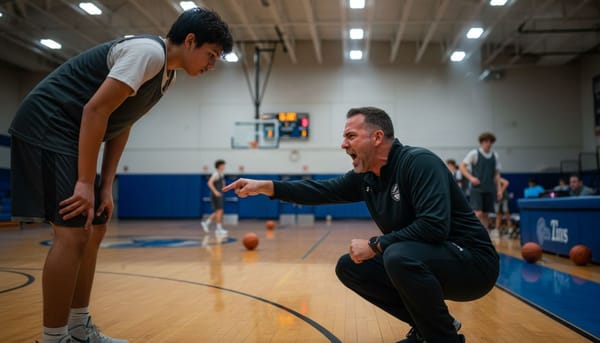
This kid was a distraction. Unfocused, joking around, pulling attention away from the group. And the coach didn't bench him. Didn't call him out harshly. Just kept using his name. Over and over. Asked him questions. Leaned on him. Treated him like a leader before he was acting like one. And by the end of two days, the kid was locking in the whole group. That's remarkable.
What struck me most was the honesty here — the coach admitted that the only reason he learns names quickly is because he usually only has one day, sometimes ten minutes, to build enough trust to coach someone hard. That's a real constraint. And his solution is so human it almost feels too simple to be true. But it works. Dale Carnegie said it decades ago: the sweetest sound in any language is a person's own name. Turns out that holds up in a gym just as well as anywhere else.
I've seen coaches lose players not because of bad X's and O's but because of a failure to connect. And connection starts absurdly early — like, in the first five minutes of meeting someone. Using someone's name is a signal that they matter to you as a person, not just as a piece of your rotation. That changes the entire dynamic of how players respond to correction and accountability over the course of a season.
The challenge he leaves coaches with is simple: use a player's name before every direction or correction for one week. No fancy system required. No film breakdown. Just — say their name first. And I genuinely think most coaches would be surprised at the response they get. It's one of those things that sounds obvious until you actually try it consistently, and then it feels like you've unlocked something you didn't know was locked.
Catch Reads, Defaults, and Why Most Players Don't Know Their Own Job
Something hit me hard in this final section of the conversation. The idea that every player on your team should have a default. Not a rigid rule, not a restriction — a default. What you do first unless the game tells you otherwise. And when I heard this, I immediately thought about how rarely I've seen that explicitly taught. Most players just... react. And because no one ever told them what their baseline behavior should be, they're making it up in real time.
The breakdown between nine-read players, seven-read players, and advantage players completely reframes how you think about roles. Giannis at the three-point line with space — his default isn't to shoot. It's to use that runway. That's not a limitation, that's clarity. That's a player who knows exactly what he does best and defaults to it without hesitation. How many players at any level can say the same thing?
The catch read framework is the part I keep coming back to. The goal of 70% catches being passes or shots rather than dribbles — that's a real, measurable standard. It forces you to confront something uncomfortable: most teams think they're spacing and moving the ball, but when you actually chart it, catch-dribble-catch-dribble is the norm. The offense looks like a passing offense on the whiteboard and a dribbling offense on the floor. That gap between intention and execution is where games are lost.
I've seen this play out personally watching youth teams where every catch turns into a two-dribble reset before anything happens. By the time the ball moves, the advantage is gone. The defense has recovered. And the coach is yelling "move the ball!" not realizing the problem isn't willingness — it's that nobody was ever taught what their default read on a catch actually is. If you're serious about helping your players make quicker decisions in basketball, this default framework is one of the most practical places to start.
Crossing the Street, Barkleys, and the Unlock Relationship
The "crossing the street" concept is deceptively simple. Get the ball from one side of the floor to the other. 70% of the time. That's it. But the reason it matters is buried in the detail — when a team scores or the ball comes in from out of bounds, the defense is set. You're not beating a set defense by attacking straight up the street. You're just running into a wall.
What struck me most was how this connects to the racker's positioning. Getting to the sideline isn't just habit — it's the mechanism that makes everything else possible. The racker on the sideline puts the defense on one side of the floor, which creates the opportunity to shift them and attack behind. Remove that positioning and the whole structure collapses. It's the kind of thing that looks like a small detail until you trace the chain of consequences and realize it's actually foundational. This is something I think about a lot when watching transition offense — teams that struggle to dominate opponents on fast breaks are almost always losing the battle in these early positioning decisions before the real action even starts.
The Barkley question was interesting too. A second-chance hunt. Not a bailout, not a reset — a continuation. The language of "level one" and "level two" protection plans gives players a hierarchy they can actually follow under pressure. And the locked/unlocked relationship between the ball and every other spot on the floor? That's the piece that ties all of it together. Players aren't just waiting. They're in a constant state of reading whether the ball has unlocked them yet.
This whole framework is part of a much bigger conversation around how modern coaching is evolving — and if you want to go deeper on the tools and methods behind all of this, the complete guide to coaching tools covers a lot of this territory in a way that's genuinely useful for coaches at every level.
What I'm walking away from this with is something pretty simple but genuinely clarifying: structure isn't the opposite of freedom. It's what makes freedom possible. When every player knows their default, knows their read level, knows whether they're locked or unlocked — they're not restricted. They're liberated. They stop guessing. And when players stop guessing, basketball actually starts to look like basketball. That's the whole point, isn't it?