Youth Coaching — The Complete Guide to Developing Players Who Actually Stay in the Game
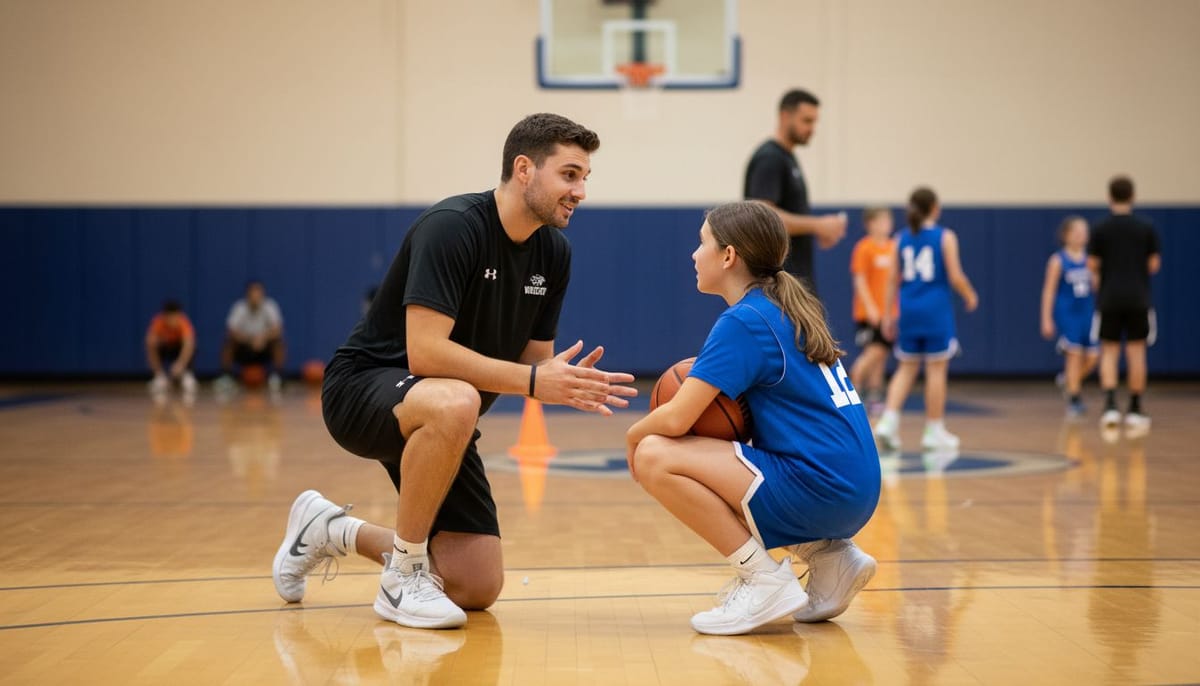
Nearly 70% of kids quit organized sports by age 13. I've sat with that number a lot. It's not a trivia stat — it's an indictment of how most youth coaching is currently done. Kids aren't leaving because the game got hard. They're leaving because the experience stopped being worth showing up for. That's a coaching problem. An environment problem. Sometimes a philosophy problem.
I've spent a lot of time around gyms, around coaches at every level, and around conversations that get into the real mechanics of what makes youth programs work — or fall apart quietly while everyone pretends the numbers are fine. This guide pulls together everything I've learned, observed, and genuinely believe about youth coaching. Not theory for theory's sake. Real decisions, real tradeoffs, real stakes. Whether you're coaching third graders in a rec league or running an academy pathway program, I think there's something here worth sitting with.
What Youth Coaching Actually Is — and What Most People Get Wrong About It
When most people hear "youth coaching," they picture someone standing on a sideline drawing up plays. And sure, that's part of it. But when I think about this honestly, youth coaching is really about environment design. You're not just teaching skills. You're shaping whether a kid decides sport is something that belongs to them.
The coaches who get this right aren't necessarily the ones with the deepest tactical knowledge. They're the ones who understand that a ten-year-old standing at half court, bored and invisible, is making a decision about whether they'll still be playing at fourteen. Every rep, every practice format, every way you speak to a kid is nudging that decision in one direction or another.
What stands out to me is how often youth programs are built around adult priorities — winning leagues, satisfying parents, demonstrating "development" through visible metrics — rather than around what actually keeps kids engaged and growing. The mission should be simpler and harder than most programs admit: create an environment so good that kids want to come back. Everything else flows from that.
That means youth coaching spans far more than technique. It includes:
- Session design — how you structure time so players are active, engaged, and learning through doing
- Communication style — how you speak to young athletes in ways that build confidence rather than compliance
- Program architecture — how you distinguish between recreational and performance goals and serve each properly
- Coach development — how you grow the adults in the room, not just the kids
- Culture building — how you create belonging that outlasts any single season
None of this is soft or secondary. This is the job.
The Retention Crisis — Why Kids Leave and What Coaches Can Actually Do About It
The 70% dropout rate by age 13 isn't an accident. It's a predictable outcome of how most youth programs are structured. I don't fully agree with the idea that kids leave simply because they find other interests — that's the comfortable explanation. The more honest one is that the sport experience stops being worth it before they're old enough to articulate why.
I've seen this play out personally. A kid who was electric at age eight — always early, always the last one to leave — who by eleven is going through the motions and by thirteen has quietly disappeared. Nobody called it a crisis. The roster just got smaller.
When I look at what actually drives kids out, a few patterns come up consistently.
First, there's the "basketball lecture" problem. Running kids through three months of structured drills, barely letting them play, and calling it development isn't a basketball experience — it's a basketball class. And classes get dropped when something more interesting comes along. When players don't feel the joy of actual competition woven throughout the process, the whole thing starts feeling like homework.
Second, there's the ownership problem. When kids feel like participants in something built for them, retention goes up. When they feel like they're just filling spots in someone else's program, they drift. This isn't abstract — it shows up in whether kids get a say in anything, whether they feel seen by their coach, whether the team has rituals and culture that actually belong to them.
Third, there's the environment-parent disconnect. When parents aren't emotionally connected to the program — when they're just dropping kids off like it's another extracurricular box to check — there's no community reinforcing the value of showing up. Kids absorb parental indifference quickly.
What coaches can actually do:
- Build real play into every session, not just at the end as a reward
- Create program rituals — pregame routines, inside language, team traditions — that give players something to belong to
- Involve parents meaningfully, not just as spectators — one idea I love is having players actually run parents through a version of practice so families understand what development looks like from the inside
- Measure success by who's still showing up in March, not just by win-loss records in October
Retention isn't a marketing problem. It's a coaching problem. And it's solvable.
Separating Recreational and Performance Programs — Why This Distinction Changes Everything
One of the most clarifying things I've come across in thinking about youth program design is this: recreational programs and performance programs are not the same thing, and treating them as if they are is how you fail both groups simultaneously.
This seems obvious when you say it out loud. But walk into most youth basketball organizations and you'll find a single coaching philosophy being applied to kids who want to play for fun and kids who are genuinely chasing a competitive pathway. The result is that the recreational kids feel overwhelmed and eventually drop out, while the performance-track kids feel under-challenged and plateau.
A recreational program's north star is retention, enjoyment, and belonging. Success looks like kids who finish a season and immediately want to sign up for the next one. It looks like a ten-year-old who wasn't sure they liked basketball deciding, after twelve weeks, that they kind of do. The KPIs are social and emotional as much as they are athletic.
A performance or academy program's north star is deliberate development with a real pathway. Success here involves higher training volume, more focused feedback, and a clear connection to what comes next — whether that's a higher-level team, a university program, or professional opportunity. These players need to be trained differently, not just more.
I've seen coaches confuse intensity with quality. They apply performance-level pressure to recreational groups and wonder why kids quit. Or they bring recreational-level casualness to performance groups and wonder why players don't progress. The fix isn't complicated — it's being honest about what each group actually needs and building the program around that, not around what's easiest to administer.
Practical steps for any program trying to make this distinction real:
- Write down the actual goals of each group — not in vague terms, but specifically: what does a successful season look like for a rec player versus an academy player?
- Assign coaches to groups based on alignment with those goals, not just availability
- Communicate clearly to families which program their child is in and why — no ambiguity about expectations on either side
- Create a genuine, transparent pathway between recreational and performance tracks so there's no ceiling on a kid who develops faster than expected
Getting this separation right is foundational. Everything built on top of it — curriculum, scheduling, coaching style — works better when the underlying goals are honest and distinct.
Why the Constraints-Led Approach Changes Everything at the Youth Level
When I think about this, I immediately come back to something Will Twigg said about his own coaching — that he walked into the constraints-led approach (CLA) thinking he already understood it. His word for that mindset was arrogant. And I think that kind of honesty is rare enough that it deserves to be taken seriously.
The constraints-led approach is not just a fancy term for small-sided games. That distinction matters enormously. Small-sided games reduce the number of players on the floor. CLA does something different — it deliberately shapes the environment so that the decision the coach wants players to discover emerges naturally from the situation itself. You're not telling them what to do. You're building conditions where doing the right thing becomes the most available option.
For youth players specifically, this is powerful because it respects how young people actually learn. Kids don't absorb information through lectures. They absorb it through exploration, repetition, and feedback that comes from the game itself rather than from a whistle and a clipboard.
What stood out to me about Will's experience at the London Lions Academy is that the initial phase of CLA felt broken. Sessions looked messier. Players seemed confused. And as a coach, that discomfort is genuinely hard to sit with — especially when parents are watching from the bleachers expecting crisp drills and visible structure.
But that discomfort is where the learning actually lives. Not just for the players. For the coach too.
- Design problems, not instructions. Instead of telling a player where to stand, create a drill where standing in that spot is the only logical choice.
- Let confusion breathe. Resist the urge to fix every mistake immediately. Some errors are the learning.
- Separate small-sided games from CLA in your thinking. One reduces numbers. The other shapes decisions. Know which you're using and why.
The Spacing Problem No One Wants to Admit
Here's a tension that every youth coach eventually runs into, whether they articulate it or not: the game demands spacing that young players physically cannot execute yet. A third grader standing at the three-point line, where a system tells them to stand, cannot make the shot that justifies being there. So why are they there?
I don't fully agree with coaches who dismiss this concern by simply saying "teach the system and let development catch up." That's real, but it's incomplete. The reason spacing still matters at young ages isn't about shooting range. It's about teaching players to read and use space as a concept — so that when the athleticism and skill do arrive, the spatial intelligence is already wired in.
The question a youth coach asked in a mailbag discussion I came across framed this perfectly. They understood spacing as a concept. They'd tried to apply it. They just couldn't reconcile what the system asked for with what their eight-year-olds could physically produce. That's a legitimate coaching problem, and it deserves a real answer — not a dismissal.
The real answer, as I understand it, is that you teach the principle of spacing — give the ball handler room, don't crowd the action, move to open areas — without rigidly enforcing a spot on the floor. The principle travels with a player for life. The spot is just a placeholder for a level of development they haven't reached yet.
- Teach spatial concepts, not coordinates. "Give space" is a principle. "Stand on the wing" is a placeholder. Lead with the principle.
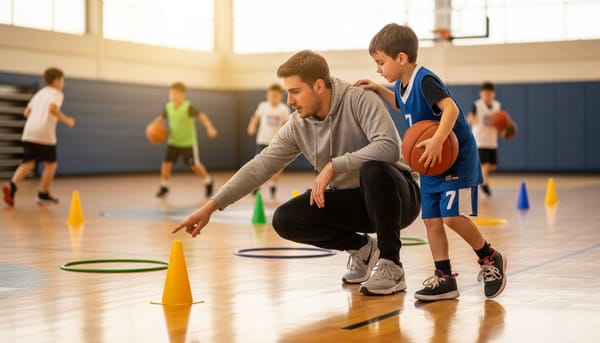
- Use visual anchors. Cones, tape, colored spots on the floor can guide positioning without requiring a coach to keep correcting verbally.
- Validate smart questions. When a player or coach asks why something isn't working, that's prior effort speaking. Treat it as progress.
Energy, Communication, and the Invisible Curriculum of Youth Practice
There's a version of youth coaching that focuses entirely on skill development — dribbling, pivoting, defensive footwork — and treats everything else as secondary. I've watched it. It doesn't work the way coaches think it does.
What Tyler and Mark described in their conversation about youth basketball development reframed something I thought I already understood. Energy isn't a mood you bring to practice. It's a teaching tool. When a coach channels their own energy deliberately, they're modeling for young players how to channel theirs. Kids arrive at practice with boundless, scattered energy. The question isn't how to calm it down. It's how to direct it toward the game.
That reframe hit me because I've seen so many youth practices where the coach is essentially in a battle against the kids' energy. Fighting for attention, fighting for focus, fighting for quiet. It's exhausting for everyone, and almost nothing gets absorbed in that environment. The coach who leans into that energy — who makes the practice feel genuinely alive and worth being inside — doesn't fight for attention. They already have it.
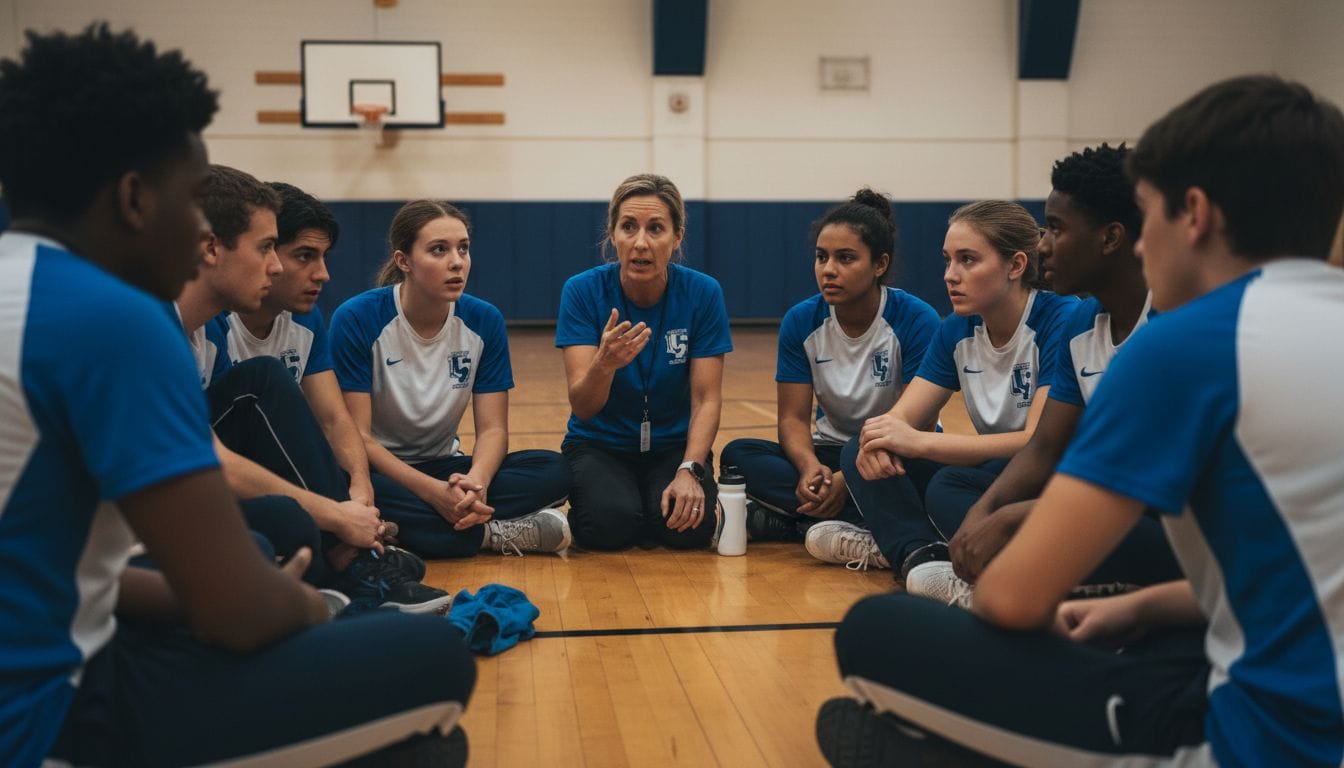
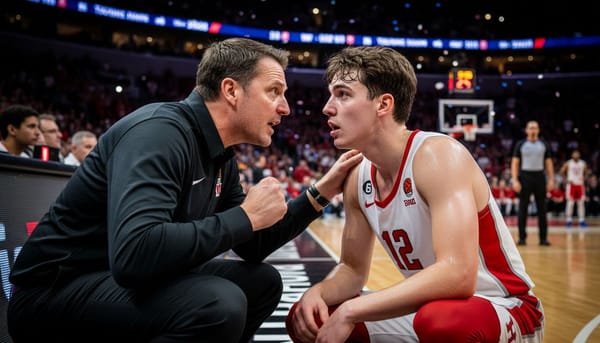
Communication sits right underneath this. Teaching players to talk on the court — calling screens, encouraging teammates, verbalizing defensive coverage — is something most youth coaches skip entirely in a rush to get to the "real" skills. But talking on the court is a real skill. It's one of the hardest ones to develop because it requires a player to process, act, and articulate simultaneously.
This is what I'd call the invisible curriculum of youth practice. It doesn't show up in a session plan. But it shapes the player more than any drill will.
- Match your energy to what you want from the room. If you want players locked in, model that focus yourself — don't just demand it.
- Build communication into drills explicitly. Require a verbal call before or after every action. Make silence the mistake, not just the wrong move.
- Treat culture as a skill. Team identity, inside rituals, shared language — these aren't soft extras. They're the glue that keeps players coming back.
Why Most Coaches Are Fighting Player Energy Instead of Using It
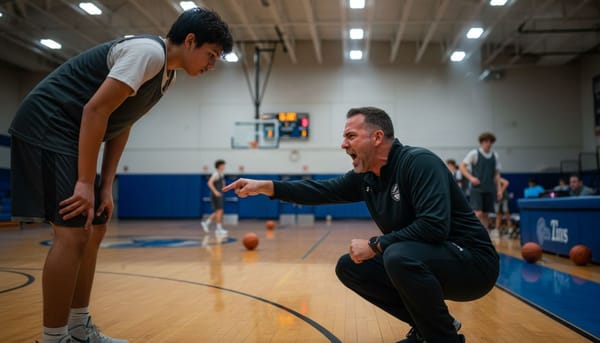
This is something I think about a lot. Walk into almost any youth practice and you'll see the same dynamic: a coach trying to impose order on a room full of kids who are vibrating with energy, and treating that energy like the enemy. The clipboard comes out. The whistle blows. Everyone sits in a line. And for about forty-five seconds, it works.
What Tyler from SAVI articulated — and what I think gets missed constantly — is that energy isn't the obstacle. Energy is the first teaching tool you have. The real skill isn't suppressing it. It's channeling it toward the game itself.
When I heard him say "college professor energy does not work for youth basketball," I laughed. Because I've watched coaches deliver fifteen-minute chalk talks to nine-year-olds who are bouncing on their heels, visibly not absorbing a single word. Then the coach complains the kids aren't retaining information. Of course they're not. You gave them a lecture when they needed a game.
High energy from the coach isn't about being performative or exhausting yourself. It's about matching the frequency of the players in front of you — and then, from inside that frequency, redirecting toward focus, effort, and communication. Those three things teach themselves when the environment is right.
The practical takeaway here is simple but easy to ignore: design the practice so the energy has somewhere useful to go from the first minute. Not from minute fifteen, after you've finished explaining. Minute one. If the kids are moving, competing, laughing, and talking to each other, you've already won the first battle.
Communication is part of this too. Calling screens. Talking on defense. Encouraging a teammate after a turnover. Most coaches skip straight to dribbling mechanics. But teaching players how to speak the language of the game — out loud, in real time — is a foundational skill that compounds for years.
The Mistake of Treating Every Player Like They Have the Same Goal
One of the clearest structural mistakes I've seen in youth programs — and the conversation about Jon Yu's work in Vietnam made this explicit — is treating a recreational player and an academy-track player as if they want the same thing from the experience. They don't. And building a program that ignores this distinction is how you fail both groups simultaneously.
I don't fully agree with the idea that you can run one unified philosophy across every tier of a youth organization and have it land equally well. The kids who are there because their parents signed them up for an extracurricular activity need belonging, joy, and enough positive repetition to want to come back next week. The kids chasing a development pathway need challenge, honest feedback, and a real competitive standard to push against. These are genuinely different environments.
When you blur that line — when you run the recreational group with academy-level intensity, or when you coddle the academy group to keep everyone feeling good — you lose both. The competitive kids get bored. The recreational kids get discouraged. Retention collapses across the board.
What struck me most about the Vietnam situation was how stark this became at scale. Four hundred kids in a recreational program, and a smaller elite feeder group connected to a professional organization. Same umbrella. Completely different KPIs. The recreational program needs to measure joy and return rate. The academy needs to measure player progression against real benchmarks.
The actionable move is to define what success looks like for each group before you design anything else. If your recreational program's north star is retention, every practice decision flows from that. If your academy's north star is player development against a competitive standard, the decisions look entirely different. Conflating the two is where well-intentioned programs quietly go wrong.
Constraints-Led Coaching: What It Actually Means and Where Coaches Get It Wrong
Most coaches who've heard of constraints-led approach think it just means small-sided games. It doesn't. That's the surface version — and Will Twigg's honest account of his work with the London Lions U14 group clarified the actual distinction for me in a way I hadn't fully processed before.
Small-sided games reduce numbers to create more touches and decisions. Constraints-led coaching goes further: it deliberately shapes the environment — the rules, the space, the task — so that the desired behavior emerges from the player rather than being instructed into them. The coach isn't standing there telling a player to drive left. The coach sets up a game where driving left becomes the logical, rewarding choice. The learning is embedded in the problem.
This is where I've seen coaches stumble, including ones who genuinely believe they're using CLA. They set up a constraint, the player finds an unintended workaround, and the coach immediately stops play to correct it. That impulse to fix — instantly, verbally — short-circuits the whole process. The discomfort of watching a player struggle through the wrong solution is exactly where the learning lives.
Will's admission that he went into this work with arrogance — his word — and had to sit in a period of genuine confusion before things clicked, is more instructive than any technical breakdown of the method. The coach's tolerance for messiness is the variable that determines whether CLA actually works. If you can't watch imperfect repetitions without intervening, you're not running a constraints-led environment. You're just running drills with smaller teams.
The practical discipline is this: identify the behavior you want, design the game condition that makes that behavior the path of least resistance, then step back and observe before you speak.
The Small Moments That Actually Stick
This is something I think about a lot — and I'll admit it took me longer than it should have to fully understand it. We spend enormous energy on the big stuff. Tournament brackets. Skill progressions. Season-end showcases. And those things matter. But when I look back at the players who genuinely flourished in programs I've been around, it's almost never the championship that they carry with them. It's something smaller. Stranger. More personal.
One coach I came across described a parent practice — where the players actually ran their parents through a version of their own training session. I love this idea. It flips the dynamic entirely. The kids become the teachers. Parents stop being passive spectators and start actually feeling what a defensive slide drill demands from a ten-year-old. That understanding changes the car ride home. It changes what gets said at the dinner table. And that ripple effect is real.
What this tells me is that the environment a coach builds matters far beyond the ninety minutes of practice. The inside joke that develops over a season. The pregame ritual the players invented themselves. The road trip where everything went slightly sideways and everyone handled it together. These are the things that forge identity — both team identity and personal identity.
I don't fully agree with the idea that coaches can manufacture these moments deliberately. You can't script belonging. What you can do is create the conditions where these things are allowed to happen. That means loosening your grip on control enough to let the team breathe. It means giving players ownership over certain rituals or routines. It means not treating every unstructured moment as wasted time.
- Build in unscripted space. Not every minute of practice needs to be coach-directed. Let players make decisions. Let culture emerge naturally from that.
- Involve parents experientially, not just informationally. A newsletter explaining your philosophy does far less than putting parents on the court and making them feel the work firsthand.
- Name the small things. When a weird pregame ritual starts to develop, don't suppress it — acknowledge it. Lean into it. Those anchors are what players remember fifteen years later.
- Resist the trophy narrative. Winning matters, and I'm not going to pretend otherwise. But framing every season around the outcome of the final game sets up most of your players for disappointment. The experience is the point.
The coaches who seem to understand this most deeply are the ones who talk about their players with genuine warmth years after they've moved on. There's a texture to those relationships that goes beyond drills. Something got transferred that wasn't on the practice plan — and it started with the coach deciding, intentionally or not, that the experience of belonging to this team was worth protecting.
Retention Is the Metric That Tells You Everything
Nearly 70% of kids quit organized sports by age 13. I've referenced this number a few times throughout this guide, and I keep coming back to it because I think it functions as a diagnostic. If you want to know whether a youth program is actually working — not just producing the occasional standout player, but working for the kids who make up the majority of your roster — look at whether they come back.
What strikes me about that 70% figure is that it doesn't represent kids who stopped loving sport. Most of them still love the game. They quit because the experience stopped feeling worth it. The environment was joyless, or authoritarian, or simply indifferent to who they were as people. And nobody noticed they were drifting until they were already gone.
I've seen this play out in programs where the coaching staff was technically competent — good drills, solid systems, appropriate progressions — but completely unaware of how individual players were experiencing the environment emotionally. A kid who feels invisible on a roster of twenty doesn't announce their disengagement. They just stop showing up to optional sessions. Then they miss a few mandatory ones. Then their parent sends an email. And the program loses a player it never fully had.
Retention doesn't require perfection. It requires paying attention.
- Track individual engagement, not just attendance. A kid physically present but emotionally checked out is already on their way out the door. Learn to read that early.
- Ask players directly — and privately — how they're feeling about the program. Not in a group setting where social dynamics suppress honest answers. One-on-one. Genuine curiosity. No defense.
- Differentiate clearly between your recreational and competitive cohorts. Retention in a rec program requires entirely different conditions than retention in an elite academy. Conflating the two is how you lose players on both ends.
- Celebrate the act of returning. When a kid comes back for a second season, acknowledge it. That decision — to keep showing up — deserves recognition. It means the experience was worth repeating.
- Build community around the program, not just inside it. When families feel connected to each other and to the club, retention climbs. Parents who feel ownership don't quietly pull their kids out. They advocate for the program instead.
The best youth programs I've studied don't measure their success by how many players made it to the next level. They measure it by how many kids are still playing at 16, at 18, at 25 — in any form, at any level, just still in the game. That's the real output. Joy that lasts. A relationship with movement and competition that extends far beyond any single season or any single coach.
When I think about what it actually means to build something meaningful in youth sport, this is where I always land. Retention is the vote of confidence that players cast with their continued presence. Every time a kid chooses to come back, they're telling you something important. The job is to keep earning that.
Where This All Lands
Youth coaching is not a simplified version of elite coaching. It is its own discipline — demanding, nuanced, and grounded in a completely different set of priorities. The through-line connecting everything in this guide is this: the best youth coaches put the child's experience at the center of every decision they make.
That means designing practices where kids actually play, not just drill. It means developing yourself as a coach with the same rigor you apply to developing your players. It means understanding that a ten-year-old experiencing genuine joy in a gymnasium is not a consolation prize on the way to producing an elite athlete — it is the outcome, full stop.
Start with one thing. Adjust your practice structure to include more game-like activity. Have a real conversation with a player you've been overlooking. Ask your parents to step onto the court instead of watching from the bleachers. Build the ritual. Name the culture. Earn the return.
The kids who move — as one of the coaches I came across put it — can move the world. Your job is to make sure they don't quit before they get the chance.