What Basketball Coaches Can Learn from Soccer’s Evolution

Here's something that'll make you do a double-take: some of the best basketball insights aren't coming from basketball people at all.
They're coming from soccer coaches.
And before you close this tab and go back to watching film, hear me out. Because what's happening on the pitch in Europe right now is about to blow up everything you think you know about developing basketball players. I'm talking about a fundamental shift in how we think about the game itself — not just X's and O's, but the entire philosophy of what makes players actually get better.
The cross-pollination between sports has never been more critical. Soccer's been ahead of the curve on player development for decades, and it's time basketball caught up. What you're about to read might challenge everything you've been taught. It should. That's the point.
The Outsider's Advantage: Why Not Being a Basketball Coach Makes You See Clearer
There's this fascinating phenomenon in sports psychology called "beginner's mind." Fresh eyes. No preconceptions.
When someone watches basketball without the baggage of years of coaching doctrine, they see things differently. They're not trapped in the "we've always done it this way" mentality that plagues so many programs from youth leagues all the way up to college ball.
Think about it.
How many times have you run the same drills your high school coach ran with you twenty years ago? How many times have you designed practice around what feels comfortable rather than what actually translates to game situations? This happens everywhere, and it's killing player development.
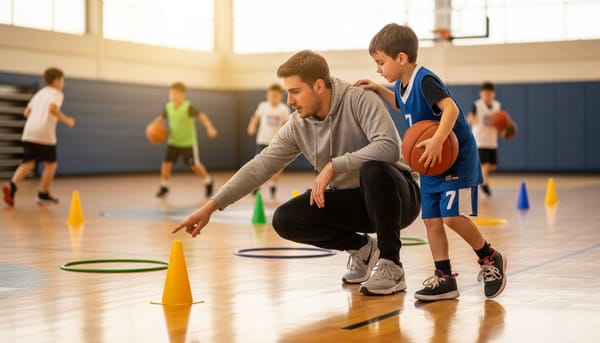
Soccer coaches don't have that basketball baggage. They watch the game and immediately spot inefficiencies that basketball lifers have become blind to. They see players standing still while one guy dribbles. They see cone drills that have zero game application. They see rigid systems that punish creativity instead of nurturing it.
And they ask the most dangerous question in coaching: "Why?"
The Constant Motion Revolution: What Soccer Gets That Basketball Doesn't
Walk into any elite soccer training session in Spain, Germany, or the Netherlands. What do you see?
Constant. Movement.
Nobody's standing in lines. Nobody's waiting for their turn while twenty-three other kids watch. Everyone's engaged, everyone's thinking, everyone's making decisions under pressure. It's organized chaos that mirrors exactly what happens in an actual match.
Now walk into your average basketball practice.
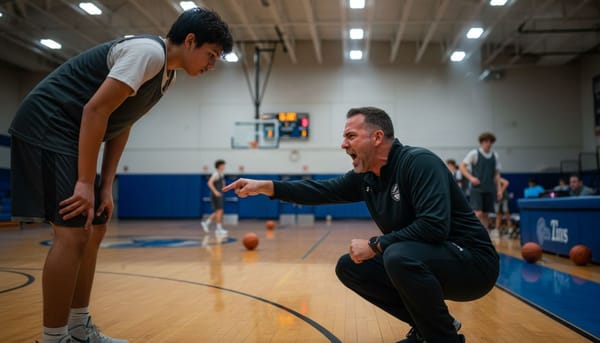
Lines. Lots of lines. Players waiting. One-at-a-time layup drills where you get maybe five reps in ten minutes. Static shooting drills where nobody's moving their feet the way they would in a game. It's the complete opposite of what happens when the scoreboard's running and the game's on the line.
Soccer's training methodology has evolved around a simple truth: you can't separate technique from decision-making. You can't practice skills in a vacuum and expect them to transfer when there's defensive pressure, fatigue, and split-second choices to make.
Basketball's still catching up to this reality. Sure, the NBA's figured it out — watch any elite team's practice footage and you'll see constant movement, live defenders, and game-realistic scenarios. But travel down to the youth and high school levels? We're still running drills that would've been outdated in 1985.
The Beautiful Game's Secret Weapon: Constraint-Led Training
Here's where it gets really interesting.
Soccer coaches have embraced something called constraint-led training. Instead of teaching perfect form and expecting players to execute it robotically, they design games and exercises with specific constraints that naturally guide players toward solutions.
Want players to pass more? Make the playing area smaller. Want them to dribble less? Give them only two touches. Want better spacing? Add a rule that you can't pass to someone within ten feet of you.
The constraints create the learning. The game becomes the teacher.
Basketball? We're still stopping practice every thirty seconds to correct form and give lengthy explanations. We're still running punishment-based systems where mistakes mean suicides instead of learning opportunities. We're teaching basketball like it's a memorization test instead of a creative, reactive, beautiful game of reads and responses.
And we wonder why our players look lost when the play breaks down.
The Counter-Press Revolution: Basketball's Borrowed Brilliance
Here's where it gets really interesting.
Counter-pressing. Gegen-pressing if you want to get technical about it. It's a soccer concept that's absolutely exploding in basketball circles right now, and honestly? It's about time we borrowed this idea.
The principle is devastatingly simple: the moment you lose possession, you attack the ball immediately. You don't retreat. You don't set up your half-court defense. You strike like a viper right where you lost it.
Why does this work so well? Because that split second after a turnover is when the offense is most vulnerable. They're not organized yet. Their ball-handler isn't ready. Their spacing is compromised. You've got numbers right there at the point of attack.
Think about it—when does a team score easiest? In transition, obviously. And what's the best way to stop transition? Prevent it from ever starting. Kill it in the crib. Recover the ball before they can even think about pushing it.
This isn't just wild scrambling, though. It requires discipline, communication, and players who understand positioning. You need guys who can read the game quickly enough to know when to trap, when to show, when to rotate. Decision making under pressure becomes absolutely critical in these chaotic moments.
The beauty of counter-pressing is that it completely flips the script on conventional transition defense. Most teams accept that they're going to give up some easy buckets in transition—it's just part of the game, right? Wrong. Counter-pressing says we're not accepting anything. We're taking the fight to them immediately.
The Eight-Second Rule: Your Secret Weapon for Organized Chaos
Now let's talk about how this connects to one of basketball's most underutilized rules.
The eight-second violation. You've got eight ticks to get the ball across half-court or you turn it over. Simple stuff. Basic basketball.
Except here's what most coaches miss: those eight seconds are pure gold for implementing counter-pressing schemes. You've got a defined space, a ticking clock, and an opponent who has to advance the ball. That's pressure you can weaponize.
When you combine aggressive counter-pressing with smart use of the eight-second count, you create absolute havoc. Your opponents can't breathe. They can't organize. They're making decisions under duress, and rushed decisions lead to mistakes. And mistakes? That's when you pounce.
This is exactly how elite teams generate tempo without necessarily running set plays in transition. You're creating possessions through defensive pressure rather than waiting for missed shots. That's offense through defense—the most demoralizing style to play against.
I've seen teams completely transform their identity by embracing this approach. Suddenly you're not just a good defensive team—you're a predatory one. There's a difference. One reacts. The other hunts.
And here's the kicker: it works at every level. Youth basketball? Absolutely. High school? You bet. College and pros? They're already doing it. The principles scale beautifully because they're based on fundamental basketball IQ and effort, not complex schemes that take months to install.
But—and this is crucial—you need live training environments to develop this skill. You can't teach counter-pressing instincts with cone drills and no defense. Your players need to feel that pressure, make those reads, experience that chaos in practice so it feels comfortable in games.
The Full-Court Pressure Blueprint That's Disrupting Modern Offenses
Here's where it gets nasty.
If you can establish defensive dominance in the opponent's own half — right there in their backcourt — you're not just playing defense anymore. You're weaponizing it. You're turning their home territory into a danger zone.
Think about a team like OKC. Lightning quick. Athletic freaks up and down the roster. Now imagine them not grabbing that offensive rebound. What happens next? They don't sulk. They don't jog back. They immediately swarm every nearby ballhandler and trap the opposition in their own half.
That's suffocating basketball.
When you pressure teams in their backcourt after a defensive rebound, you're forcing rushed decisions before they can even think about running their offense. You're turning a made basket into a potential turnover. And if you're coaching a team that wants to play faster, this aggressive mindset creates instant transition opportunities going the other way.
The beauty of this approach? It completely disrupts rhythm. Teams want to grab the ball, take a breath, and organize their attack. Don't let them breathe. Close down passing lanes. Force the sideline trap. Make them panic before they cross halfcourt.
Managing the Modern Game With Modern Tools
All these defensive concepts — the rotations, the backcourt pressure, the situational awareness — they require meticulous tracking and communication. You can't just wing it during games and expect your players to execute perfectly.
That's where having the right infrastructure matters.
CourtClok isn't just about keeping score. It's about managing your entire operation — from league schedules to game stats to player development tracking. When you're implementing complex defensive schemes or working to improve your team's shot selection, you need data that tells you what's working and what's not.
The scoreboard shows one story. The deeper metrics tell another. And in today's game, the teams that leverage both are the ones staying ahead of the curve. Whether you're running a youth league, organizing pickup games, or coaching at any level, the administrative side can't be an afterthought — it's part of your competitive advantage.
Final Whistle
Defense wins championships. We've heard it a million times, right? But elite defense isn't about effort alone — it's about positioning, awareness, communication, and relentless pressure in the right situations. It's about turning your opponent's strengths against them and making every possession feel like climbing a mountain.
Master the backcourt trap. Perfect your rotations. Dominate in transition. And make sure you've got the tools — both on the court and off it — to track your progress and manage your program like a champion. Because when the game's on the line and the pressure's mounting, the teams that have done the work are the ones walking off with the W.
Now get in the gym and make it happen.