This 1 Rule Will Help Your Players to Space the Floor Better

Here's something you've probably noticed if you've coached or watched basketball in the last five years: teams have more space than ever, yet somehow players still manage to clog the paint. How does that happen? We recently came across a fascinating podcast episode that breaks down exactly why modern spacing is so tricky — and more importantly, how to fix it with constraints that actually work. The host made several points that hit home for us at CourtClok, especially given what we see working with leagues every week. Let's dive in.
The Mid-Range Ban That Actually Makes Sense
The episode opens with a bold constraint: "You cannot catch the ball in the mid-range." At first, this sounds extreme. Isn't banning an entire zone of the court limiting your offense? But here's the thing — this constraint isn't about what you can't do. It's about forcing awareness of what creates good offense.
This is spot on because it addresses the real problem most teams face. Players drift into the mid-range not because they're hunting specific shots, but because they haven't developed a feel for spacing yet. They're filling dead space rather than creating advantage space. By removing the mid-range as a catch location, you force players to make a decision: am I going to the rim, or am I spotting up behind the arc?
We'd add to this that the constraint works beautifully when you frame it correctly. It's not "mid-range shots are bad" — it's "if you're catching the ball, you need to be in a position where you're a threat." Because let's be honest: a stationary player at the elbow who can't shoot threes and isn't attacking isn't threatening anyone. They're just occupying real estate that their teammates need.
Think about how how Luka plays so slow, yet still destroys everyone. He uses the mid-range brilliantly, but he's moving through it, not camping in it. That's the distinction young players need to understand.
Becoming "Attuned to Spacing" — What Does That Actually Mean?
The podcast mentions that this constraint forces players to become "more attuned to what spacing we want." That phrase stuck with us. What does it mean to be attuned to spacing?
In our experience working with leagues, spacing isn't just about standing in the right spots. It's about understanding why those spots matter. It's reading where your defender's eyes are. It's recognizing when your position is helping your teammate versus when you're bringing your defender into their driving lane. It's knowing the difference between being "open" and being "useful."
Most youth and recreational players think spacing means "spread out." They'll stand in the corners because coach said to, but they don't understand the geometry they're creating. They don't see that by being one step too close to the paint, they've given their defender help position on a drive. They don't recognize that being in the short corner instead of the true corner has collapsed the entire weak side.
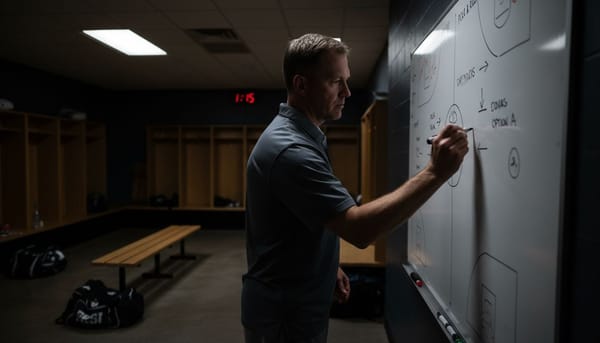
The part that really stood out to us was the implicit acknowledgment that spacing is learned through constraints, not through diagramming. You can draw perfect floor spacing on a whiteboard all day long. But until players feel the consequence of poor spacing — the clogged drive, the lack of passing angles, the defense that can guard two players with one help defender — they won't internalize it.
That's why rules like "no mid-range catches" work. They create immediate, tangible feedback. If you're drifting into the elbow and calling for the ball, your teammate literally can't pass it to you. You're forced to relocate. And through that repetition, you start developing court sense.
How This Connects to Shot Selection
This constraint naturally improves how to improve your team's shot selection without ever mentioning shot quality. When players can only catch the ball at the rim or behind the arc, they're automatically taking higher-value shots. But more importantly, they're learning to read defense in binary terms: can I get to the rim, or should I spot up?
That decision-making framework is gold for developing players. Instead of having infinite options (which paradoxically leads to hesitation), they have clear categories. Attack or space. Collapse or stretch. It simplifies the game in a way that builds confidence.
The Unintended Benefit: Better Cutting
Here's something the podcast touched on that deserves more attention: when you eliminate mid-range catches, players start cutting harder. They have to. If they want to get the ball in scoring position, they need to either be wide open behind the three-point line or actively moving toward the basket.
We've seen this play out in the leagues we work with. Teams that implement spacing constraints suddenly have more backdoor cuts, more basket cuts off screens, more purposeful movement. Why? Because standing still in the mid-range is no longer an option. You're either creating an advantage or getting out of the way.
The beauty of this is that it mirrors what makes one rule that makes your team play faster so effective. Constraints breed urgency. When players know they can't just drift and call for the ball, they move with intention. The pace picks up naturally because there's no safe middle ground to camp in.
Teaching Players to Recognize the "Gold"
Here's where it gets really interesting. Once you've defined what exploiting advantages actually looks like in your system, everything becomes clearer for your players. Suddenly, they're not just running plays—they're hunting for specific situations.
This is spot on because we see this struggle constantly in the leagues we work with. Coaches will run beautiful sets, but players don't recognize when they've actually created an advantage. They get the defense rotating, create a 2-on-1 situation on the weak side, and then... nothing. They hesitate. Or worse, they pass it back out top and reset.
Why does this happen?
Because nobody taught them what "gold" looks like. We're so focused on teaching the action itself—the screen, the cut, the spacing—that we forget to teach the actual decision-making moment. The part that really stood out to us was how much easier the game becomes when players know exactly what they're looking for. It's like how does Luka play so slow, yet still destroy everyone—he sees advantages three steps ahead because he knows what he's hunting for.
In our experience working with leagues, the teams that dominate aren't necessarily the most talented. They're the ones where every player recognizes the same opportunities. When your point guard, your wings, and your bigs all see "gold" in the same situations, you've created a shared basketball language that's incredibly hard to defend.
The Advantage Recognition Problem
Think about your last game. How many times did your team create a legitimate advantage but fail to capitalize? Be honest.
It happens more than we want to admit. A great ball screen creates a two-on-one. The defense scrambles. For a split second, there's an opening. And then your player makes the safe pass instead of the right pass.
We'd add to this point that it's not just about seeing the advantage—it's about having the confidence to exploit it immediately. That's a training issue, not a talent issue. Players need repetitions where they're forced to make these reads under pressure. Not in static drills where everything is predetermined, but in situations where defenders are actually contesting and the margin for error is real.
This connects directly to how to improve your teams shot selection, too. When players understand what constitutes a real advantage versus a marginal one, they naturally take better shots. They're not settling for contested threes when they could make one more pass for a layup. They're not forcing drives into traffic when the defense is loaded up.
The shift happens when you stop teaching basketball as a series of plays and start teaching it as a series of advantages to recognize and exploit.
Floor is Lava: The Constraint That Changes Everything
The episode wrapped with a concept that sounds almost too simple to work: "floor is lava." But here's the thing—this constraint is exactly the kind of principle that transforms abstract concepts into tangible player behavior.
By creating a simple rule that forces movement and spacing, you're not micromanaging every cut and screen. You're establishing a principle that naturally generates the actions you want. Players aren't waiting around. They can't. The floor is lava.
This is spot on because it mirrors what we see in the most effective league structures. Coaches who try to script every possession end up with robotic players who crumble when the script breaks down. But coaches who establish clear principles? Their teams adapt. They problem-solve. They actually play basketball instead of running a choreographed routine.
In our experience working with leagues, the teams that thrive are the ones where players understand the why behind spacing and movement, not just the what. A constraint like "floor is lava" does exactly that—it forces the habit without killing creativity.
We'd add to this that constraints work across all skill levels. Youth players especially benefit from simple, game-like rules that make practice feel less like drill work and more like play. And isn't that the point? When training incorporates realistic constraints, players develop instincts that actually transfer to real games.
The beauty of the "floor is lava" principle is that it's self-correcting. Stand still? You're out. It's immediate feedback. No whistle needed. No lecture about spacing theory. Just a simple rule that creates the behavior you're looking for.
Why This Matters for Your League
Look, we built CourtClok because we believe basketball should be more accessible, better organized, and ultimately more fun for everyone involved. But the best scoreboard and league management system in the world can't fix bad basketball philosophy.
That's why conversations like this matter so much.
The coaches who embrace player development over rigid systems? Those are the leagues that keep players coming back season after season. The ones who understand that punitive approaches kill growth? They're building something sustainable.
Whether you're running a recreational league, a competitive travel program, or just trying to make your Monday night run better organized, the underlying philosophy matters. Are you creating an environment where players develop decision-making skills? Or are you just running them through the motions?
The difference shows up in the stats we track, the games we score, and the leagues we help manage. Teams built on principles consistently outperform teams built on plays. It's not even close.
Final Thoughts
This episode reinforced something we've believed for a while now: basketball is moving in the right direction. Coaches are getting smarter. They're questioning old methods. They're prioritizing what actually works over what's always been done.
The shift from set plays to principles isn't just theory—it's showing up in gyms everywhere. And honestly? It's making the game better. More creative. More fun. More basketball.
If you're a coach or league organizer reading this, here's our challenge: pick one principle from this discussion and implement it this week. Maybe it's a simple rule that generates more scoring opportunities. Maybe it's giving your players actual decision-making reps instead of running another static drill. Maybe it's just asking yourself whether your current approach is developing players or just keeping them busy.
Because at the end of the day, that's what separates good programs from great ones. Not the plays you run. Not the gear you have. But whether you're actually developing basketball players who can think, adapt, and play the game at its highest level.
And yeah, having a reliable way to