How One Coach's Contemporary Basketball Coaching Approach Evolved Across Three Continents
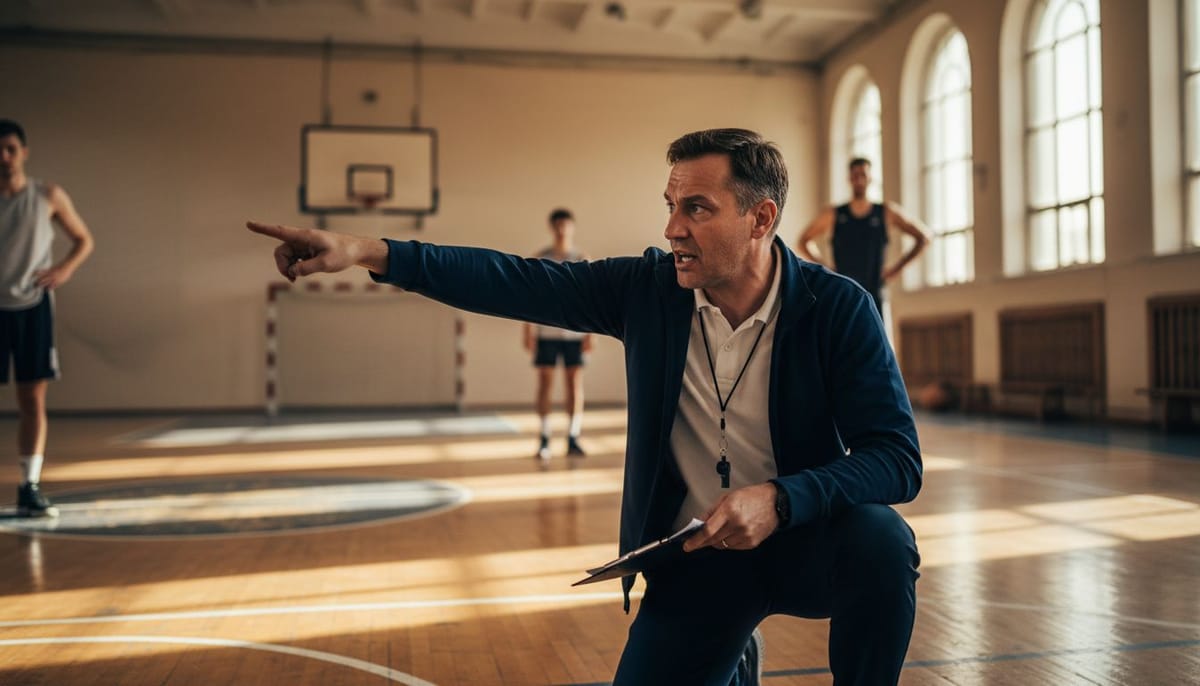
There's a moment most coaches recognize — the one where you realize that doing exactly what you were told, drilling exactly what the textbook says, and running the same progressions you've always run... just isn't producing the players you hoped for. I've heard coaches describe it differently, but it almost always comes back to the same feeling: something's missing. That search for something better is precisely what defines a contemporary basketball coaching approach, and it's at the heart of what Nabil Murad has been navigating across a 15-year journey that's taken him from Ireland to the United States, through the UK, and eventually to the Austrian Alps — where he's now entering his sixth season with Basket Swans Kundl in Upper Austria. His story isn't about having all the answers. It's about being honest enough to admit he's still looking for them. And I think that honesty is exactly what makes it worth paying attention to.
How Coaches Actually Discover a New Way of Thinking
I find it fascinating that most coaches who shift toward more ecological, player-led approaches don't arrive there through a formal education moment. It's rarely a textbook. It's rarely a certification course. For Nabil, it was Twitter — which sounds almost too simple, but when I think about this, I immediately understand it. Social media genuinely made the world smaller. Suddenly coaches in small European leagues were engaging with ideas that previously only circulated in elite academic or professional settings.
What he describes is an openness to being uncomfortable. He had enough experience with the traditional "do exactly what I say" model — and enough personal awareness — to recognize it was creating a ceiling. That's a harder thing to admit than it sounds. When you've built your identity around a particular way of coaching, questioning it isn't just an intellectual exercise. It's personal.
What stands out to me is that Nabil doesn't position himself as someone who's fully converted. He's explicit about it: he's not fully in. He can still see the value in elements of the traditional side. And I think that kind of intellectual honesty is something the coaching community could use more of. There's a tendency in any emerging movement — ecological dynamics included — for people to perform certainty they don't actually have. Nabil isn't doing that, and it makes his perspective more credible, not less.
The thread that runs through his discovery is the same one I've seen in coaches who make genuine, lasting changes to their practice: they stopped looking for confirmation and started looking for better questions. This shift in mindset — away from instruction and toward inquiry — is central to what the broader conversation around coaching innovations in basketball has been building toward over the last decade.
Why Most Coaches Stay Stuck at 30 or 50 Percent
Here's the part that really got me thinking. When asked why coaches who understand ecological dynamics often only implement it partially — sitting at maybe 30, 40, or 60 percent — Nabil reached for an analogy I won't forget quickly.
He described being stranded on an island. Not a great island. But a known one. And there's a boat. The boat might save you. It might also take you somewhere worse. Most people stay on the island.
That's it. That's the whole thing.
The status quo isn't just comfortable because it's familiar — it's comfortable because failure within it is socially protected. If you lose running traditional sets and drills, people nod sympathetically. If you lose trying something unconventional, suddenly your methods are the story. Nabil referenced Pete Carroll's Super Bowl decision, which is one of the most instructive examples in sports psychology: a statistically defensible call that became a cultural punchline because the outcome was bad. That's the environment coaches are operating in. The incentive to fail conventionally is enormous.
I don't fully agree that this is just about fear, though. I think there's also a real competence gap that holds people back — and it's worth separating those two things. Some coaches aren't avoiding ecological approaches out of social anxiety. They genuinely don't yet know how to design practice environments that create the right constraints, affordances, and decisions. Fear and skill deficit look similar from the outside, but they need different solutions.
What Nabil describes as being stuck at 30 or 50 percent is also, I'd argue, a reasonable place to be during a genuine learning process. Nobody who's actually honest about skill acquisition expects linear progress. The problem isn't being at 50 percent — it's pretending you're at 90 when you're not, or giving up and going back to 0 because the discomfort felt like failure.
The Specific Areas Where Ecological Coaching Feels Hardest
When I pressed into the practical side — what specific areas of basketball feel most resistant to an ecological approach — Nabil's answer was refreshingly blunt: everything, honestly.
But he pointed to a few areas worth unpacking. Technical and tactical refinement is where coaches most often feel the tension. There's a moment in practice where a player's footwork is genuinely inefficient — and the traditional instinct is to stop, correct, and repeat. The ecological approach asks you to instead manipulate the environment so that better movement emerges naturally. That's a real skill. It takes experience to know which constraints to add, which to remove, which tasks will create the affordances that push players toward better mechanics without you explicitly dictating them.
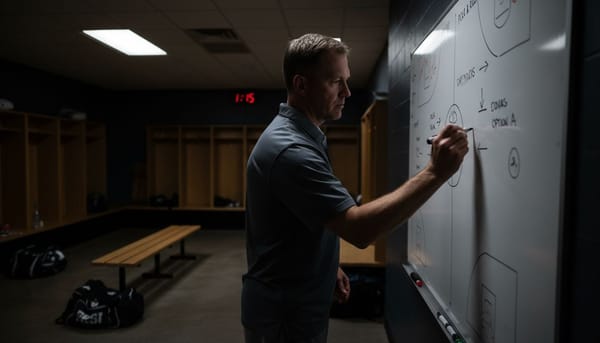
Practice planning is the other major friction point. A traditional session plan is a comfort object. It tells you what's next when you're not sure. The ecological framework doesn't eliminate planning — but it asks you to hold that plan much more loosely, to be responsive to what's actually happening in front of you rather than executing a predetermined sequence. Nabil describes not being there yet with that level of in-session flexibility. That's honest. Most coaches aren't.
The third area he touched on — and this one I find particularly underexplored — is the mental or psychological side. How do you design a constraint or task that targets a player's decision-making under pressure, or their emotional regulation in tight moments? That's a genuinely hard design problem, and I've seen very few coaches talk about it concretely.
There's also something important in what Nabil implicitly revealed: the journey from "games-based approach" to truly constraint-led practice isn't as short as people assume. He described his own early ecological work as fairly generic — small-sided games, three-on-three, two-on-two — before realizing that those environments, while better than closed drills, still weren't specific enough. Players weren't encountering the right affordances frequently enough to develop certain skills. The same footwork decision, from different starting positions, in different defensive alignments, with different spacing — that variability doesn't just happen because you run five-on-five scrimmage.
This is where one-on-one environments — specifically varied, constraint-rich one-on-one — become so valuable. Not the kind where you put the ball on the hip and go right. The kind where you've designed dozens of entry conditions, starting positions, and defensive parameters that force the attacker to solve different problems every single time.
The Death of Rote Repetition — And What Actually Works Instead
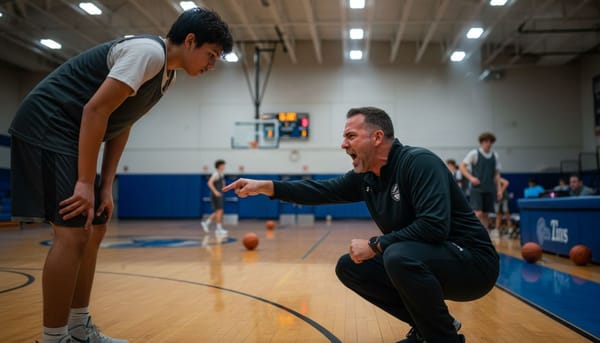
There's something I find genuinely frustrating when I watch youth basketball practice. A coach lines up ten players. One by one they go through a shooting drill. Nine do it "right." One makes a mistake. And suddenly everyone stops — the whole group stands there while the coach lectures for three minutes. Nine players mentally checked out. One player embarrassed. And the coach thinks that's teaching. I don't think that's teaching at all.
The argument against rote repetition isn't just philosophical — it's practical. Think about how you actually learned to speak your first language. Nobody handed you a grammar textbook when you were two years old and drilled you on conjugation. You made noise, got feedback through context, made mistakes, adjusted. You were immersed. That's the model. Duolingo can teach you vocabulary, sure, but it's not going to make you fluent. Immersion does that. And yet we keep designing basketball practice like a Duolingo lesson.
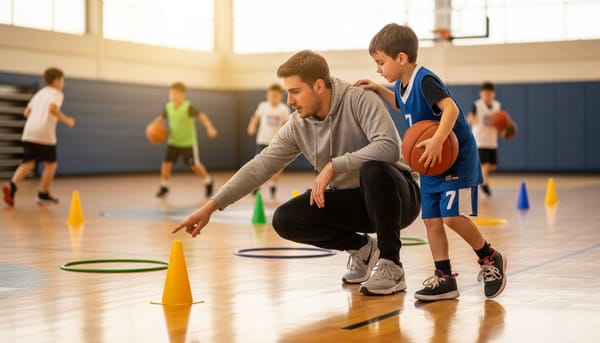
What I find compelling about the alternative — constraint-led activities — is that they force engagement by design. When a player knows there's a live constraint in front of them, some kind of defensive pressure, a limited number of dribbles, a scoring incentive tied to speed, they can't sleepwalk through the rep. Their brain is actually on. And here's the thing: when players are genuinely engaged, they're not just more focused in that moment — they build confidence faster, stay motivated longer, and develop the kind of problem-solving instinct that no blocked practice drill can replicate.
One activity I keep coming back to as an example is exactly what was described with the transition-to-half-court flow. Give a team four points if they score in under five seconds. Count out loud. Suddenly the entire gym is alive. Players aren't waiting for instructions — they're making decisions, reading space, feeling the difference between a real advantage and a manufactured one. Yes, it looks like chaos early on. Someone panics at "two" and chucks a terrible shot. Someone else dribbles and waits for a ball screen because that's the comfortable pattern. But that chaos is the process. You can't skip it. The coaches who try to skip it — who step in, freeze the play, reposition everyone perfectly so it looks clean — are robbing their players of exactly the kind of messy, pressured, cognitive work that actually builds skill.
The block practice model made a kind of intuitive sense for a long time. Repetition builds habit. Habit builds consistency. But what it actually builds, in most cases, is performance that looks great in controlled conditions and falls apart the moment a defender does something unexpected. And honestly? Most youth sports environments are still running on that model because it feels productive. A drill that runs clean looks like good coaching from the outside. A constraint activity that produces errors and confusion looks like a mess — even when it's the better learning environment by a mile.
I think the shift coaches need to make isn't just methodological. It's psychological. You have to get comfortable watching your players struggle. You have to resist the urge to step in and make it look good. That takes a certain security — a confidence in the process even when the results in front of you don't yet reflect it. That's genuinely hard. I respect coaches who can do it.
Building a Conceptual Offense — And the Real Challenge Nobody Talks About
Here's a tension that I think about a lot when it comes to modern offensive systems: the gap between what a conceptual, principles-based offense looks like on paper and what it actually looks and feels like when you're running it with a group of sixteen-year-olds in early November.
The case for moving away from rigid, play-heavy offenses is strong. Rigid systems make players dependent on calls. They create a ceiling — once a defense figures out your sets, you're stuck. A principles-based approach, where players understand why they're making a given movement rather than just executing a memorized sequence, is more adaptable, more durable, and ultimately produces smarter basketball players. I genuinely believe that. But the hard part — and this is something coaches don't talk about enough — is the transition period. Specifically, the moment when your players come out of transition offense, recognize there's no advantage to push, and need to flow naturally into your half-court attack. That moment of recognition and response is extraordinarily difficult to train.
What I find fascinating about the "four-second countdown" idea is what it reveals about player cognition. Most players, when left without structure, will default to comfort. They'll dribble. They'll wait for a ball screen. They'll stall until someone calls something. The countdown forces them out of that passive state. But the next problem is what happens right at the edge of the window — players start making decisions based on the count, not the read. They chuck a shot at "one" not because the shot is good, but because the count is expiring. So now you've solved one problem and created a new one. That's just coaching. You solve the next thing.
Limiting actions — restricting a team to only get-actions and pin-downs during a given practice phase, for example — is one of the more underrated tools in this process. It forces players to become truly fluent in those actions before expanding the vocabulary. I think the instinct a lot of coaches have is to show players everything early, give them the full system, let them see the big picture. But fluency doesn't come from exposure to a wide vocabulary. It comes from depth with a narrow one. Once they can run a get-action under pressure, automatically, without thinking — then you add the next layer.
Patience is the word that comes up again and again in this context. Patience with the players who are still in early learning stages. Patience with yourself as a coach when practice looks like organized chaos. One of the more honest things I've heard coaches admit is how tempting it is, in those moments of frustration, to just go back to what works — to install something rigid and controlled because at least it looks good on film. That impulse is understandable. But giving in to it is exactly how you end up with players who can execute drills and can't play basketball. This tension between structure and freedom is one of the central questions across the full landscape of coaching innovations being explored at every level of the game right now, and there's no clean answer — just coaches who are willing to sit with the discomfort long enough to let real learning happen.
Connecting Actions — The Craft of Sequencing in Practice Design
One of the things that genuinely impressed me when I think about how sophisticated practice design has become is the idea of running actions in sequence — not just in isolation. The example that sticks with me is something like flowing from a pistol action into a get, into a flare, into a pin-down. On the surface that sounds complicated. But what it's actually doing is mimicking what real basketball looks like. Possessions aren't a single action. They're a chain of reads.
When you train actions in isolation — even with good constraints — you're still giving players an artificial environment. The first action is always the first action. There's no "before" and no "after." But when you start chaining actions together in practice, players have to hold more cognitive context. They have to remember where they came from, recognize where they are now, and anticipate what might come next. That's a fundamentally different kind of processing. It's harder. And it's much closer to what a real game demands.
What strikes me about this is how it creates a natural bridge between skill training and the conceptual offense you're trying to run. Players who've only ever practiced pin-downs in isolation will run a pin-down when they're supposed to run a pin-down. Players who've practiced a pin-down as the third action in a flowing sequence will run a pin-down when the read calls for it. That's a meaningful difference. That's the difference between a player who executes a system and a player who understands the game.
The adaptation piece matters here too. Taking a framework you've seen — actions you've been shown, concepts you've absorbed at a clinic or from a colleague — and reshaping them to fit your specific roster, your specific context, your specific season phase? That's its own skill. It's not enough to understand a drill. You have to understand it well enough to break it, rebuild it, and make it fit somewhere it was never originally designed to fit. That's the mark of a coach who's genuinely thinking rather than just borrowing. And frankly, I think that's the contemporary basketball coaching approach that separates the coaches who produce real development from the ones who produce impressive-looking practice footage.
Designing Practice Environments That Actually Work: Constraints, Chaos, and Player Engagement
One thing that keeps coming back to me in all of this is a question that seems simple but cuts deep: why are players frustrated in practice? Why aren't they engaged? When I think about this, I immediately go to the environment itself. We design practices that bore or confuse players, then act surprised when they mentally check out. That's on us as coaches. Not on them.
What the constraint-led approach does — and this is something I think about a lot — is flip that dynamic entirely. Instead of telling players what to do, you build the environment so that the right decision becomes the most attractive one. The player discovers it. And that discovery is everything.
Take something like FIBA 3v3 with a chair constraint. Add a second chair a foot away for the defense to navigate, and suddenly you've got a natural baseline drive advantage built into the structure of the drill. Nobody told the offensive player to attack the baseline. The environment made it obvious. Meanwhile, you're watching whether help rotates, whether someone fills the corner, whether the cutter at the 45 makes the right read. You're working on all of it — without a single instruction.
Chaos shooting is another one I've seen generate real buzz among coaches recently, and I think the reason it works is that it compresses game-realistic pressure into a short, repeatable format. Offensive players are shooting under stress. Defenders are closing out hard and honestly. Nobody's jogging through the motions because the structure won't allow it.
And then there's cutthroat — an old-school drill that's been around forever. What's interesting to me is that adding a theoretical lens to something that old can completely transform it. Constraining the triggers, changing what earns points, adding something like a "floor is lava" rule to discourage mid-range catches and push optimal spacing — none of that requires buying new equipment or reinventing your entire practice plan. It just requires thinking more carefully about what you want players to perceive and respond to.
The point scoring piece deserves its own moment here. I don't fully agree with the idea that you always need to keep score to motivate players — but I do think attaching points to specific behaviors is one of the most underused tools in practice design. Give the defense minus five if an uncontested layup drops because nobody rotated? Watch how fast an active help defender appears. Even with beginners. Especially with beginners. Because they haven't been told where to stand — they've figured out why it matters.
The cutthroat constraint around perimeter catches — where the defense loses a point if the offense catches cleanly outside the arc — is a good example of how you can represent real-game aggression without running a full scouting report on an opponent. You're training the back-door cut because you've made denying the catch painful for the defense. The players don't need a lecture on it. The environment teaches it.
Making It Variable: The Detail Most Coaches Miss
Here's where I want to push the conversation a little further, because I think this is the detail most coaches miss even when they're already using small-sided games and constraint-based activities. Variability. Not in what you're working on — but in how the activity begins.
That transition four-on-four drill where the defense touches the halfcourt line to create an advantage? Useful. But the moment every rep starts the same way — same spacing, same depth, same positions — you've quietly turned a constraint-led activity into a patterned drill. Players start anticipating instead of reading.
Starting players at completely different depths, different widths, one at halfcourt, one at the baseline, one off the court entirely — it sounds chaotic, and honestly it looks messy at first. But what it does is force genuine perception. The offense can't fall into a rehearsed pattern because the starting conditions are never the same. The defense can't pre-solve the problem. Everyone has to actually see the picture in front of them and respond to it.
This connects directly to why coaching innovations in basketball have shifted toward environment-first thinking rather than instruction-first — because the research keeps pointing in the same direction: intrinsic motivation, skill transfer, and decision-making quality all improve when players are solving real problems, not running choreography.
The transition drill constraint work is still evolving, and I think that honesty matters. Not every practice design idea lands immediately. Sometimes the defense doesn't rotate to the first pass and the offense just gets a layup before you've built anything worth building. You adjust. You constrain the defense. You reshape the offense. That's the process — and it's ongoing, not a finished product.
What stands out to me most after thinking through all of this is how much of modern practice design is really about patience. Patience to let players figure things out. Patience to tinker with a drill across weeks, not just one session. Patience to trust that if you build the environment right, the understanding will come — even with beginners, even early in the season, even when it looks messy in the middle. The messiness isn't a sign you're doing it wrong. Most of the time, it's a sign something real is being learned.