How Germany's Basketball Scene Is Quietly Leading a Coaching Revolution (And Why Most Coaches Still Aren't Listening)
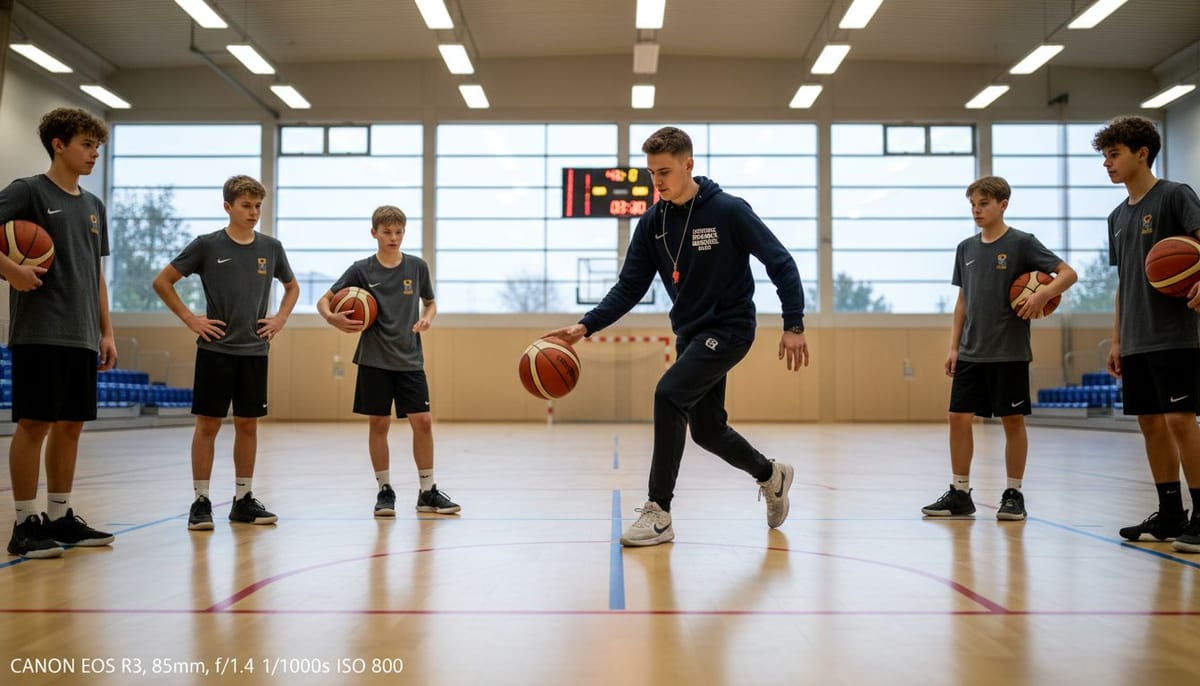
Only a handful of countries in the world are genuinely rethinking how basketball is taught at the grassroots level. Germany might be one of the most interesting ones right now — and most people haven't noticed yet. I came across a conversation between Alex and Simon Bertram, a coach working with Bamberg, one of Germany's most respected youth basketball clubs, and honestly, it stopped me in my tracks. Not because of some radical new drill or tactical system. But because of something far more uncomfortable: the gap between coaches who are evolving and coaches who are still doing exactly what they did twenty years ago.
That gap is everywhere. And Simon's honesty about it — including within his own club — is what made this conversation worth writing about.
The CLA Is Spreading in Germany, But Only at the Top
Simon made a point early in the conversation that I found both encouraging and a little sobering. He said that among professional youth coaches in Germany, he "hardly knows anyone who's not doing the CLA anymore." The Constraints-Led Approach — a framework built around designing training environments that force players to solve real basketball problems — has genuinely taken hold at the higher levels. That's real progress.
But then he said this: once you go below the professional tier, into the volunteer-run clubs, the community leagues, the weekend coaches? It becomes almost impossible to get people on board.
When I heard this, I immediately thought about how universal that divide is. It's not just Germany. It's everywhere. The coaches working full-time in structured environments tend to be the ones reading, researching, attending camps, questioning their methods. The volunteers — who, let's be honest, make up the absolute majority of youth basketball — are often just running the same session they've run since 2004. Why would they change? They show up twice a week, they care about the kids, and they do what they know. That's not laziness. That's just human nature.
Simon even mentioned watching his own son's U10 coach struggle to engage with new ideas. That's not abstract. That's his kid. There's something raw and real about that observation — it's not some theoretical problem, it's happening right in front of him.
This is something I think about a lot, especially when I read about coaches who've walked away from elite environments just to reconnect with the fundamentals of how players actually learn. The willingness to question everything — even at personal cost — is rare. Most people, coaches included, default to comfort.
The Problem Isn't Knowledge — It's Identity
Here's what struck me most about Simon's take on resistance to change: he didn't just blame lack of information. He said it's age-related. It's mentality. It's the psychological difficulty of admitting that what you've been doing for decades might not be the best approach.
That's a harder conversation than just sharing a new drill or a better framework. Because you're not just asking someone to learn something new — you're asking them to let go of something old that feels like part of who they are.
Simon is 37. He noted that most of the coaches he knows personally are in that same age range, and that even within that group, the openness to change varies wildly. What does that tell us? That experience alone doesn't create adaptability. Some people hit a certain number of years in coaching and become more curious. Others calcify.
I don't think this is unique to basketball, either. But in a sport where so much youth coaching is still built around rigid systems, memorized plays, and drill-for-drill's-sake training, the stakes of that calcification are real. Kids end up spending years in environments that teach compliance instead of problem-solving. And by the time they reach a coach who actually challenges them to think, they've already been trained not to.
That's why I find so much value in the conversation around shifting away from set plays toward genuine player development. It's not just a stylistic preference. It's about whether players leave the game with real basketball intelligence or just a set of memorized responses.
How Bamberg Actually Made the Shift — And Why It Wasn't Instant
One of the most honest moments in the conversation was when Simon described how the CLA rollout at Bamberg actually happened. He didn't walk in on day one and revolutionize everything. In fact, when Alex first visited Bavaria and introduced the framework formally, Simon's reaction was essentially: oh, so that's what I've already been doing, but now I have language for it.
That's a genuinely important insight. The framework gave him terminology. And terminology gave him the ability to articulate what he was doing, teach it to others, and build on it systematically. Before that, he was doing CLA-adjacent things intuitively — rarely doing "air" drills, almost always working one-on-one with a defender present — but he couldn't explain why in a way that brought other coaches along with him.
This is why I think training with a defender present is such a foundational shift — it's not just a tactical choice, it's a philosophical one about what practice is actually for. If you believe players should be solving real problems, then removing the defender removes the problem. Simple as that.
Simon also talked about his assistant coach Niklas — someone who was already leaning toward a constraints-based style without the vocabulary for it. When Simon arrived, he gave Niklas a framework. And then they both watched what happened with the players over time. Not in one week. Not in two. But slowly, sustainably. Niklas's own words were memorable: "With you, I learned basketball completely new."
That kind of transformation — coach to coach, within a club — is exactly how these ideas need to spread. Top-down mandates don't work. Academic papers don't move people. But watching a colleague get results, watching the kids show up to practice genuinely engaged, watching the learning stick deeper than it ever did before? That moves people.
Simon put it simply: you can only convince people by showing them results. And I agree with that almost completely. Almost — because results take time, and in volunteer coaching environments, the timeline for "results" is often just the next Saturday's score. That's the real tension. And it's one Simon acknowledged openly: weekend results, he said, don't matter to him anymore. The development is what matters. Getting an entire club culture to share that belief? That's the harder project.
It reminds me of something I read about how punishment-based coaching creates short-term compliance at the cost of long-term development — the same underlying issue, really. Coaches optimize for what's visible and immediate, even when the deeper work is happening slower and more quietly underneath.
Winning Isn't the Point — Development Is
Most coaches would never admit this out loud: they'd rather lose with a developing player than win with a stagnant one. When I heard Simon say exactly that — that he texted about a 1.90m twelve-year-old he deliberately put in a ball-handling role just to stretch him — I immediately thought, how many coaches actually have the courage to do that? Not many. Seriously.
It's easy to talk about player development in theory. It's hard to watch your team turn the ball over repeatedly because you chose to put a kid in an uncomfortable position on purpose. Simon made a really blunt point here that I think deserves more attention: if you chase results at youth level, you ultimately have no one to show for it when it matters. No players in the pro team, no players in the top leagues. Nothing. The wins were real, but they meant nothing in the long run.
I've seen this play out personally. Coaches who run tight zone defense with eleven-year-olds, who run set plays with thirteen-year-olds, who never let kids struggle — and their teams look great at that age. Then those same players hit sixteen and they can't read a game, can't make decisions under pressure, can't handle anything unscripted. The wins were borrowed time. And this is something coaches need to hear more bluntly — the shift from set plays to genuine player development isn't just a philosophical preference, it's the only approach that actually prepares kids for what's coming.

What struck me most was how unsentimental Simon was about it. He wasn't dramatic. He just said: I don't care about losing the ball. That quiet confidence in the process — that's rare. That's the kind of coaching philosophy that changes careers.
The Silo Problem Is Bigger Than Most Clubs Want to Admit
This part of the conversation hit close to home for me. The "siloed effect" — where U12 coaches have no idea what U14 coaches are doing, where the performance team and the development team never talk — is everywhere. And the scary thing is that most clubs don't even realize it's happening. Every coach just does their thing in their own gym and assumes everyone else is aligned.
Simon described something that I think is underrated as a coaching tool: work shadowing. Just going to another age group's practice. Watching. Asking questions. Giving feedback. It sounds obvious. It almost never happens. He mentioned that when he came to the JBL practice and just had a conversation with coach Yan — why did you do that, what if you tried this instead — that informal exchange was genuinely valuable for both of them. That's not a formal meeting. That's just two coaches actually talking about basketball.
And I loved what he said about Nuremberg — one practice a week where all the performance teams from U12 through to the men's team were in the same gym. One gym. All coaches watching each other work. Think about what that does for alignment, for shared language, for coaches actually understanding where their players are coming from and where they're going next. It's such a simple idea and yet most clubs would never even attempt it. If you're thinking about how to build that kind of structure, it's worth looking at how one coach literally walked away from the NBA just to understand the game from the ground up — that kind of humility and curiosity is exactly what breaks silos.
The London Lions example was really compelling too. Catching up with Bamberg at a Christmas tournament in Belgium and being two of maybe two clubs in two hundred who were actually doing things differently — that's a sobering picture. Two out of two hundred. And yet you could see the difference immediately. In the warm-ups. In how players interacted. In the small-sided games instead of the traditional drills. That visibility matters. It shows the approach works. It just takes courage to be in the minority for a while.
You Can't Coach What You Don't Understand
This is the part of the conversation that I think will be hardest for a lot of coaches to hear. Simon made the point plainly: to coach within a constraints-led approach, you need to actually master the game. You need to know what outcome you want from every drill, every exercise, every constraint you set. You can't just throw kids into small-sided games and call it CLA. There has to be a plan, a progression, an intention behind every decision.
And that, he said, is probably why so many coaches don't make the jump. Because the moment you start coaching this way, you realize you don't know the game as well as you thought you did. That's a painful realization. Most people would rather keep doing what feels safe — running the same drills, running the same sets — than confront that. I don't fully agree with calling it "mediocrity" because I think that's a harsh frame, but I understand what Simon is getting at. There's a comfort in routine that has nothing to do with quality.
The "old wine in new bottles" debate that came up near the end was interesting to me. I've heard this criticism of CLA before — that coaches have been doing small-sided games for decades and this is just rebranding. And I think Simon and the interviewer were both right to push back on it, but also honest enough to say it's not completely false either. The difference isn't the games themselves. It's the understanding of why you're running them, how you're manipulating constraints to get specific outcomes, and whether the terminology and principles of play actually connect everything together. Without that framework, you're just doing random small-sided games and hoping something transfers. That's a crucial distinction, and it's why this one training switch has changed careers for coaches who truly committed to understanding it — not just borrowing the surface-level aesthetics of it.
This is something I think about a lot when I watch practices. Are coaches actually designing their sessions with intention? Or are they just picking drills from a list? Because there's a big difference between a coach who runs a 3v3 because they always run a 3v3, and a coach who runs a 3v3 with a specific constraint because they know exactly what decision they're trying to force. If you're genuinely trying to sharpen that intentionality in your sessions, even something as targeted as helping players make quicker decisions in basketball can reveal how much design and purpose matters in practice structure. The game looks the same from the outside. The thinking behind it is completely different.
Warming Up Like You Actually Play — And Why Other Coaches Think You're Crazy
Something Simon said early in this final stretch of the conversation genuinely made me laugh out loud. He described how his team warms up — one-on-one, two-on-two, three-on-three, four-on-three, five-on-four, five-on-five — and how coaches from other teams walk over and say, "Are you guys playing already?" And his answer is just... yeah. So what? Why wouldn't we?
I love that. I really do. Because the assumption buried in that question — "are you playing already?" — is that warming up and playing are two different things. That there's some necessary ritual of line drills and stationary shooting you have to do first before you're allowed to actually play basketball. When I heard this, I immediately thought about how many hours get burned every single week in gyms around the world on warmup routines that have zero connection to what happens in a real game. Kids standing in lines. Passing to a cone. Shooting from spots with zero pressure. And then we wonder why they freeze when a defender shows up.
Simon made a point that I think deserves to be repeated loudly: fun doesn't exclude progress. That's not a soft, feel-good statement. That's a coaching philosophy backed by everything the Constraints-Led Approach stands for. When his kids are laughing during jungle shooting while the team on the other side of the gym is robotically running line drills, and the other kids are looking over thinking "that looks fun" — that's not just a vibe difference. That's a development difference. If you've ever thought seriously about what we're actually teaching young players during these structured, repetitive routines, this moment in the conversation hits hard.
What struck me most was the G-League angle too. The host mentioned doing the exact same thing with the Rip City Remix — using former players as defenders, running one-on-twos, one-on-threes, playing with constraints in pregame warmups — and getting looks from opposing coaching staffs like they'd landed from another planet. If G-League players, guys on the doorstep of the NBA, are thriving under this approach and loving it, that should tell us something serious about how much room there is to grow at every level of the game.
Talent Identification That Actually Makes Sense
The second half of this conversation shifted to something I wasn't expecting to find this interesting — talent identification. And honestly? It might be the part I'll be thinking about longest.
Simon's situation in Bamberg is real. Small city. Roughly 160,000 kids within an hour's drive. A BBL academy that needs to find the right players to develop. And for ten years, they were doing school activities — moving around 20,000 kids a year — and getting not one single kid from those activities into their performance programs. Not one. That number stopped me cold. All that exposure, all that outreach, and zero conversion. Something was clearly broken.
So he changed the model entirely. Instead of hoping the right kid would just appear, they built a system. They go into schools with a split staff — some coaches running the session, one coach doing nothing but scouting. Just watching. Identifying. Who's fast? Who moves well? Who looks like they might be tall? Then they hand out flyers with a QR code, kids register through a questionnaire, and the ones who look promising get invited to a formal Talent Day. Anthropometric measurements. Wingspan. Standing reach. Schuhle runs. Optojump testing for jump height and air time. Everything feeds into a database, generates scores, and about thirty minutes later you have a comparative profile for every single kid — ranked against their age group peers across speed, agility, cognition, coordination.
This is something I think about a lot — how much raw talent quietly disappears every year simply because nobody was looking in the right place at the right time with the right tools. The kids who don't come from basketball families. The kids who've never been in a gym. The kid who's fast and coordinated and tall-projected but has spent the last eight years playing football. They exist everywhere. The question is whether your club has a system to find them — or whether you're just waiting for them to find you.
What I found smart about Simon's approach is that it's not just athletic measurement. It's combining physical projection — how tall will this kid be — with cognitive and coordinational results to build a fuller picture. A kid who's off the charts in agility but lower in cognition scores tells you something different than a kid who's the opposite. Neither is automatically out. But knowing the difference shapes how you develop them. And if you're serious about developing decision-making as a trainable skill, having baseline cognitive data on your young players from the start seems genuinely powerful.
I don't fully agree that data alone tells the full story — there's something about watching a kid compete, watching how they respond to pressure, watching whether they're coachable, that no algorithm captures cleanly. But as a first filter? As a way to make sure you're not missing the kid standing right in front of you? I think this is exactly the kind of systematic thinking that small clubs need most. Big clubs have pipelines. Small clubs need smarter eyes.
What I'm Taking Away From All of This
Across all three parts of this conversation, what keeps coming back to me is a single thread: the coaches who are doing the most interesting work right now are the ones who went deep on why, not just what. Simon didn't just adopt CLA drills — he understood the theory well enough to scale constraints, shape activities, and apply the same thinking to warmups, to talent ID, to every corner of his program. The host didn't just run different pregame sessions — he understood the principles well enough that G-League players bought in completely. That depth is what separates someone who runs a new drill from someone who actually transforms how they coach. It's also, honestly, what makes me want to go back and reread everything I thought I already understood about player development — because conversations like this remind me there's always more underneath the surface if you're willing to look.
Want the complete picture? Read our full guide: The Complete Guide to Ecological Learning Approach in Basketball Coaching