A New Host, a Brazilian Coach, and the Moment Everything Changed: Inside the Transforming Basketball Podcast Handover
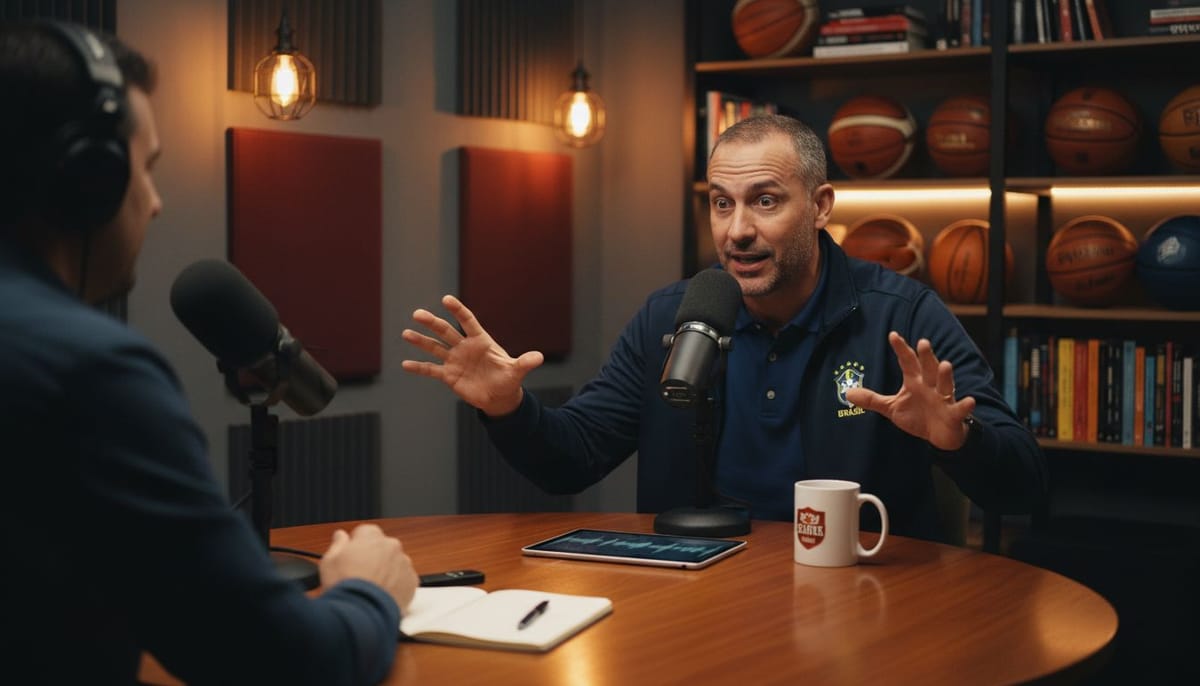
Most coaching origin stories follow a familiar arc. You played the game, you retired, you started coaching. Clean, linear, predictable. But what happens when the person handing over the microphone is a strength and conditioning master's student, the new host is a Brazilian-born coach who once tried to argue that muscle memory doesn't exist — and the whole thing was shaped by a former basketball executive who's now the president of a brand new WNBA franchise? That's the episode I just finished listening to, and honestly, I'm still processing it.
This was the final episode hosted by Adam, the outgoing host of the Transforming Basketball Podcast. And it wasn't a swan song so much as a handoff. A genuine, thoughtful transition to a new voice — George Vaz — someone who, by Alex's own admission, only discovered CLA (Constraints-Led Approach) about a year and a half ago and is now a professional coach. That trajectory is wild to me. And the conversation that unfolded around it touched on so many things I think about constantly when it comes to coaching development, how people actually learn, and what it really means to commit to a philosophy.
When the Host Leaves, the Mission Stays
What struck me most was how Adam framed his decision to step back. He didn't say he was burned out or that the podcast had run its course. He said he simply didn't have enough time to do it justice. He's started a master's in strength and conditioning and coaching practice through Altus — a systems-oriented track and field organization — and he made the call that half-effort wasn't worth it. I respect that enormously. How many people do you know who would rather quietly hand something off than let it slide into mediocrity?
When I heard this, I immediately thought about the coaches I've seen try to do everything at once — manage their team, run their development program, study new methodologies, handle admin — and how something always suffers. Usually it's the players. Adam's decision to step back is, paradoxically, one of the most coach-like things I've ever heard a podcaster do. He modeled the very principle the show teaches: prioritize depth over breadth.
And the replacement wasn't just grabbed off a shortlist. Alex spent several weeks deliberating. He said interest in the podcast is as high as it's ever been, which means the stakes for getting this wrong were real. The fact that he landed on George — someone he literally lived with for a year, someone he watched evolve from skeptic to practitioner in real time — tells you something about how seriously he took the decision. This is something I think about a lot: how rarely we see that kind of intentionality in sports organizations, let alone podcasts.
George Vaz and the Muscle Memory Argument That Started Everything
George's story is the kind that doesn't fit neatly into a bio. Born in Brazil. Didn't play basketball there. Moved to America at a young age, picked up the game at 11. Then Ireland. Then the UK. Then Slovenia — where he first crossed paths with the Transforming Basketball world while studying to become a coach. Then London, working at the Lions Academy, living with Alex, listening through apartment walls to podcast recordings being made in real time.
I've seen this play out personally — that thing where proximity to a conversation you're not fully part of is sometimes more formative than the conversation itself. George described hearing those early episodes through the walls and being drawn in by the ideas being discussed. That kind of slow absorption, before you've even committed to a framework, is often where the deepest learning begins. It's passive at first. Then it becomes obsessive.
His first real introduction to CLA came through a series of workshops Alex ran — and his initial reaction was to push back. Hard. The opening claim that there's no such thing as muscle memory set him off immediately. He started firing back with examples. And I love that. I don't fully agree with the idea that skepticism is always a barrier to learning — in George's case, it was clearly the gateway. He questioned it, got curious enough to do his own research, and then couldn't stop. Alex mentioned that George was reading a new paper every two days during their time in London. That's not someone going through the motions. That's someone genuinely infected by an idea.
This connects to something broader about how coaching development actually works. It rarely happens in a classroom or through a certification course alone. It happens when you're immersed — when you're living and breathing something, when the ideas follow you into the kitchen while you're scrambling eggs in the morning. That level of immersion is exactly what coaches who want to shift from set plays to genuine player development need, because the conceptual gap between old-school methods and modern approaches isn't small. It takes time to rewire how you see the game.
The London Lions Academy and What Full Immersion Actually Looks Like
The backstory behind how George ended up in that London apartment is genuinely fascinating. It was Vana Cerny's idea — the same Vana who appears in the Transforming Basketball book and is now president of the Valkyries, the newest WNBA franchise connected to the Golden State Warriors organization. She selected three coaches she believed in and sent them abroad for full immersion into a professional youth academy in Europe. George was one of those three.
Think about what that experience actually offers. You're not reading about elite coaching environments. You're inside one. You're watching how full-time professional coaches in Europe structure their days, their sessions, their relationships with players. You're being thrown into contexts that your previous experience hasn't prepared you for, which is — if you're paying attention — exactly how you grow fastest. It reminds me of how one coach walked away from the NBA entirely just to understand the game from the ground up — sometimes you have to strip away the status and the familiarity to actually learn something real.
What I find particularly interesting is the structure of that immersion. It wasn't just observation. Alex ran four workshops for the group during that period — and that's when he first met George on Zoom, before any of this London season began. By the time they were living in the same flat, George had already started his own research journey. The workshops gave him the spark. His own curiosity did the rest.
That combination — structured learning plus self-directed research — is something I think coaches at every level underestimate. There's a version of coaching education that's entirely top-down: someone tells you what to do, you implement it. And there's a version that's entirely self-directed, which can get chaotic without a framework. George seems to have found the balance. He was challenged by an idea, pushed back on it, then went and did the work himself. That's exactly the kind of independent decision-making process we want to develop in players — and it turns out it applies just as well to coaches learning their craft.
George also mentioned something Edisha Curry said to him during a call — that she'd been a coach for as long as she'd played basketball. And he reflected that he felt the same way. Even as a player, his instinct was always to make others better. That orientation — toward others, toward the team, toward the craft of teaching — is something you either have or you don't. No certification gives it to you. And listening to George talk, it's clear he has it. The question now is what he does with the microphone.
What a Coach Development Plan Actually Looks Like in Practice
When I heard George describe the coach development plan — strengths, building blocks, areas for improvement — I immediately thought: why isn't every program doing this? We talk endlessly about player development plans, but the coaching staff? They're usually just left to figure it out on their own. That gap is massive.
What struck me most was the accountability piece. It wasn't just Alex sitting down with each coach one-on-one and handing down feedback from above. All the coaches held each other accountable. That's a completely different dynamic. That's trust built into the structure of the program itself.

I've seen this play out personally — when you put something on paper, it becomes real. You can't unsee it. George said it himself: writing down your strengths and weaknesses forces you to organize thoughts that otherwise just float around in your head never becoming anything. There's something almost confrontational about it in the best possible way. And doing it twice across the season means you're actually tracking growth, not just creating a document that lives in a drawer.
What I also loved was Alex's approach to giving George room to experiment. The phrase "that's great — what could be better?" is so much more powerful than silence or outright dismissal. That framing protects the coach's confidence while still pushing them forward. If you're the kind of coach who wants to understand what a single training philosophy shift can do to a coaching career, this kind of structured reflection is exactly where that shift starts. It's not dramatic. It's just consistent, honest, supported development.
And honestly? The fact that George was inventing games on the spot — basketball baseball, pivot-square drills pulled from random court markings — that's not recklessness. That's creative coaching. That's what happens when someone gives you permission to push boundaries instead of punishing you every time something doesn't land perfectly. Speaking of which, the problem with punishment in basketball culture runs deeper than most coaches realize — and it shows up in how coaches treat each other too, not just players.
Principles of Play With Under-16 Girls — The Real Challenges
This is something I think about a lot. Coaching principles of play at the under-16 level — girls or boys — is where you find out what you actually believe about basketball development. It's easy to talk about positionless basketball and player autonomy in theory. It's something else entirely when you're standing in front of a group of teenagers who haven't fully internalized why spacing even matters.
The London Lions under-16 girls program is a perfect case study because it strips away all the excuses. These aren't players with years of deeply ingrained bad habits at the professional level. These are young players who can actually be shaped. That's the opportunity. But it's also the challenge — because without the right principles installed early, you're just building on sand.
George touched on something important when he mentioned the things they couldn't get the team to do at first. That's the honest part of coaching nobody wants to admit publicly. There's always a gap between the principles you're trying to teach and what actually shows up in a game. Always. And the real coaching work happens in that gap.
One of the most common problems at that age group — and I'd bet this was true for the Lions squad too — is decision-making speed. Players know what they're supposed to do in theory, but the moment pressure arrives, they freeze or revert to instinct. If your players are struggling with exactly that, developing quicker decision-making on the court isn't just about drills — it's about building environments in practice that force real choices under real pressure, consistently.
Floor spacing is another one. You can talk about it all you want. You can draw it on a whiteboard. But until players feel the difference between being clustered and being spread — until they experience what an open lane looks like because they positioned themselves correctly — it just doesn't click. There's actually one simple rule that helps players internalize floor spacing far faster than most coaches expect, and at the youth level especially, that kind of constraint-based learning is gold.
What I respect about the London setup is that they weren't trying to bulldoze through those problems. They were patient enough to discover them, name them, and then solve them systematically across a full season. That's real coaching. Not a highlight reel. A long, sometimes messy, ultimately rewarding process.
Roles, Reps, and the Power of Playing to Your Personnel
This is something I think about a lot. The idea of deliberately assigning players as targets, pickers, and converters — and then building your whole practice structure around getting those specific players the right kind of reps — is so much smarter than just running everyone through the same system and hoping it clicks. When I heard this part of the conversation, I immediately thought about how many youth coaches I've watched treat every player identically in practice, rotating roles randomly, and then wondering why nobody truly masters anything. You can't develop expertise without repetition. And you can't get repetition without intentional design.
What struck me most was the point about the pickers. The tall girls — 6'2 and up — were obviously the natural screeners. But instead of just using that height as a generic advantage, the coaches were drilling them specifically on how to set a screen based on coverage. Hold longer on a conservative drop. Slip immediately on a switch. That's nuance. That's real basketball IQ being built through targeted reps, not through a whiteboard lecture. And if you're curious about becoming elite in the pick and roll, this kind of role-specific training is exactly the foundation you need.
I've seen this play out personally — when players know their role, they stop hesitating. The converter isn't scanning the whole floor wondering if she should cut, post up, or shoot. She already knows. Her job is to read the defense and finish. That mental clarity speeds everything up. Twenty reps per quarter as a target versus two? That's not a small difference. That's a completely different developmental trajectory over the course of a season.
Constraint-Based Defense Making the Offense Better — And Vice Versa
The feedback loop they described between their pressing defense and their ball-handling improvement — that part genuinely surprised me. Not because it's wrong, but because it's so obvious in hindsight and yet so rarely coached intentionally. They weren't just pressing to get steals. They were pressing to make their own offense harder in practice, so that when games came, the real pressure felt manageable. That's elegant coaching. That's understanding that quicker decision-making in basketball isn't taught in isolation — it's forced out of players by well-designed pressure environments.
The skip pass drill they described was a perfect example of task simplification done right. Strip it down to one problem: defender switches, shooter in the corner, you have to deliver a strike-zone pass under pressure. That's it. One constraint. One skill. One measurable outcome. No chaos, but enough resistance to make it real. I don't fully agree with coaches who think scrimmage alone develops these skills — because in a full five-on-five, a player might only face that exact situation twice all practice. The drill gives them ten reps in five minutes. And just as important, knowing how floor spacing shapes those passing windows is what makes those reps actually transfer to the game.
What I keep coming back to after sitting with this whole conversation is how much of great coaching is really just great problem identification. They saw the turnovers. They traced them back to pressure handling. They built every competitive game around fixing that one thing. The turnovers went down. The offense got better. The defense got sharper. It all connected — because they were paying attention to the right thing at the right time. That's not a system. That's not a playbook. That's genuine coaching intelligence. And honestly, it's the kind of thinking that separates player development from just running plays. If this conversation made you rethink even one thing about how you structure practice, that's exactly the point.