Why Replacing Your Drills With Games Is the Most Important Shift in Modern Basketball Coaching
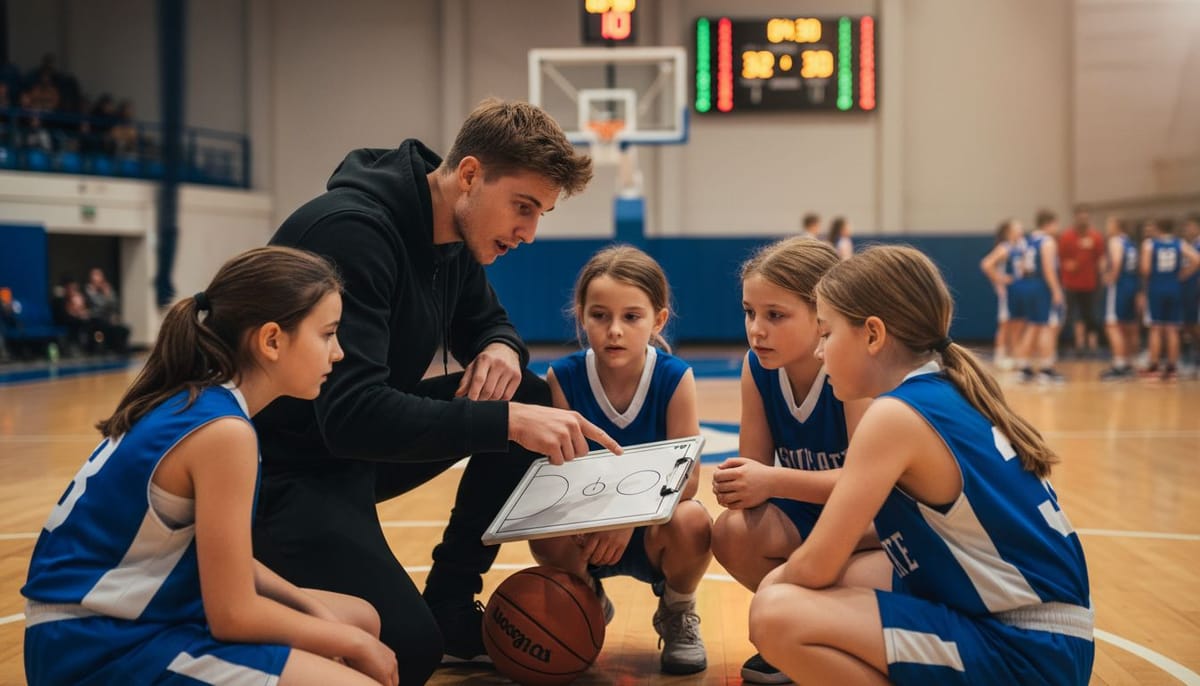
Stationary dribbling for an hour and a half. That's how Claire Murphy — a college-level basketball player — described what practice looked like growing up. Not occasionally. Consistently. At every level. And honestly? When I heard that, I didn't laugh. I nodded. Because I've been there too, and I'd bet most people reading this have been there as well.
There's a podcast episode I've been sitting with lately from Tyler and Claire over at Savvy Coaching, and it hit me in a way I wasn't expecting. They're talking about something that sounds simple on the surface — replacing drills with games — but the deeper I got into what they were actually saying, the more I realized this isn't just a practice design conversation. It's a philosophy conversation. It's about how we learn, how we develop, and honestly, why so many players stop loving the sport before they ever reach their potential.
I want to break down what they discussed, share where I completely agree, where I think the idea gets even bigger than they stated, and where — in a couple of spots — I'd push back a little.
We Coach the Way We Were Coached — And That's the Problem
Tyler said something in the opening that I think is one of the most honest things any coach can admit. He said when he first started coaching, he just duplicated what he experienced as a player. Static stretching. Stationary ball handling. Three-man weave. Shell drill. Walk through the offense. Scrimmage. Repeat.
This is something I think about a lot. How many coaches out there right now are running practices that look exactly like the ones they sat through 15, 20, 25 years ago — not because they've researched it, not because they've tested it, but because that's simply the template that got handed to them? The answer is: a lot. Probably most.
And look, I'm not throwing stones here. That's a deeply human thing to do. We default to what's familiar. We trust what we experienced. But basketball has changed. The game has evolved. what basketball coaches can learn from soccer's evolution is something that more and more people are starting to pay attention to — and the core lesson is the same: the sport's best thinkers stopped copying tradition and started asking why. Why are we doing this? Does this actually transfer? And if it doesn't, what does?
Claire made a point about getting siloed that really stuck with me. When you finish your playing career, you almost never get coached again. You never get to sit inside someone else's practice culture and feel what it's like. So you work with what you've got. You pepper in a new drill here, a new concept there, but the foundation stays rigid. And rigid foundations crack under the pressure of a changing game.
The Difference Between a Drill and a Game Is One Word: Win
Here's the part of the conversation that I thought was genuinely sharp. Tyler made this observation — and it's deceptively simple — that the difference between a drill and a game isn't really about movement, or structure, or time. It comes down to one question: can you win?
Think about that for a second. When was the last time you got genuinely fired up about a drill? I can't think of one. I remember getting locked in during competitive small-sided games. I remember caring deeply when there was something at stake. But a cone drill? A stationary ball-handling sequence? My body was there. My mind was somewhere else entirely.
And this matters because the players you most want to develop — the competitive ones, the high achievers — they respond to the opportunity to win. That's when they elevate. That's when focus sharpens, effort spikes, and the skill you're trying to teach actually gets stress-tested in a way that resembles real competition. Which, last time I checked, is the whole point.
I've seen this play out personally watching youth practices where a coach spends 40 minutes on isolated footwork and the kids are zombies — and then the moment a competitive game gets introduced, everyone is suddenly alive. The skill wasn't the problem. The context was the problem. If you're thinking about how to make quicker decisions in basketball, the answer almost never lives inside a repetitive drill done in isolation. It lives inside situations where a decision actually has consequences.
That's what games give you. Stakes. And stakes create learning.
The Exposure Shift — And Why International Basketball Changed Everything
Claire brought up something that I don't think gets enough credit in these coaching conversations. She talked about how the explosion of access to international basketball — through video, through social media, through clinics — has genuinely cracked open the closed-mindedness that used to dominate coaching circles.
She described going to a clinic about a decade ago where a coach from Spain presented an open-face, chest-to-ball denial technique. And people were livid. Coaches were visibly upset. Not skeptical — furious. Like, how dare you suggest there's another way to guard a pass. That visceral reaction she described? I believe it completely. I've watched something similar happen in smaller doses even recently. People don't just disagree with new ideas — they take it personally, like the new idea is an attack on everything they've built.
But here's what's changed. That reaction is becoming less common. Not gone. But softer. Coaches are asking "how can we work this in?" rather than "this is wrong." And that shift in posture — from defensive to curious — is everything. It's the entire ballgame when it comes to growth.
Tyler connected this directly to why games are more functional now than ever. When there was one right way to shoot, one right way to deny, one right way to defend, drilling made sense. You drill the one right answer into muscle memory. But when we've collectively accepted — because the evidence demands it — that there are multiple ways to successfully put the ball in the basket, multiple stances that work in defense, multiple reads off a pick and roll, then drilling one specific answer starts to feel not just limiting but actively counterproductive.
This is something stopping the obsession with perfect shooting form gets at directly — when we insist on one mechanical template, we're actually fighting against the natural variation that makes players effective. And the same logic applies to practice design broadly. Drill the one answer, or play games that let players find their own answers within a framework you've set.
I know which one produces more complete players. And the data from how the best international programs have developed talent over the last two decades makes a pretty convincing case too. There's a reason the argument that Europeans are taking over the NBA isn't just talk — it's rooted in a fundamentally different philosophy about how players are developed when they're young.
The game-based approach isn't a trend. It's a correction.
The Pickup Game Is Dead — And Coaches Have to Fill That Gap
Here's something I hadn't really sat with before hearing this conversation. Pickup basketball is disappearing. Not completely, but meaningfully. And when I heard this, I immediately thought about how much I learned just from messing around at the local park as a kid — no coach, no structure, no consequences. Just figuring stuff out through trial and error with whoever showed up that afternoon.
That's gone now. Or at least it's going.
The reasons are layered. More organized club ball. More indoor facilities. More scheduled skills sessions. Kids are busier. Their basketball time is accounted for. And when every hour has a purpose, nobody's just playing anymore. The sandbox is empty because everyone's been handed a lesson plan instead.
What really struck me was the point about AAU coaches yelling at kids to win so the parents keep paying up. I've seen this play out personally. That dynamic is brutal for development. The kid isn't experimenting — they're performing. There's a difference, and it matters enormously. Experimentation requires the freedom to fail without someone screaming from the sideline. If you're curious about what actually transfers from practice environments into real game situations, the conversation around drills that actually transfer to the game is worth digging into — because most of what we do in traditional practices doesn't.
So if kids aren't getting unstructured play outside practice, coaches have to build that sandbox inside practice. It's not optional anymore. It's the whole point.
Cooperative IQ Is the Pain Point Nobody Talks About Honestly
This section of the conversation hit me hard. Because the pain coaches describe — players with no basketball IQ, no sense of how to play off the ball, no help-side awareness, overdribbling, hunting their own shot regardless of context — that pain is real. I hear it constantly.
But here's where I think the diagnosis usually goes wrong. Coaches identify the symptom and then go looking for a drill to fix it. They run more one-on-one work. They add ball-handling stations. They do more shooting reps. None of that touches cooperative IQ. None of it. Because cooperative IQ, as it was framed in this podcast, is a shared intelligence — it changes based on who's on the floor with you, what their tendencies are, how they move, what they prioritize.
The Stockton and Malone example said it perfectly. That two-man game wasn't built in drills. It was built by playing thousands of reps together in real game conditions, learning each other, adjusting, developing something that couldn't be scripted. Same thing with Jokic and whatever combination he's cooking up right now. This is something I think about a lot — how players like Luka operate at a seemingly different speed than everyone else isn't just skill, it's an accumulated intelligence about space, timing, and reading teammates that can only be built through game repetitions.
The AI analogy genuinely surprised me with how clean it was. You can't train intelligence on a small, constrained data set. Drills are a constrained data set — A then B, A then B, same inputs every time. Games are the open universe. Infinite inputs. That's where intelligence actually forms. And improving quicker decision-making isn't about drilling one specific action faster — it's about flooding players with diverse game situations until pattern recognition becomes automatic.
I don't fully agree with the implied idea that drills have zero value — I think targeted constraints can serve a purpose. But the point stands completely when it comes to cooperative, team-level IQ. That only grows inside actual games.
The Skills Training Industry Built a Generation of Overtrained, Underskilled Players
Okay, this is where it got spicy. And honestly? I'm here for it.
The critique of the skills training industry isn't about hating individual trainers. It's about what the industry has done structurally — which is to flood players with moves and techniques that look impressive in a gym with no defense but completely dissolve the moment a real game starts. A player who has a step-back but doesn't know when to use it isn't skilled. They're trained. Those are not the same thing.
What I found fascinating was the point about the coach's voice. Twenty years ago, the team coach was essentially the only basketball authority a player had access to. Now there are thousands of voices — Instagram trainers, highlight compilations, influencers with a cone and a camera. The noise is deafening. And the suggestion that maybe coaches should stop trying to be another voice and instead create a game environment that helps players filter all of that noise? That's actually quite radical. And smart.
The story about Camille coming back from France with a different shooting voice than her coach back home — that's such a real tension. Players absorb information from everywhere now, and sometimes competing voices just create confusion rather than clarity. This connects to a broader argument I've been thinking about around whether obsessing over perfect shooting form is actually making players worse — because adding mechanical instruction on top of an already overloaded player might do more harm than good.
Let the game be the teacher. Create conditions where players have to solve real problems. That's how you filter noise. That's how real skill — not just training — actually gets built.
The Environment Is the Teacher — And We've Been Getting This Wrong
When I heard Claire say "in games, the environment is the teacher," I immediately thought — that's it. That's the whole argument in one sentence. The whistle teaches. The score teaches. The clock teaches. Your teammates teach. And yet we spend so much practice time with one person — the coach — doing all the teaching, carrying all the cognitive load, burning themselves out trying to be the answer to every question on the floor.
I've seen this play out personally. Coaches who are exhausted not because basketball is hard, but because they've made themselves the single point of failure in every learning moment. And what happens when you remove that coach from the equation — when it's game day and the environment takes over? Players freeze. They haven't been trained to read feedback from the game itself. They've only ever been trained to read feedback from one person's voice.
This is something I think about a lot, especially when it comes to how players make quicker decisions in basketball. Decision-making doesn't improve in a vacuum. It improves when the stakes are real, when there's a score, a defender, a clock, and consequences. That's what games give you that drills simply can't replicate.
Tyler's "drill drill play done" framework hit me hard because I've watched it happen at every level. You run your drills, you run your actions, you scrimmage at the end, and then you pack up and go home. But what did you actually measure? Did anyone get better at that specific thing? You don't know. There's no comparison. No progression. Just vibes. And as Tyler said — measurement is magic. Without it, you're coaching blind.
Five Constraints That Actually Change What Players Learn
Claire's five — scoring, violations, time, spacing, and communication — are deceptively simple. And I mean that as a compliment. The best frameworks always are. What struck me most was how each one of these can be dialed up or down to emphasize exactly what you want players to focus on, without ever stopping the game to lecture them. You're not removing the game. You're just tilting it. Shaping the environment so the right lessons become unavoidable.
The scoring example is the one that really landed for me. "Show me your scoring system, I'll show you your basketball priorities." That's honestly one of the cleanest coaching principles I've ever heard. If you say you care about transition defense but your scoring system doesn't punish giving up layups — do you actually care? The numbers don't lie. This reminds me of everything I believe about improving your team's shot selection — you can talk about it all you want, but until there's a consequence or a reward built into the structure, players will default to habits. Change the scoring. Change the behavior.
I also loved the bonus point Claire made about familiarity with the organization. This one doesn't get talked about enough. When you introduce a new drill every single day, players spend most of their mental energy figuring out what they're supposed to do — not actually improving at basketball. But when they already know the game, they can put all of that cognitive energy into the actual skill. That's when learning compounds. That's when you see the jumps. It's also exactly why modern basketball development is shifting away from set plays and scripted drills toward environments where players have to think, adapt, and own their own growth.
And look — I don't fully agree that drills have zero value. I think isolated skill work has a place. But the point these two are making is about proportion and sequencing, and on that, I'm completely sold. Play, play, play, done. Let the game teach. Measure what changes. Adjust the constraints. That's not a radical idea — it's just a smarter one. And the coaches who figure that out early? They're not just developing better players. They're becoming better coaches too. The kind worth listening to — and the kind who actually last.
Want the complete picture? Read our full guide: The Complete Guide to Ecological Learning Approach in Basketball Coaching