What a Division I Signing, Coach K's Bus Story, and a Career Pivot Taught Me About Choosing the Right Path in Basketball
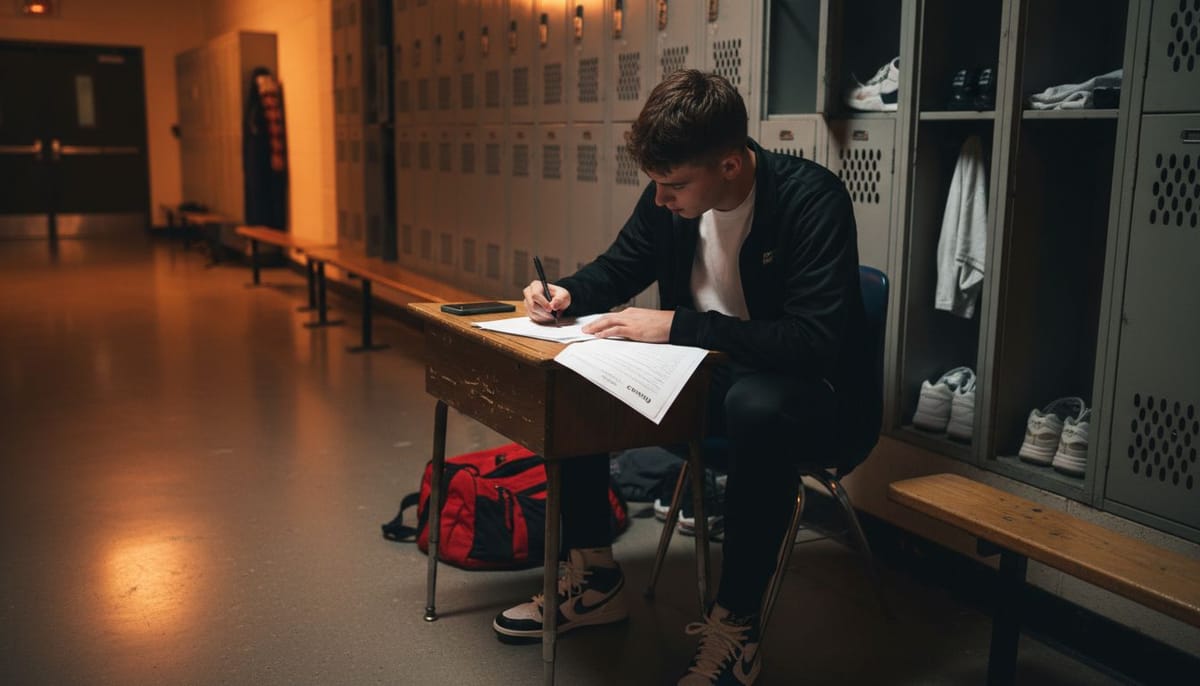
Most coaches I know can tell you exactly where they were when they realized basketball would define their life. For Kyle — the guest on this episode of The Hours — that moment happened in a bathroom stall, signing a Division I scholarship his dad slid under the door while commenting on the smell. I'm not making that up. And honestly? That's the most human, real, unpretentious origin story I've heard in a long time. No highlight reel. No dramatic locker room speech. Just a kid, a fax deadline, and a toilet.
But beneath all the laughter in this episode, there's something genuinely worth sitting with. This conversation between Mark, Tyler, and their guest Kyle touches on identity, coaching philosophy, presence, and what it actually means to build a life — and a team — around the right principles. I want to dig into all of it, because when I heard some of this, I immediately thought about how much of it applies not just to players chasing dreams, but to every coach trying to figure out who they are and what they stand for.
The "Right Bus" Metaphor Is Simple — And That's Exactly Why It Works
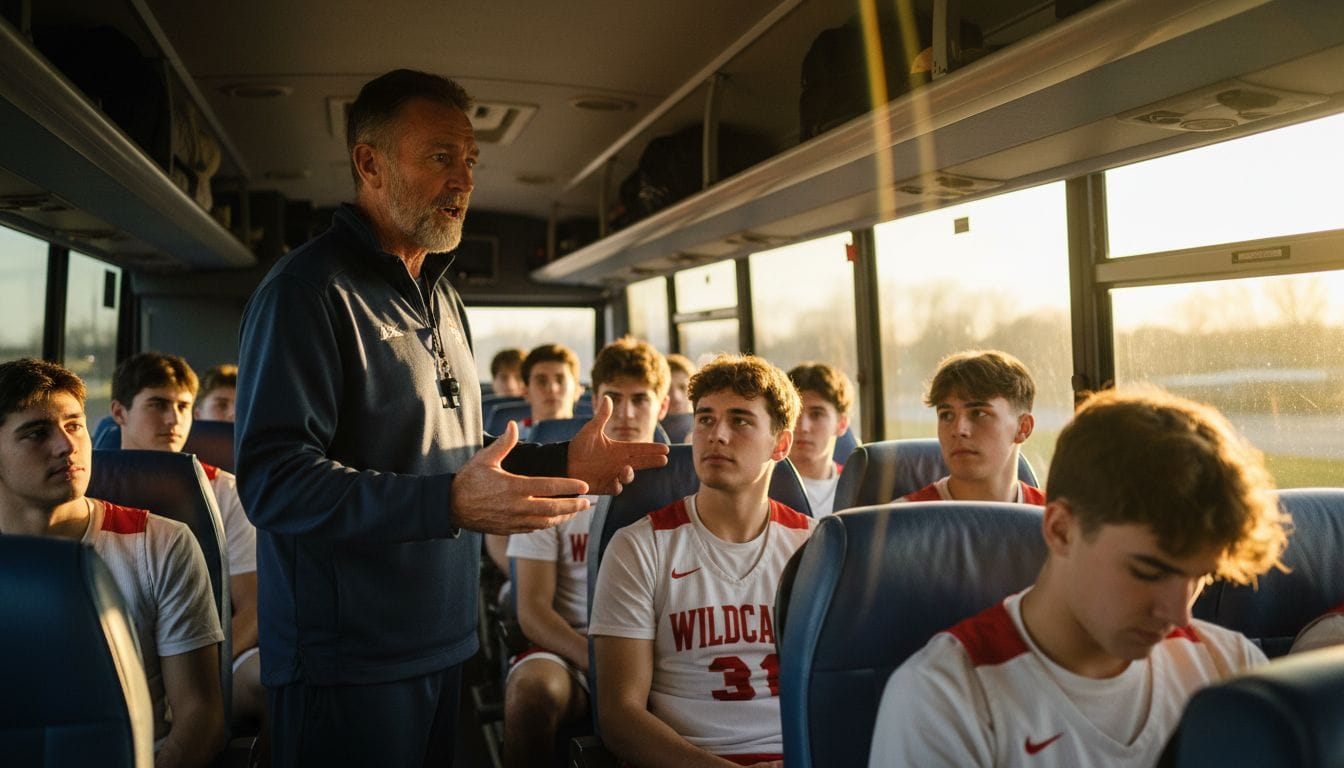
Coach K told a story at Duke camp that Kyle has clearly carried with him for years. His mom told young Mike Krzyzewski to "get on the right bus." Not literally. She meant: choose your direction deliberately, and be intentional about who you let ride with you.
When I heard this, I immediately thought about how often coaches give their players complicated frameworks when the most powerful ideas are the simplest ones. This bus metaphor — which Coach K has apparently told many times — is the kind of thing a sixth grader can absorb and a 40-year-old coach can still find meaning in. That's rare. Most coaching wisdom gets lost in translation between age groups. This didn't.
What struck me most was the dual responsibility packed into that metaphor. First, you choose your direction. That's about agency — knowing where you want to go and not just drifting onto whatever bus shows up first. Kyle genuinely believed he'd play for Duke. He went to camp three years in a row, sixth through eighth grade. He was all in on that identity. And then life redirected him — to Louisiana Monroe, then Rollins College — and he had to recalibrate. He had to get on a different bus. The question is whether you do that consciously or whether it just happens to you.
Second, you decide who gets on. For coaches, I think this is actually the harder part. The relationships you build with your players — who you invest in, who you hold accountable, who you let shape the culture — that's the real architecture of a team. You can draw up the best plays in the world. If the wrong people are on your bus, none of it matters.
I've seen this play out personally. The teams that fall apart mid-season almost always have a bus problem, not a scheme problem. The wrong voices get too loud. The wrong attitudes go unchecked. The direction gets muddy. And no amount of tactical adjustment fixes a cultural mess.
Coach K's Presence — Earned or Projected?
Here's something in this conversation that I genuinely found fascinating. Mark asked a sharp question: was Coach K's presence real, or were the kids just projecting it onto him because of who he was?
Kyle's honest answer? It was probably both. Positional authority preceded the moment. Five hundred kids and their parents in Cameron Indoor Stadium — nobody needed to be told to quiet down. Coach K walked in and it was silent. But Kyle was thoughtful enough to acknowledge that some of that came from the reputation, the legend, the idea of Coach K rather than just the man himself.
I don't fully agree with the idea that presence is purely earned through results, though. I've been around coaches with incredible records who had zero command of a room. And I've seen young coaches — first-year guys with nothing on their résumé — who walked in and immediately had every player's attention. There's something innate in it. Something about conviction, about how comfortable you are in your own skin, about whether you actually believe what you're saying.
This is something I think about a lot, especially when I hear coaches talk about wanting to build authority with their players. You can't manufacture presence. You can develop it, sure. But the foundation has to be genuine. Players — especially young players — are incredibly good at detecting when someone is performing confidence versus actually having it. The coaches who really connect with their players during high-pressure moments are the ones whose presence feels real, not rehearsed.
What I keep coming back to is this: Coach K could silence a room at Duke camp in 2006. But that presence was built over decades of showing up the same way, day after day. The legend wasn't separate from the man — it grew from him. That's actually encouraging if you're a coach early in your journey. You're not behind. You're building.
Kyle's Path — And What It Says About Identity in Basketball
Kyle's story hit me in an unexpected way. He was voted most likely to become a professional athlete in high school — based entirely on the assumption he'd play professional basketball. Then life didn't go that direction. He played D1, transferred to D2, built a career in coaching and player development through PGC Basketball. And now, in some twist none of his high school classmates saw coming, he actually is a professional athlete — just not in basketball.
There's something almost poetic about that. The identity he thought was fixed — future NBA player — turned out to be a shell for something deeper, which was a genuine love of competition and the athlete's mindset. That transferred. It just transferred somewhere unexpected.
I think a lot of coaches and players lock themselves into a single version of their basketball story. If it doesn't go exactly the way they imagined, they feel like they failed. Kyle's arc suggests something different — that the skills, the discipline, the pattern recognition you develop through basketball don't disappear if the basketball dream doesn't work out. They just show up somewhere else.
This connects to something I've been thinking about lately: how the coaches who truly understand the game from the inside out are often the ones who've had their original path disrupted. Being forced to rethink your relationship with basketball — whether that's stepping away, transferring, pivoting — seems to produce a more honest and ultimately more useful perspective on the game than if everything had gone smoothly.
Kyle didn't get to play for Duke. He signed his scholarship in a bathroom stall in Niceville, Florida. And somehow that version of the story is more interesting, more instructive, and more real than the clean version would have been. I think that matters. Not just as a feel-good lesson, but as a genuine coaching principle: the detours are part of the foundation you're building as a coach and as a person in this game.
Getting on the Right Bus — and Letting the Right People On
There's a line in this conversation that stopped me cold. Tyler looks at Kyle and says something like, "That might be your superpower — getting on the right bus, and letting the right people on that bus." And I just sat with that for a second. Because honestly? That's one of the most underrated skills in any career. Not talent. Not work ethic. Proximity.
Kyle's story about walking up to Tyler after a keynote — as a freshman in college, barely knowing what he was going to say — is something I think about a lot. Most people don't do that. Most people watch someone impressive from across the room, think "I should introduce myself," and then... don't. Kyle just went. Twenty seconds of courage. That's literally all it took to set off a chain of events that shaped his entire career trajectory.
When I heard this, I immediately thought about how many coaches are sitting on real potential but are essentially invisible. Tyler put it bluntly: people hire the people they know. You can be genuinely skilled, you can do everything right in a coaching interview, but if the right people have never heard your name — it's an uphill battle. That's not cynical. That's just how human networks work.
What I also love here is that this wasn't networking in the gross, transactional sense. Kyle wasn't calculating. He just genuinely admired Tyler, walked up, and was honest about it. That kind of authentic pursuit of people who are further along than you — that's what actually builds careers. The intentionality matters, but so does the sincerity behind it.
From Basketball to Pro Pickleball in 15 Months — What That Actually Means
Okay. Let's talk about the elephant in the room. Kyle went from never touching a pickleball paddle to becoming a professional pickleball player in fifteen months. Fifteen. I don't fully have words for that. Not because it's a feel-good story — though it is — but because of what it reveals about how Kyle actually learns.
Think about it. This is someone who was already considered among the best basketball teachers around. He understood skill acquisition, repetition, competitive environments. And then he walked into a gym in Scottsdale, played pickleball for the first time, texted Tyler immediately saying "this is the sport," and went back the next day. And the day after that. And kept going until someone invited him to a private court with better players, and then he found himself surrounded by people talking about pro pickleball — a world he didn't even know existed three months earlier.
I've seen this play out personally — the moment when a new environment just clicks and you go all in. There's something powerful about that early-stage obsession. Most people dabble. Kyle committed. And that commitment came from being honest with himself about what was lighting him up.
This connects to something I genuinely believe about skill development in basketball too. The coaches who grow fastest are the ones who find something that forces them to be a student again. Kyle essentially did that — he put himself back at zero, got uncomfortable, sought out better competition deliberately, and accelerated. That's not a pickleball story. That's a learning story.
What struck me most was that Kyle describes those early months as just... fun. Not strategic. Fun. The great workout, the good people, the game itself pulling him back every single day. I don't think that part should be overlooked. Intrinsic motivation moves faster than discipline alone. Always.
Be a "Now" Person — Why This Simple Commitment Changes Everything
Toward the end of this section, Tyler mentions something almost in passing that I think deserves way more attention. He talks about how he and Kyle are both committed to being "now" people. Do it right now. Not later. Not when it's convenient. Now.
It sounds almost too simple, right? But think about Kyle's whole story through that lens. He walked up to Tyler right after the keynote — not after thinking about it overnight. He texted Tyler the first day he played pickleball — not a week later when he was sure about his feelings. He went back to the pickleball court the next day. And the day after. The "now" instinct runs through everything he's done.
I think this is something a lot of coaches genuinely struggle with — and it shows up in the gym too. Decision-making speed is a skill that has to be trained, and it starts with the habits you build off the court. If you're the kind of person who hesitates in life — delays the email, puts off the conversation, waits for the perfect moment — that hesitation bleeds into everything. Including how you coach. Including how your players play.
There's also something refreshing about two successful people openly admitting they still need each other. Tyler says Kyle used to be a huge part of his life and now, with Kyle in Phoenix, that's returned. Kyle literally moved cities partly because of that relationship. That's not weakness. That's self-awareness. Knowing who makes you better and then actually restructuring your life around that? Most people never do that. They just hope the right people stay close by accident.
And maybe that's the whole point of this part of the conversation. Talent alone doesn't build a career. The coaches who reach the highest levels are the ones who stay curious, stay humble, and keep surrounding themselves with people who challenge them — whether that's in basketball, pickleball, or whatever arena they're competing in next.
The Most Important Question You Can Ask Yourself Every Single Day
When I heard Kyle talk about asking himself daily — what is the most important skill I can work on that will have the greatest impact on my game? — I immediately thought: how many coaches and players actually do this? Like, genuinely? Not just at the start of a season, not just when things are going badly, but every single day as a real, honest habit. Very few. And that's a problem.
It sounds almost too simple. But simplicity is deceptive. Because to answer that question well, you have to actually know where your gaps are. You have to be self-aware enough to admit them. And then you have to have the discipline to ignore everything else and attack that one thing. That's three hard things wrapped inside one easy-sounding question.
I've seen this play out personally. The players who improve the fastest aren't always the most naturally gifted. They're the ones who have identified something specific — a weak hand, slow decision-making, poor spacing instincts — and then gone after it relentlessly. It's why making quicker decisions in basketball is such a crucial area of focus, because so many players know it's a weakness and still don't deliberately train it. Knowing and doing are completely different things.
What struck me most was that Kyle came from a basketball background and brought those exact principles into a completely different sport. That transfer of mindset — not just skill, but the mentality of targeted, intentional daily improvement — is something I think every coach should be talking about explicitly with their players. Don't just show up. Show up with a purpose.
Reinvention, Risk, and the Courage to Start Over
The pickleball journey Kyle described — going from zero to professional in 12 months, drawing a line in the sand, committing fully after one last basketball tournament — honestly hit me differently than I expected it to. It wasn't really about pickleball. It was about the willingness to be a beginner again.
Think about that for a second. This is someone who had elite basketball experience, deep coaching knowledge, and a real community around him — and he walked away from all of that comfort to become the worst person on a completely different court. That takes guts. Most people, especially people who've been good at something, don't want to go back to not knowing what they're doing. The ego doesn't like it. It's actually one of the reasons walking away from established success to rebuild from the ground up is so rare — and so powerful when someone actually does it.
And the content strategy? Brilliant. Not just for the YouTube growth, but because it gave him clarity on the mission. "From never playing to pro pickleball in 12 months." One line. One direction. Everything else filters through that. I think a lot of coaches could benefit from applying this same thinking to their programs — a single, clear identity that tells everyone, players included, exactly what you're about. It removes ambiguity. It removes the noise. It keeps you honest when you're tempted to drift.
The bit about writing things down so you can forget them — that also stuck with me. We write things down to free our mind, not to revisit them obsessively. It's about releasing the mental load so you can be fully present in what's happening right now. Whether that's a practice, a game, or a drill session, presence matters. And speaking of drills that actually demand presence and real-time problem solving, the best training environments stop chasing perfect form and start chasing real decisions under pressure — which is exactly the kind of thinking Kyle brought from basketball into his pickleball content.
Final Thoughts
This conversation genuinely surprised me. I came in expecting a straight basketball coaching discussion and left thinking about mindset, identity, risk, and the kind of daily intentionality that separates people who improve from people who just show up. Kyle's story isn't really about pickleball — it's about what happens when you take real coaching principles and apply them with full commitment to whatever you're doing. The daily question about your most important skill, the willingness to be a beginner, the clarity of a one-liner mission — these are things I'm thinking about differently now. And honestly? That's the mark of a conversation worth having.
Want the complete picture? Read our full guide: The Complete Guide to Ecological Learning Approach in Basketball Coaching